• 文献检索
  • 文档翻译
  • 深度研究
  • 学术资讯
  • Suppr Zotero 插件Zotero 插件
  • 邀请有礼
  • 套餐&价格
  • 历史记录
应用&插件
Suppr Zotero 插件Zotero 插件浏览器插件Mac 客户端Windows 客户端微信小程序
定价
高级版会员购买积分包购买API积分包
服务
文献检索文档翻译深度研究API 文档MCP 服务
关于我们
关于 Suppr公司介绍联系我们用户协议隐私条款
关注我们

Suppr 超能文献

核心技术专利:CN118964589B侵权必究
粤ICP备2023148730 号-1Suppr @ 2026

文献检索

告别复杂PubMed语法,用中文像聊天一样搜索,搜遍4000万医学文献。AI智能推荐,让科研检索更轻松。

立即免费搜索

文件翻译

保留排版,准确专业,支持PDF/Word/PPT等文件格式,支持 12+语言互译。

免费翻译文档

深度研究

AI帮你快速写综述,25分钟生成高质量综述,智能提取关键信息,辅助科研写作。

立即免费体验

探究与健康相关的广告干扰如何促成网络疑病症的发展:一种压力源-压力-结果方法。

Exploring how health-related advertising interference contributes to the development of cyberchondria: A stressor-strain-outcome approach.

作者信息

Zhang Xinmiao, Zheng Han, Zeng Yueliang, Zou Jiayi, Zhao Lin

机构信息

School of Sociology, University of Bristol, Bristol, UK.

School of Information Management, Wuhan University, Wuhan, China.

出版信息

Digit Health. 2024 Feb 20;10:20552076241233138. doi: 10.1177/20552076241233138. eCollection 2024 Jan-Dec.

DOI:10.1177/20552076241233138
PMID:38384368
原文链接:https://pmc.ncbi.nlm.nih.gov/articles/PMC10880534/
Abstract

OBJECTIVES

Cyberchondria is increasingly recognized as the dark side of digital health, given the pervasive use of the internet as a main source of health information in people's daily lives. While previous studies have identified many factors contributing to cyberchondria, there is a dearth of research on the impact of health-related advertisements. Therefore, this study adopts the stressor-strain-outcome (SSO) model to investigate how health-related advertising interference is directly and indirectly related to cyberchondria.

METHODS

To empirically validate the proposed research model, we conducted an online survey with 437 internet users with medical information seeking experience in China. Structural equation modeling (SEM) was employed to analyze the survey data.

RESULTS

Our findings revealed a positive, direct association between health-related advertising interference and cyberchondria. Meanwhile, advertising interference was positively related to both information overload and information irrelevance, with the former further predicting cyberchondria. Moreover, doctor-patient communication weakened the positive effect of information overload on cyberchondria.

CONCLUSIONS

The study not only theoretically contributes to the literature by theorizing the relationship between health-related advertising interference and cyberchondria but also practically underlines the pivotal role of effective doctor-patient communication in reducing the development of cyberchondria.

摘要

目标

鉴于互联网在人们日常生活中作为健康信息主要来源的广泛使用,网络疑病症日益被视为数字健康的阴暗面。虽然先前的研究已经确定了许多导致网络疑病症的因素,但关于健康相关广告影响的研究却很匮乏。因此,本研究采用压力源-压力-结果(SSO)模型来调查健康相关广告干扰如何直接和间接地与网络疑病症相关联。

方法

为了实证验证所提出的研究模型,我们对437名有医疗信息搜索经验的中国互联网用户进行了在线调查。采用结构方程模型(SEM)来分析调查数据。

结果

我们的研究结果揭示了健康相关广告干扰与网络疑病症之间存在正向直接关联。同时,广告干扰与信息过载和信息不相关均呈正相关,前者进一步预测了网络疑病症。此外,医患沟通削弱了信息过载对网络疑病症的正向影响。

结论

该研究不仅在理论上通过对健康相关广告干扰与网络疑病症之间的关系进行理论化,为文献做出了贡献,而且在实践中强调了有效的医患沟通在减少网络疑病症发生方面的关键作用。
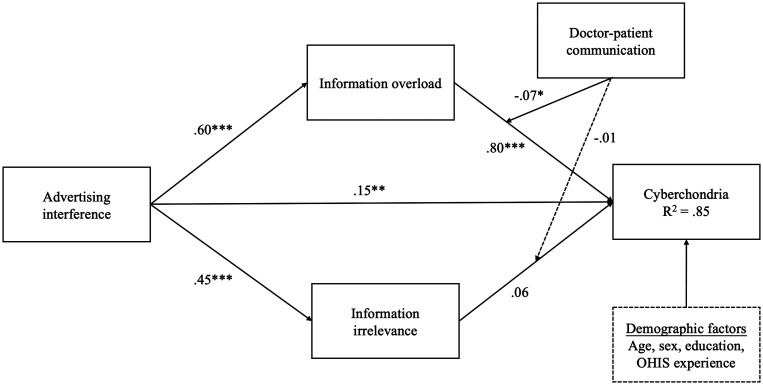
https://cdn.ncbi.nlm.nih.gov/pmc/blobs/ee55/10880534/e369397f69ad/10.1177_20552076241233138-fig2.jpg
https://cdn.ncbi.nlm.nih.gov/pmc/blobs/ee55/10880534/0ae87ddbf23b/10.1177_20552076241233138-fig1.jpg
https://cdn.ncbi.nlm.nih.gov/pmc/blobs/ee55/10880534/e369397f69ad/10.1177_20552076241233138-fig2.jpg
https://cdn.ncbi.nlm.nih.gov/pmc/blobs/ee55/10880534/0ae87ddbf23b/10.1177_20552076241233138-fig1.jpg
https://cdn.ncbi.nlm.nih.gov/pmc/blobs/ee55/10880534/e369397f69ad/10.1177_20552076241233138-fig2.jpg

相似文献

1
Exploring how health-related advertising interference contributes to the development of cyberchondria: A stressor-strain-outcome approach.探究与健康相关的广告干扰如何促成网络疑病症的发展:一种压力源-压力-结果方法。
Digit Health. 2024 Feb 20;10:20552076241233138. doi: 10.1177/20552076241233138. eCollection 2024 Jan-Dec.
2
Linking the Pathway from Exposure to Online Vaccine Information to Cyberchondria During the COVID-19 Pandemic: A Moderated Mediation Model.将 COVID-19 大流行期间的暴露途径与网络搜索健康信息行为联系起来:一个有调节的中介模型。
Cyberpsychol Behav Soc Netw. 2022 Oct;25(10):625-633. doi: 10.1089/cyber.2022.0045. Epub 2022 Aug 26.
3
Insights into the antecedents of cyberchondria: a perspective from the USA.网络疑病症的成因探究:来自美国的视角
Health Promot Int. 2022 Aug 1;37(4). doi: 10.1093/heapro/daac108.
4
Evaluation of Relationship Between Cyberchondria and Obsessive Beliefs in Adults.成人网络疑病症与强迫观念之间的关系评估
P R Health Sci J. 2022 Dec;41(4):233-238.
5
Anxiety sensitivity and intolerance of uncertainty as potential risk factors for cyberchondria.焦虑敏感性和对不确定性的不耐受作为网络疑病症的潜在风险因素。
J Affect Disord. 2015 Mar 15;174:64-9. doi: 10.1016/j.jad.2014.11.023. Epub 2014 Nov 22.
6
Moderating Effect of Coping Strategies on the Association Between the Infodemic-Driven Overuse of Health Care Services and Cyberchondria and Anxiety: Partial Least Squares Structural Equation Modeling Study.应对策略对信息疫情驱动的过度使用医疗服务与网络疑病症和焦虑之间关联的调节作用:偏最小二乘结构方程模型研究。
J Med Internet Res. 2024 Apr 9;26:e53417. doi: 10.2196/53417.
7
Relationships between cyberchondria and obsessive-compulsive symptom dimensions.网络疑病症与强迫症状维度之间的关系。
Psychiatry Res. 2015 Dec 15;230(2):441-6. doi: 10.1016/j.psychres.2015.09.034. Epub 2015 Sep 25.
8
The Status and Influencing Factors of Cyberchondria During the COVID-19 Epidemic. A Cross-Sectional Study in Nanyang City of China.新冠疫情期间网络疑病症的现状及影响因素。中国南阳市的一项横断面研究。
Front Psychol. 2021 Nov 11;12:712703. doi: 10.3389/fpsyg.2021.712703. eCollection 2021.
9
Exploring associations between eHealth literacy, cyberchondria, online health information seeking and sleep quality among university students: A cross-section study.探索大学生电子健康素养、网络疑病症、在线健康信息搜索与睡眠质量之间的关联:一项横断面研究。
Heliyon. 2023 Jun 22;9(6):e17521. doi: 10.1016/j.heliyon.2023.e17521. eCollection 2023 Jun.
10
Associations Between the Perceived Severity of the COVID-19 Pandemic, Cyberchondria, Depression, Anxiety, Stress, and Lockdown Experience: Cross-sectional Survey Study.新冠大流行严重程度感知、网络疑病症、抑郁、焦虑、压力与封控经历之间的关联:横断面调查研究。
JMIR Public Health Surveill. 2021 Sep 16;7(9):e31052. doi: 10.2196/31052.

引用本文的文献

1
Online Health Information Seeking and Cyberchondria Among Men at Risk of HIV Infection: A Moderated Mediation Model.感染艾滋病毒风险男性的在线健康信息搜索与网络疑病症:一个有调节的中介模型
Int J Sex Health. 2024 Dec 27;37(1):102-115. doi: 10.1080/19317611.2024.2444590. eCollection 2025.

本文引用的文献

1
Effects of COVID-19 Misinformation on Information Seeking, Avoidance, and Processing: A Multicountry Comparative Study.新冠疫情虚假信息对信息寻求、回避及处理的影响:一项多国比较研究
Sci Commun. 2020 Oct;42(5):586-615. doi: 10.1177/1075547020959670.
2
Understanding the role of social media usage and health self-efficacy in the processing of COVID-19 rumors: A SOR perspective.从刺激-机体-反应视角理解社交媒体使用和健康自我效能在新冠疫情谣言传播过程中的作用
Data Inf Manag. 2023 Jun;7(2):100043. doi: 10.1016/j.dim.2023.100043. Epub 2023 May 30.
3
Insights into the antecedents of cyberchondria: a perspective from the USA.
网络疑病症的成因探究:来自美国的视角
Health Promot Int. 2022 Aug 1;37(4). doi: 10.1093/heapro/daac108.
4
Linking the Pathway from Exposure to Online Vaccine Information to Cyberchondria During the COVID-19 Pandemic: A Moderated Mediation Model.将 COVID-19 大流行期间的暴露途径与网络搜索健康信息行为联系起来:一个有调节的中介模型。
Cyberpsychol Behav Soc Netw. 2022 Oct;25(10):625-633. doi: 10.1089/cyber.2022.0045. Epub 2022 Aug 26.
5
Frequent and diverse use of electronic health records in the United States: A trend analysis of national surveys.美国电子健康记录的频繁且多样化使用:全国调查的趋势分析
Digit Health. 2022 Jul 6;8:20552076221112840. doi: 10.1177/20552076221112840. eCollection 2022 Jan-Dec.
6
How does information overload about COVID-19 vaccines influence individuals' vaccination intentions? The roles of cyberchondria, perceived risk, and vaccine skepticism.关于新冠疫苗的信息过载如何影响个体的接种意愿?网络恐病症、感知风险和疫苗怀疑论的作用。
Comput Human Behav. 2022 May;130:107176. doi: 10.1016/j.chb.2021.107176. Epub 2022 Jan 4.
7
Understanding the effects of message cues on COVID-19 information sharing on Twitter.了解信息线索对推特上新冠疫情信息分享的影响。
J Assoc Inf Sci Technol. 2022 Jun;73(6):847-862. doi: 10.1002/asi.24587. Epub 2021 Oct 15.
8
Factors influencing COVID-19 vaccination intention: The roles of vaccine knowledge, vaccine risk perception, and doctor-patient communication.影响 COVID-19 疫苗接种意愿的因素:疫苗知识、疫苗风险感知和医患沟通的作用。
Patient Educ Couns. 2022 Feb;105(2):277-283. doi: 10.1016/j.pec.2021.09.023. Epub 2021 Sep 20.
9
Cyberchondria in the time of the COVID-19 pandemic.新冠疫情时期的网络恐病症
Hum Behav Emerg Technol. 2021 Jan;3(1):53-62. doi: 10.1002/hbe2.233. Epub 2020 Nov 23.
10
Cyberchondria During the Coronavirus Pandemic: The Effects of Neuroticism and Optimism.新冠疫情期间的网络疑病症:神经质和乐观主义的影响
Front Psychol. 2020 Oct 30;11:567345. doi: 10.3389/fpsyg.2020.567345. eCollection 2020.