Iwazu Yoshitaka, Kotani Kazuhiko, Sugase Taro, Nagata Daisuke, Yamada Toshiyuki
Department of Clinical Laboratory Medicine, Jichi Medical University, Shimotsuke 329-0498, Japan.
Division of Anti-Ageing Medicine, Center for Molecular Medicine, Jichi Medical University, Shimotsuke 329-0498, Japan.
Metabolites. 2024 Feb 7;14(2):111. doi: 10.3390/metabo14020111.
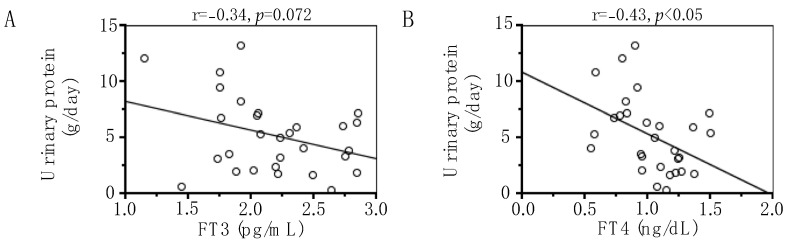
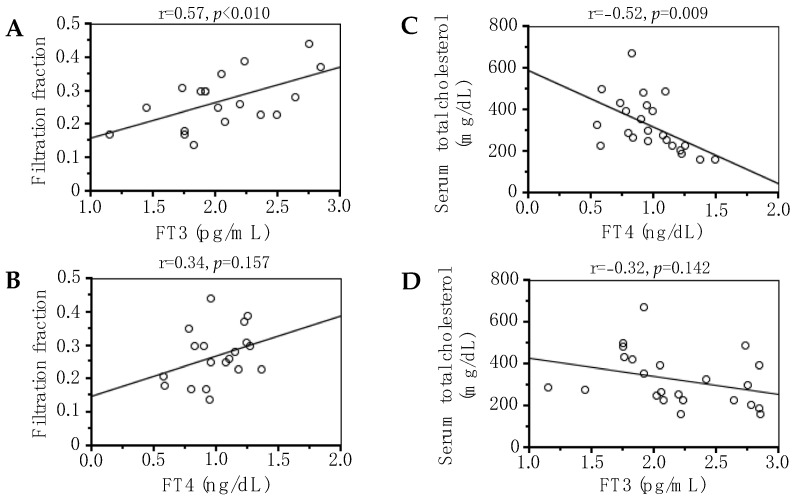
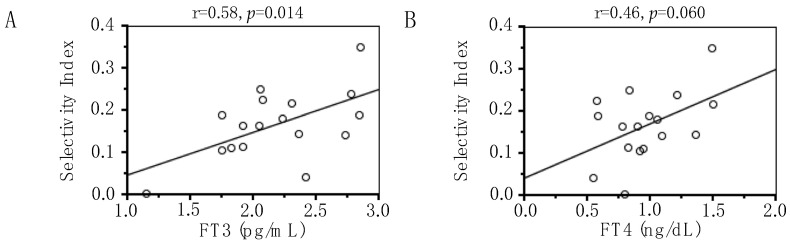
Nephrotic syndrome and hypothyroidism are respectively reported to influence renal hemodynamics and hypercholesterolemia. However, the relationship of proteinuria-associated thyroid function with renal hemodynamics and cholesterol metabolism has yet to be determined in a simultaneous analysis of thyroid, renal, and cholesterol variables. We investigated the hypothesis that the changes in thyroid hormones by proteinuria may contribute to changes in cholesterol metabolism and renal hemodynamics by proteinuria. Twenty-nine patients (17 men and 12 women) with proteinuric kidney disease (mean age 46 years) were enrolled in a pilot study. Data for serum free triiodothyronine (FT3), free thyroxine (FT4), total cholesterol, and filtration fraction (FF; assessed by para-aminohippuric acid clearance) were used in variable-adjusted correlation analyses. The patients had the following data (mean ± standard deviation): urinary protein 5.18 ± 3.28 g/day, FT3 2.18 ± 0.44 pg/mL, FT4 1.03 ± 0.26 ng/dL, FF 0.27 ± 0.07, and total cholesterol 327 ± 127 mg/dL. There was a significant positive correlation of FT3 with FF (β = 0.58, = 0.01) and a significant inverse correlation of FT4 with total cholesterol (β = -0.40, = 0.01). A positive correlation of FT3 with FF and an inverse correlation of FT4 with total cholesterol were demonstrated in patients with proteinuric kidney disease. The proteinuria-associated reduction in serum thyroid hormone levels was correlated with hypercholesterolemia and the reduced glomerular FF. Further studies of these relationships are required.
据报道,肾病综合征和甲状腺功能减退分别会影响肾脏血流动力学和高胆固醇血症。然而,在同时分析甲状腺、肾脏和胆固醇变量时,蛋白尿相关的甲状腺功能与肾脏血流动力学和胆固醇代谢之间的关系尚未确定。我们研究了这样一个假设,即蛋白尿引起的甲状腺激素变化可能导致蛋白尿引起的胆固醇代谢和肾脏血流动力学变化。29例蛋白尿性肾病患者(17例男性和12例女性,平均年龄46岁)参与了一项初步研究。血清游离三碘甲状腺原氨酸(FT3)、游离甲状腺素(FT4)、总胆固醇和滤过分数(FF;通过对氨基马尿酸清除率评估)的数据用于变量调整相关分析。患者有以下数据(平均值±标准差):尿蛋白5.18±3.28g/天,FT3 2.18±0.44pg/mL,FT4 1.03±0.26ng/dL,FF 0.27±0.07,总胆固醇327±127mg/dL。FT3与FF呈显著正相关(β=0.58,P=0.01),FT4与总胆固醇呈显著负相关(β=-0.40,P=0.01)。在蛋白尿性肾病患者中,FT3与FF呈正相关,FT4与总胆固醇呈负相关。蛋白尿相关的血清甲状腺激素水平降低与高胆固醇血症和肾小球滤过分数降低相关。需要对这些关系进行进一步研究。