Department of Veterinary Clinical Sciences, College of Veterinary Medicine, Iowa State University, Ames, Iowa, United States of America.
Ceva Santé Animale, Libourne, France.
PLoS One. 2024 Feb 23;19(2):e0298030. doi: 10.1371/journal.pone.0298030. eCollection 2024.
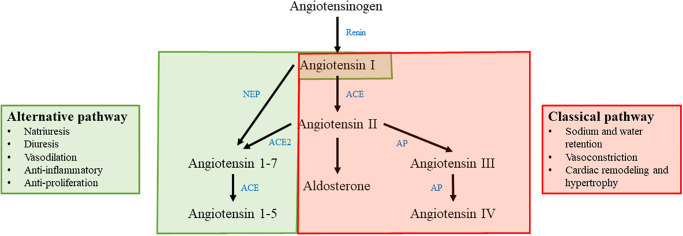
To characterize the dose-exposure-response effect of spironolactone on biomarkers of the classical and alternative arms of the renin-angiotensin-aldosterone system (RAAS) in healthy dogs.
Ten healthy purpose-bred Beagle dogs.
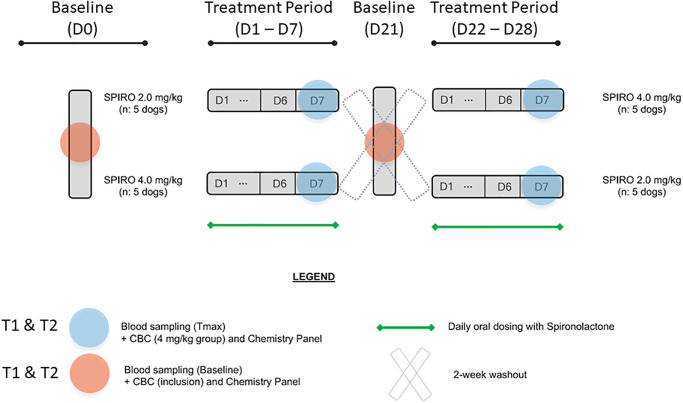
Study dogs were randomly allocated to 2 spironolactone dosing groups (2 mg/kg PO q24hr, 4 mg/kg PO q24hr). The dogs received 7-day courses of spironolactone followed by a 14-day washout period in a crossover (AB/BA) design. Angiotensin peptides and aldosterone were measured in serum using equilibrium analysis, and plasma canrenone and 7-α-thiomethyl spironolactone (TMS) were quantified via liquid chromatography-mass spectrometry/mass spectroscopy (LC-MS/MS). Study results were compared before and after dosing and between groups.
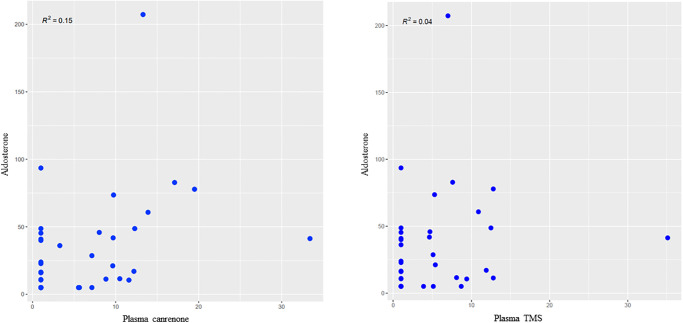
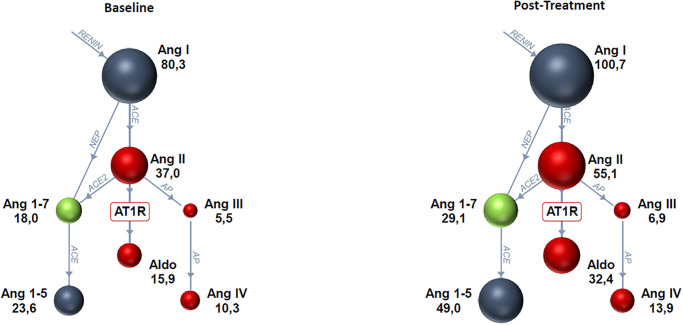
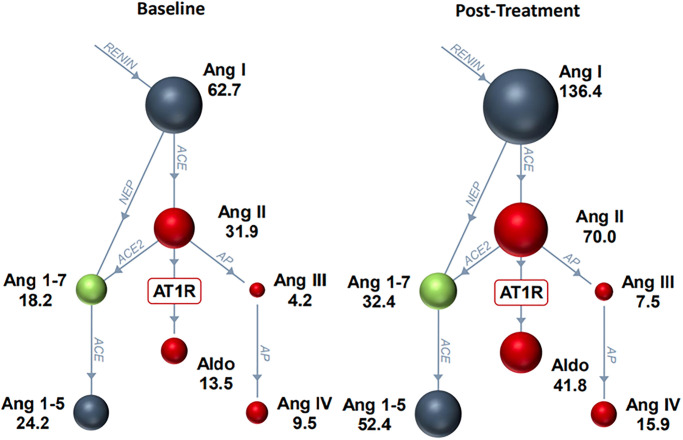
Following spironolactone treatment, dogs had a significant increase in serum aldosterone concentration (P = 0.07), with no statistical differences between dosing groups. Significant increases in angiotensin II (P = 0.09), angiotensin I (P = 0.08), angiotensin 1-5 (P = 0.08), and a surrogate marker for plasma renin activity (P = 0.06) were detected compared to baseline following spironolactone treatment during the second treatment period only. Overall, changes from baseline did not significantly differ between spironolactone dosages. RAAS analytes were weakly correlated (R < 0.4) with spironolactone dosage and plasma canrenone or plasma TMS. There were no adverse clinical or biochemical effects seen at any spironolactone dosage during treatment.
Treatment with spironolactone increased serum aldosterone concentration in healthy dogs and impacted other biomarkers of the classical and alternative arms of the RAAS. There was no difference in effect on the RAAS between 2 and 4 mg/kg/day dosing. Dosage of 4 mg/kg/day was safe and well-tolerated in healthy dogs.
描述螺内酯对健康犬类经典和非经典肾素-血管紧张素-醛固酮系统(RAAS)生物标志物的剂量-暴露-反应效应。
10 只健康的纯种比格犬。
研究犬随机分配到 2 个螺内酯剂量组(2 mg/kg PO q24hr,4 mg/kg PO q24hr)。采用交叉(AB/BA)设计,狗接受了 7 天的螺内酯疗程,然后进行 14 天的洗脱期。使用平衡分析测量血清中的血管紧张肽和醛固酮,通过液相色谱-质谱/质谱(LC-MS/MS)定量测定血浆坎利酮和 7-α-硫甲基螺内酯(TMS)。比较给药前后和组间的研究结果。
螺内酯治疗后,狗的血清醛固酮浓度显著升高(P=0.07),但两组之间无统计学差异。与基线相比,仅在第二次治疗期间,狗在螺内酯治疗后血清血管紧张素 II(P=0.09)、血管紧张素 I(P=0.08)、血管紧张素 1-5(P=0.08)和血浆肾素活性的替代标志物(P=0.06)均显著升高。总体而言,螺内酯剂量之间的基线变化无显著差异。RAAS 分析物与螺内酯剂量和血浆坎利酮或血浆 TMS 呈弱相关(R < 0.4)。在治疗期间,任何螺内酯剂量均未观察到不良的临床或生化作用。
螺内酯治疗可增加健康犬的血清醛固酮浓度,并影响 RAAS 的经典和非经典臂的其他生物标志物。2 至 4mg/kg/天剂量之间对 RAAS 的影响无差异。4mg/kg/天的剂量在健康犬中是安全且耐受良好的。