Department of Health Sciences, Faculty of Applied Health Sciences, Brock University, St. Catharines, ON L2S 3A1, Canada.
Int J Mol Sci. 2024 Feb 6;25(4):1950. doi: 10.3390/ijms25041950.
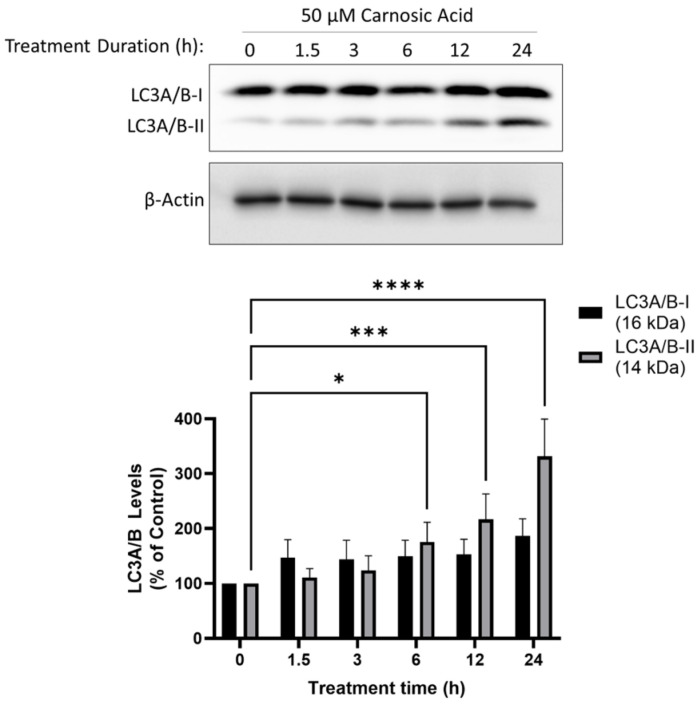
Non-small cell lung cancer (NSCLC) represents 80% of all lung cancer cases and is characterized by low survival rates due to chemotherapy and radiation resistance. Novel treatment strategies for NSCLC are urgently needed. Liver kinase B1 (LKB1), a tumor suppressor prevalently mutated in NSCLC, activates AMP-activated protein kinase (AMPK) which in turn inhibits mammalian target of rapamycin complex 1 (mTORC1) and activates unc-51 like autophagy activating kinase 1 (ULK1) to promote autophagy. Sestrin-2 is a stress-induced protein that enhances LKB1-dependent activation of AMPK, functioning as a tumor suppressor in NSCLC. In previous studies, rosemary () extract (RE) activated the AMPK pathway while inhibiting mTORC1 to suppress proliferation, survival, and migration, leading to the apoptosis of NSCLC cells. In the present study, we investigated the anticancer potential of carnosic acid (CA), a bioactive polyphenolic diterpene compound found in RE. The treatment of H1299 and H460 NSCLC cells with CA resulted in concentration and time-dependent inhibition of cell proliferation assessed with crystal violet staining and H-thymidine incorporation, and concentration-dependent inhibition of survival, assessed using a colony formation assay. Additionally, CA induced apoptosis of H1299 cells as indicated by decreased B-cell lymphoma 2 (Bcl-2) levels, increased cleaved caspase-3, -7, poly (ADP-ribose) polymerase (PARP), Bcl-2-associated X protein (BAX) levels, and increased nuclear condensation. These antiproliferative and proapoptotic effects coincided with the upregulation of sestrin-2 and the phosphorylation/activation of LKB1 and AMPK. Downstream of AMPK signaling, CA increased levels of autophagy marker light chain 3 (LC3), an established marker of autophagy; inhibiting autophagy with 3-methyladenine (3MA) blocked the antiproliferative effect of CA. Overall, these data indicate that CA can inhibit NSCLC cell viability and that the underlying mechanism of action of CA involves the induction of autophagy through a Sestrin-2/LKB1/AMPK signaling cascade. Future experiments will use siRNA and small molecule inhibitors to better elucidate the role of these signaling molecules in the mechanism of action of CA as well as tumor xenograft models to assess the anticancer properties of CA in vivo.
非小细胞肺癌(NSCLC)占所有肺癌病例的 80%,由于化疗和放疗耐药,其生存率低。迫切需要新的 NSCLC 治疗策略。肝激酶 B1(LKB1)是 NSCLC 中普遍突变的肿瘤抑制因子,它激活 AMP 激活的蛋白激酶(AMPK),AMPK 又抑制雷帕霉素哺乳动物靶标复合物 1(mTORC1)并激活 UNC-51 样自噬激活激酶 1(ULK1),促进自噬。Sestrin-2 是一种应激诱导蛋白,可增强 LKB1 依赖性 AMPK 激活,作为 NSCLC 的肿瘤抑制因子发挥作用。在之前的研究中,迷迭香()提取物(RE)通过激活 AMPK 途径,同时抑制 mTORC1,抑制 NSCLC 细胞的增殖、存活和迁移,导致 NSCLC 细胞凋亡。在本研究中,我们研究了在 RE 中发现的生物活性多酚二萜化合物 carnosic 酸(CA)的抗癌潜力。CA 处理 H1299 和 H460 NSCLC 细胞,通过结晶紫染色和 H-胸苷掺入评估,细胞增殖呈浓度和时间依赖性抑制,使用集落形成测定评估浓度依赖性存活抑制。此外,CA 诱导 H1299 细胞凋亡,表现为 B 细胞淋巴瘤 2(Bcl-2)水平降低、裂解 caspase-3、-7、多聚(ADP-核糖)聚合酶(PARP)、Bcl-2 相关 X 蛋白(BAX)水平升高和核浓缩增加。这些增殖抑制和促凋亡作用与 sestrin-2 的上调以及 LKB1 和 AMPK 的磷酸化/激活相一致。AMPK 信号下游,CA 增加自噬标志物微管相关蛋白轻链 3(LC3)的水平,LC3 是自噬的公认标志物;用 3-甲基腺嘌呤(3MA)抑制自噬可阻断 CA 的增殖抑制作用。总的来说,这些数据表明 CA 可以抑制 NSCLC 细胞活力,CA 的作用机制涉及通过 Sestrin-2/LKB1/AMPK 信号级联诱导自噬。未来的实验将使用 siRNA 和小分子抑制剂来更好地阐明这些信号分子在 CA 作用机制中的作用,以及肿瘤异种移植模型来评估 CA 在体内的抗癌特性。