
激活的人干细胞分泌组的免疫调节和再生潜能减轻了大鼠慢性肝衰竭模型中的急性肝衰竭。
The Immunoregulatory and Regenerative Potential of Activated Human Stem Cell Secretome Mitigates Acute-on-Chronic Liver Failure in a Rat Model.
机构信息
Centro de Medicina Regenerativa, Facultad de Medicina, Clínica Alemana-Universidad del Desarrollo, Av. La Plaza 680, Las Condes, Santiago 7610658, Chile.
Departamento de Biotecnología, Facultad de Ciencias Naturales, Matemáticas y del Medio Ambiente, Universidad Tecnológica Metropolitana, Las Palmeras 3360, Ñuñoa, Santiago 7800003, Chile.
出版信息
Int J Mol Sci. 2024 Feb 8;25(4):2073. doi: 10.3390/ijms25042073.
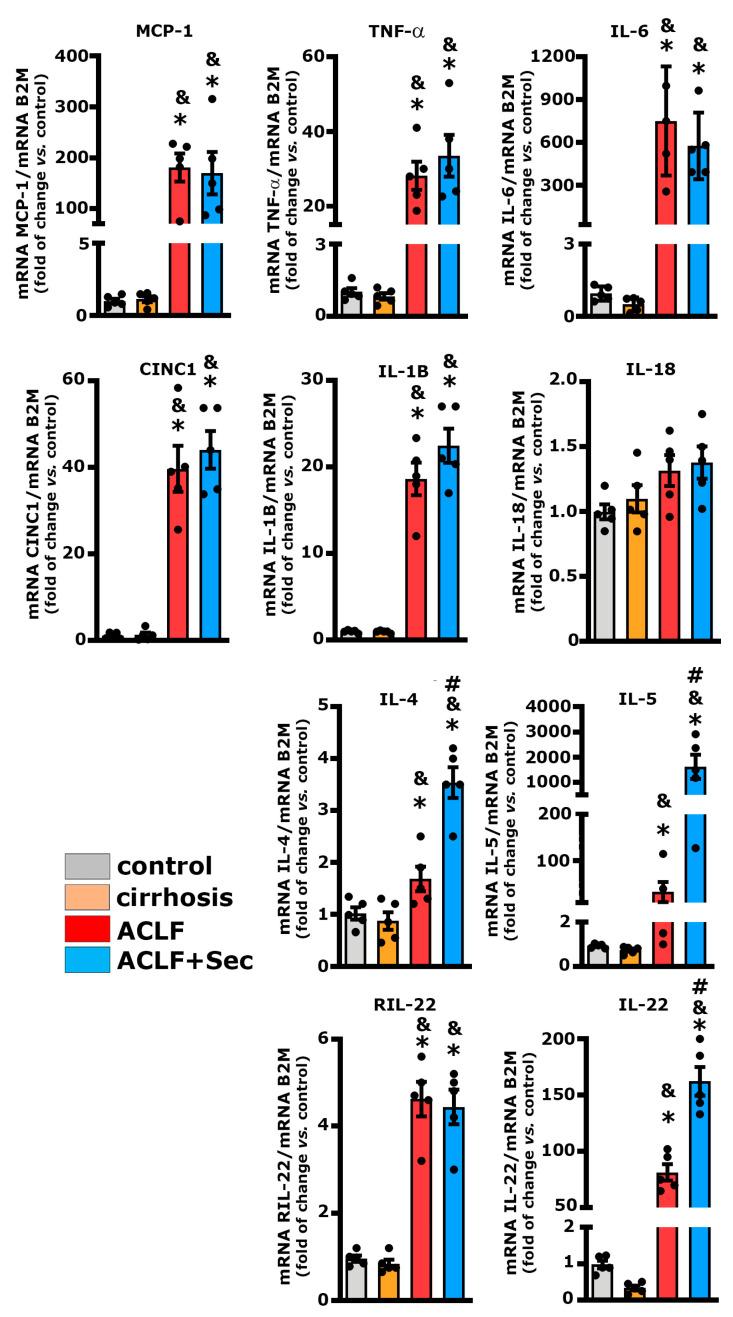
Acute-on-chronic liver failure (ACLF) is a syndrome marked by sudden liver function decline and multiorgan failure, predominantly acute kidney injury (AKY), in patients with chronic liver disease. Unregulated inflammation is a hallmark of ACLF; however, the key drivers of ACLF are not fully understood. This study explores the therapeutic properties of human mesenchymal stem cell (MSC) secretome, particularly focusing on its enhanced anti-inflammatory and pro-regenerative properties after the in vitro preconditioning of the cells. We evaluated the efficacy of the systemic administration of MSC secretome in preventing liver failure and AKI in a rat ACLF model where chronic liver disease was induced using by the administration of porcine serum, followed by D-galN/LPS administration to induce acute failure. After ACLF induction, animals were treated with saline (ACLF group) or MSC-derived secretome (ACLF-secretome group). The study revealed that MSC-secretome administration strongly reduced liver histological damage in the ACLF group, which was correlated with higher hepatocyte proliferation, increased hepatic and systemic anti-inflammatory molecule levels, and reduced neutrophil and macrophage infiltration. Additionally, renal examination revealed that MSC-secretome treatment mitigated tubular injuries, reduced apoptosis, and downregulated injury markers. These improvements were linked to increased survival rates in the ACLF-secretome group, endorsing MSC secretomes as a promising therapy for multiorgan failure in ACLF.
急性肝衰竭(ACLF)是一种以慢性肝病患者的肝功能突然下降和多器官衰竭为特征的综合征,主要表现为急性肾损伤(AKI)。炎症失调是 ACLF 的标志;然而,ACLF 的关键驱动因素尚未完全了解。本研究探讨了人间充质干细胞(MSC)分泌组的治疗特性,特别是研究了细胞体外预处理后增强的抗炎和促再生特性。我们评估了 MSC 分泌组在预防猪血清诱导的慢性肝病大鼠 ACLF 模型中肝衰竭和 AKI 的疗效,随后给予 D-半乳糖胺/脂多糖(D-galN/LPS)诱导急性衰竭。在 ACLF 诱导后,动物用生理盐水(ACLF 组)或 MSC 衍生的分泌组(ACLF-分泌组)治疗。研究表明,MSC 分泌组治疗强烈减轻了 ACLF 组的肝组织损伤,这与更高的肝细胞增殖、增加的肝和全身抗炎分子水平以及减少的中性粒细胞和巨噬细胞浸润相关。此外,肾脏检查表明,MSC 分泌组治疗减轻了肾小管损伤,减少了细胞凋亡,并下调了损伤标志物。这些改善与 ACLF 分泌组的存活率提高有关,支持 MSC 分泌组作为 ACLF 多器官衰竭的一种有前途的治疗方法。




 Zotero 插件