
利用泵浦-探测阴影成像技术对熔融石英中激光诱导损伤的超快过程进行表征
Ultrafast Process Characterization of Laser-Induced Damage in Fused Silica Using Pump-Probe Shadow Imaging Techniques.
作者信息
Liu Zhichao, Zhang Jian, Wang Shengfei, Geng Feng, Zhang Qinghua, Cheng Jian, Chen Mingjun, Xu Qiao
机构信息
Research Center of Laser Fusion, China Academy of Engineering Physics, Mianyang 621900, China.
Center for Precision Engineering, Harbin Institute of Technology, Harbin 150001, China.
出版信息
Materials (Basel). 2024 Feb 9;17(4):837. doi: 10.3390/ma17040837.
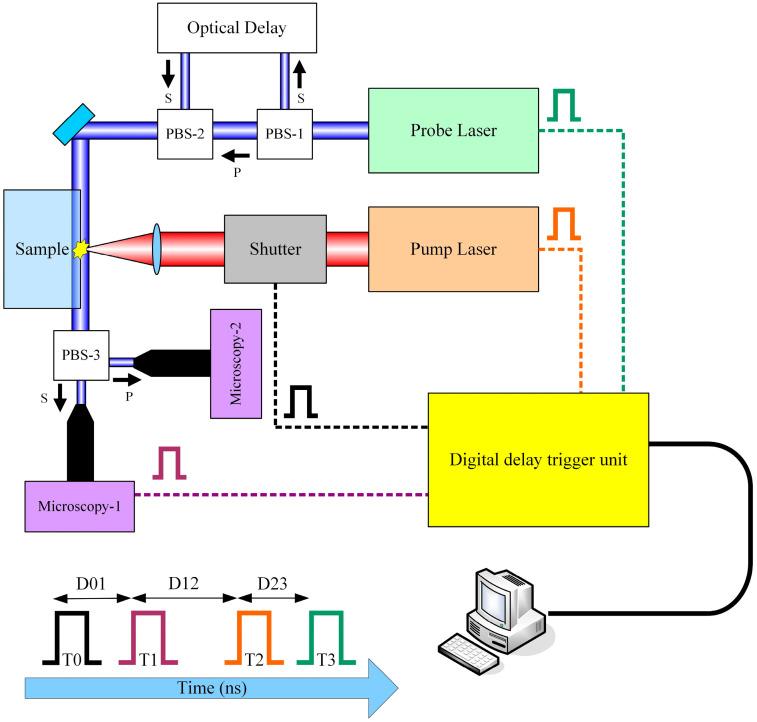
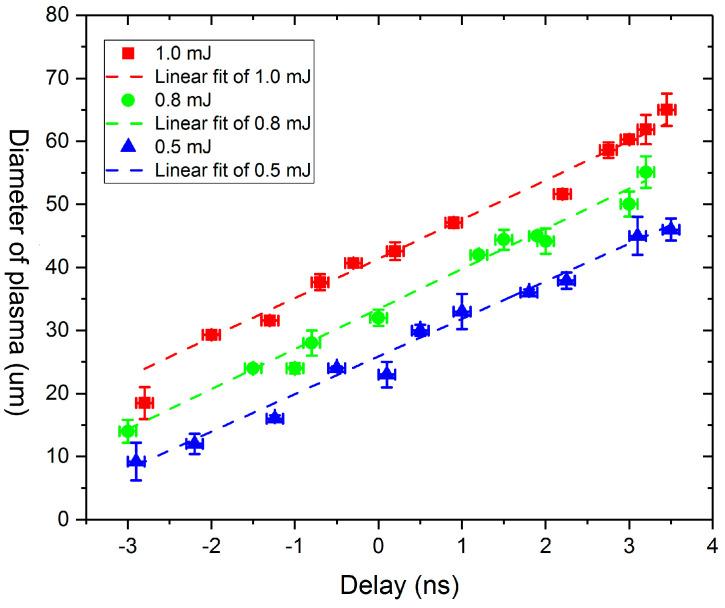
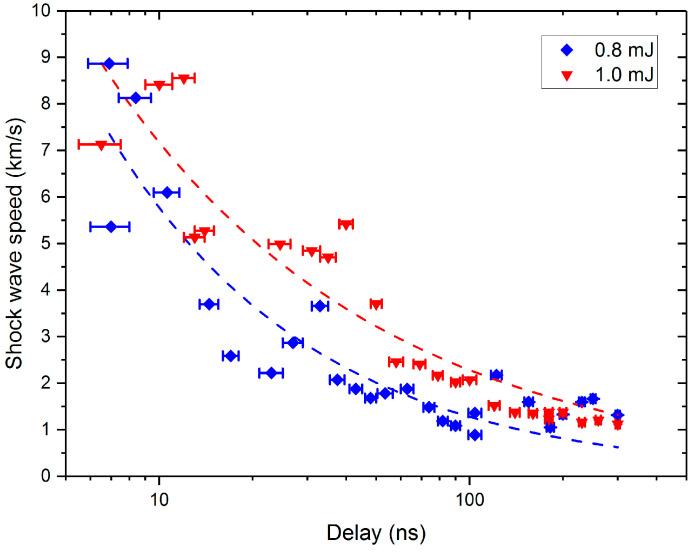
This study delves into the intricate dynamics of laser-induced damage in fused silica using a time-resolved pump-probe (TRPP) shadowgraph. Three typical ultra-fast processes, laser-induced plasma evolution, shockwave propagation and material fracture splashing, were quantitatively investigated. The results indicate that the diameter of plasma is proportional to the pulse laser energy and increases linearly during the pulse laser duration with an expansion rate of approximately 6 km/s. The maximum shockwave velocity on the air side is 9 km/s, occurring at the end of the pulse duration, and then rapidly decreases due to air resistance, reaching approximately 1 km/s around a 300 ns delay. After hundreds of nanoseconds, there is a distinct particle splashing phenomenon, with the splashing particle speed distribution ranging from 0.15 km/s to 2.0 km/s. The particle sizes of the splashing particles range from 4 μm to 15 μm. Additionally, the smaller the delay, the faster the speed of the splashing particles. Overall, TRPP technology provides crucial insights into the temporal evolution of laser-induced damage in fused silica, contributing to a comprehensive understanding essential for optimizing the performance and safety of laser systems.
本研究利用时间分辨泵浦 - 探测(TRPP)阴影成像技术深入探究了熔融石英中激光诱导损伤的复杂动力学过程。对激光诱导等离子体演化、冲击波传播和材料破碎飞溅这三个典型的超快过程进行了定量研究。结果表明,等离子体的直径与脉冲激光能量成正比,并且在脉冲激光持续时间内以约6 km/s的膨胀速率线性增加。空气侧的最大冲击波速度为9 km/s,出现在脉冲持续时间结束时,然后由于空气阻力迅速降低,在约300 ns延迟时降至约1 km/s。数百纳秒后,出现明显的颗粒飞溅现象,飞溅颗粒的速度分布范围为0.15 km/s至2.0 km/s。飞溅颗粒的尺寸范围为4μm至15μm。此外,延迟越小,飞溅颗粒的速度越快。总体而言,TRPP技术为深入了解熔融石英中激光诱导损伤的时间演化提供了关键见解,有助于全面理解优化激光系统性能和安全性所必需的知识。






 Zotero 插件