Department of Orthopaedic Surgery, Orthopaedic and Rheumatologic Institute, Cleveland Clinic Foundation, 9500 Euclid Avenue, Cleveland, OH, 44195, USA.
Arthritis and Total Joint Specialists, 2000 Howard Farm Drive, Suite 200, Cumming, GA, 30041, USA.
Arch Orthop Trauma Surg. 2024 Apr;144(4):1843-1850. doi: 10.1007/s00402-024-05230-8. Epub 2024 Feb 24.
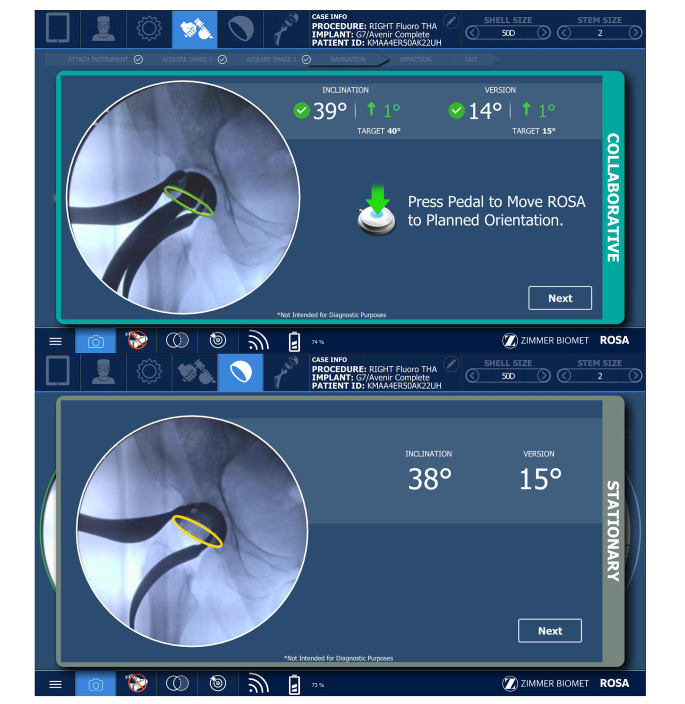
The adoption of new technology should be supported by improvements in patient-reported outcomes (PROMs). The purpose of this study was to assess the one-year PROMs of patients who underwent total hip arthroplasty (THA) using a novel, fluoroscopy-based, robotic-assisted (RA-THA) system when compared to a manual, fluoroscopic-assisted technique (mTHA).
A review of 91 consecutive mTHA and 85 consecutive RA-THA via a direct anterior approach was conducted. All cases were performed by the same surgeon at the same institution, for a pre-operative diagnosis of osteoarthritis, avascular necrosis, or rheumatoid arthritis. Outcomes included one-year Veterans RAND-12 (VR-12) Physical/Mental, Hip Disability and Osteoarthritis Outcome (HOOS) Pain/Physical Function/Joint Replacement, and University of California Los Angeles (UCLA) Activity scores, as well as the difference between pre-operative and one-year post-operative PROMs.
Patients in the RA-THA cohort had lower pre-operative HOOS-JR scores compared to patients in the mTHA cohort (37.0 vs. 43.1; p = 0.031). Cohorts experienced similar one-year post-operative VR-12, HOOS, and UCLA Activity scores. Patients in the RA-THA cohort experienced greater improvements across all pre- and post-operative HOOS scores compared to patients in the mTHA cohort: Pain (+ 54.7 vs. +42.1; p = 0.009), Physical Function (-41.6 vs. -28.7; p = 0.007), and Joint Replacement (+ 46.6 vs. +33.0; p = 0.002). These differences exceeded minimum clinically important difference (MCID).
Both manual and robotic cohorts experienced benefit from THA at one-year post-operative. Importantly, the use of a novel, fluoroscopy-based robotic assistance system for primary THA resulted in greater improvements in PROMs at one-year relative to manual technique.
新技术的采用应该得到患者报告结局(PROMs)的改善的支持。本研究的目的是评估使用新型基于荧光透视的机器人辅助(RA-THA)系统进行全髋关节置换术(THA)的患者在 1 年时的 PROMs,与手动、荧光透视辅助技术(mTHA)相比。
回顾性分析了 91 例直接前路 mTHA 和 85 例直接前路 RA-THA。所有病例均由同一位外科医生在同一机构进行,术前诊断为骨关节炎、股骨头坏死或类风湿关节炎。结果包括一年的退伍军人 RAND-12(VR-12)身体/精神、髋关节残疾和骨关节炎结果(HOOS)疼痛/身体功能/关节置换以及加州大学洛杉矶分校(UCLA)活动评分,以及术前和术后 1 年 PROM 之间的差异。
RA-THA 组患者的术前 HOOS-JR 评分低于 mTHA 组(37.0 对 43.1;p=0.031)。两组患者在术后 1 年时的 VR-12、HOOS 和 UCLA 活动评分相似。与 mTHA 组相比,RA-THA 组患者在所有术前和术后 HOOS 评分中均有更大的改善:疼痛(+54.7 对+42.1;p=0.009)、身体功能(-41.6 对-28.7;p=0.007)和关节置换(+46.6 对+33.0;p=0.002)。这些差异超过了最小临床重要差异(MCID)。
手动和机器人组在术后 1 年均从 THA 中获益。重要的是,与手动技术相比,新型基于荧光透视的机器人辅助系统用于初次 THA 可在术后 1 年时显著改善 PROMs。