Division of Hematology, Cincinnati Children's Hospital Medical Center, Hematology ML, 3333 Burnet Ave., Cincinnati, OH, 701545229, USA.
Division of Clinical Pharmacology, Cincinnati Children's Hospital Medical Center, Cincinnati, OH, USA.
Clin Pharmacokinet. 2024 Mar;63(3):357-365. doi: 10.1007/s40262-024-01349-4. Epub 2024 Feb 24.
L-Glutamine is a treatment for children and adults with sickle cell disease. A comprehensive evaluation of the pharmacokinetics of L-glutamine in sickle cell disease has not been conducted. We aimed to assess the effects of long-term dosing, multiple dose levels, and food intake on L-glutamine exposure in patients with sickle cell disease compared to normal participants.
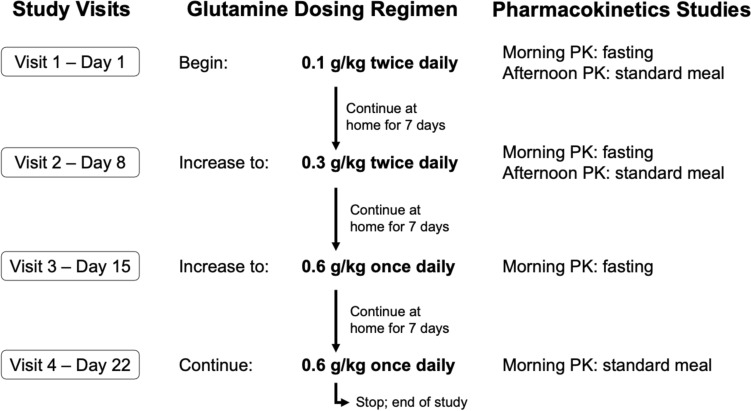
We conducted an open-label dose-ascending trial of L-glutamine in pediatric and adult participants with sickle cell disease (N = 8) and adult healthy volunteers (N = 4), providing a total of 400 plasma L-glutamine concentrations. Each participant received three ascending oral doses (0.1 and 0.3 g/kg twice daily and 0.6 g/kg once daily) over 3 weeks. Plasma L-glutamine concentrations were quantified using ion exchange chromatography. Both a non-compartmental pharmacokinetic analysis and a population pharmacokinetic analysis were performed.
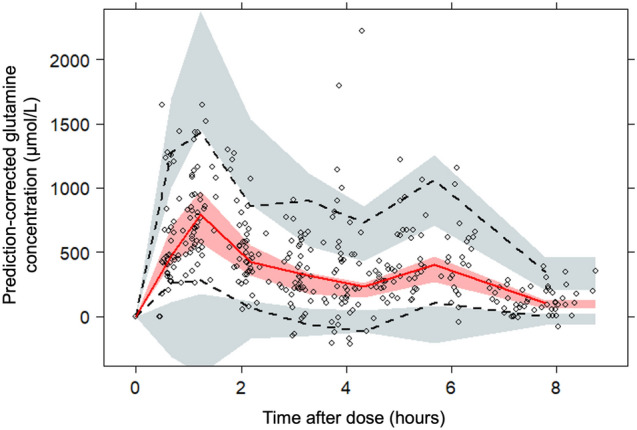
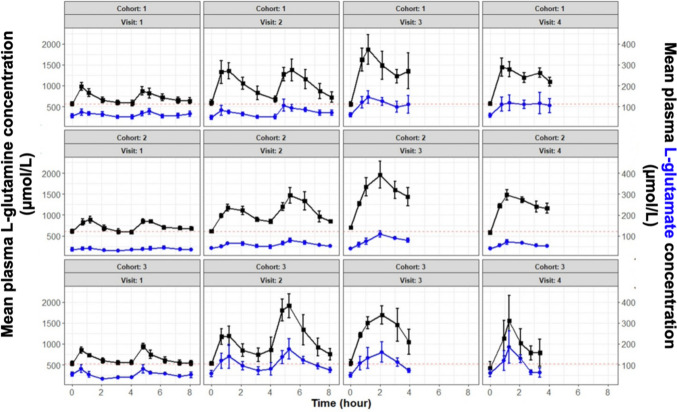
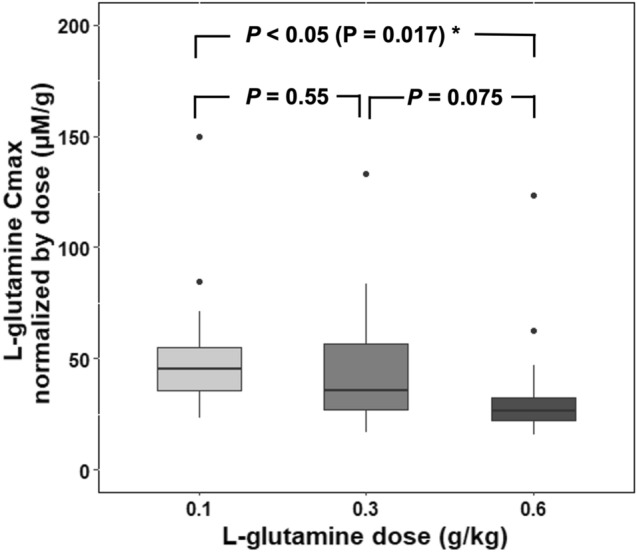
L-glutamine had rapid absorption and elimination, and there was no significant change in the baseline (pre-dose) L-glutamine concentration throughout the study, indicating no drug accumulation. Pharmacokinetics was best described by a one-compartment model with first-order kinetics. The dose-normalized peak concentration decreased with dose escalation, indicating the capacity-limited non-linear pharmacokinetics of oral L-glutamine. A covariate analysis showed that baseline L-glutamine concentrations correlated negatively with glutamine clearance, whereas dose positively correlated with volume of distribution. Food intake did not significantly affect glutamine clearance, indicating that L-glutamine can be taken with or without food.
We report the first pharmacokinetic study of multiple-dose, long-term oral L-glutamine therapy and the first population pharmacokinetic analysis of L-glutamine for sickle cell disease. These findings may permit optimized dosing of L-glutamine for patients with sickle cell disease to maximize treatment benefits.
This trial is registered at ClinicalTrials.gov (NCT04684381).
L-谷氨酰胺可用于治疗镰状细胞病患儿和成人。目前尚未对镰状细胞病患者的 L-谷氨酰胺药代动力学进行全面评估。我们旨在评估与正常参与者相比,长期给药、多个剂量水平和饮食摄入对镰状细胞病患者 L-谷氨酰胺暴露的影响。
我们对镰状细胞病患儿和成年患者(N=8)以及成年健康志愿者(N=4)进行了 L-谷氨酰胺开放性剂量递增试验,共提供了 400 份血浆 L-谷氨酰胺浓度。每位参与者在 3 周内接受 3 次递增口服剂量(0.1 和 0.3 g/kg,每日 2 次和 0.6 g/kg,每日 1 次)。使用离子交换色谱法定量测定血浆 L-谷氨酰胺浓度。进行了非房室药代动力学分析和群体药代动力学分析。
L-谷氨酰胺吸收迅速,消除迅速,整个研究过程中基线(预剂量)L-谷氨酰胺浓度无明显变化,表明无药物蓄积。药代动力学最好用一室模型和一级动力学来描述。随着剂量递增,剂量归一化的峰浓度降低,表明口服 L-谷氨酰胺具有容量限制的非线性药代动力学。协变量分析表明,基线 L-谷氨酰胺浓度与谷氨酰胺清除率呈负相关,而剂量与分布容积呈正相关。饮食摄入对谷氨酰胺清除率无显著影响,表明 L-谷氨酰胺可随餐或不随餐服用。
我们报告了首个关于多剂量、长期口服 L-谷氨酰胺治疗的药代动力学研究,以及首个用于镰状细胞病的 L-谷氨酰胺群体药代动力学分析。这些发现可能使镰状细胞病患者的 L-谷氨酰胺剂量优化,以最大限度地提高治疗效果。
本试验在 ClinicalTrials.gov 注册(NCT04684381)。