Vajner Daniel A, Holewa Paweł, Zięba-Ostój Emilia, Wasiluk Maja, von Helversen Martin, Sakanas Aurimas, Huck Alexander, Yvind Kresten, Gregersen Niels, Musiał Anna, Syperek Marcin, Semenova Elizaveta, Heindel Tobias
Institute of Solid State Physics, Technical University of Berlin, 10623 Berlin, Germany.
Department of Experimental Physics, Faculty of Fundamental Problems of Technology, Wrocław University of Science and Technology, Wyb. Wyspiańskiego 27, 50-370 Wrocław, Poland.
ACS Photonics. 2024 Jan 23;11(2):339-347. doi: 10.1021/acsphotonics.3c00973. eCollection 2024 Feb 21.
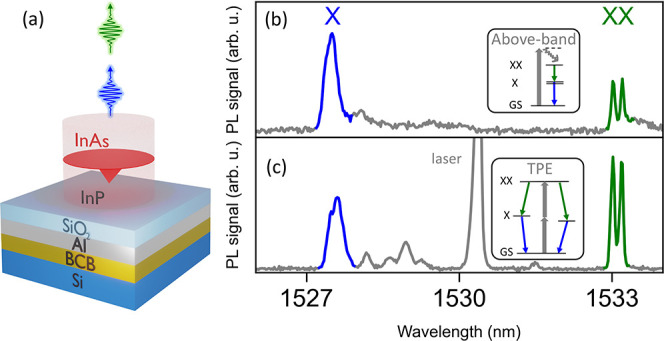
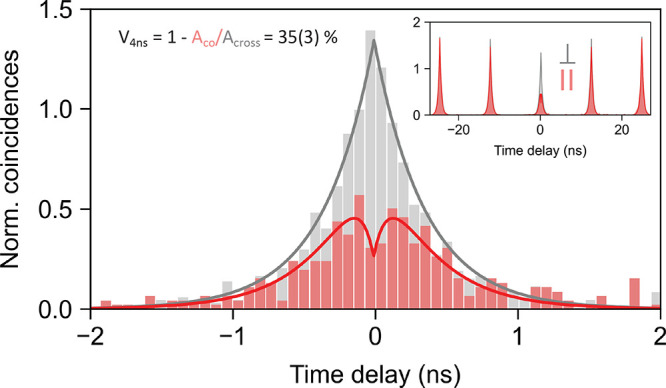
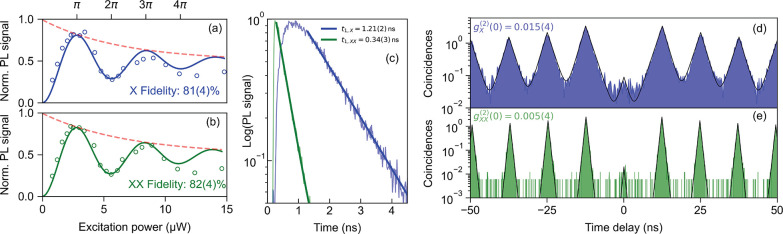
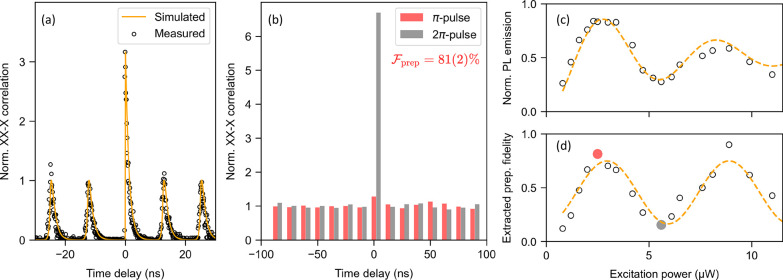
Semiconductor quantum dots (QDs) enable the generation of single and entangled photons, which are useful for various applications in photonic quantum technologies. Specifically for quantum communication via fiber-optical networks, operation in the telecom C-band centered around 1550 nm is ideal. The direct generation of QD-photons in this spectral range with high quantum-optical quality, however, remained challenging. Here, we demonstrate the coherent on-demand generation of indistinguishable photons in the telecom C-band from single QD devices consisting of InAs/InP QD-mesa structures heterogeneously integrated with a metallic reflector on a silicon wafer. Using pulsed two-photon resonant excitation of the biexciton-exciton radiative cascade, we observe Rabi rotations up to pulse areas of 4π and a high single-photon purity in terms of (0) = 0.005(1) and 0.015(1) for exciton and biexciton photons, respectively. Applying two independent experimental methods, based on fitting Rabi rotations in the emission intensity and performing photon cross-correlation measurements, we consistently obtain preparation fidelities at the π-pulse exceeding 80%. Finally, performing Hong-Ou-Mandel-type two-photon interference experiments, we obtain a photon-indistinguishability of the full photon wave packet of up to 35(3)%, representing a significant advancement in the photon-indistinguishability of single photons emitted directly in the telecom C-band.
半导体量子点(QDs)能够产生单光子和纠缠光子,这对于光子量子技术中的各种应用非常有用。特别是对于通过光纤网络进行的量子通信,在以1550 nm为中心的电信C波段中运行是理想的。然而,在该光谱范围内以高质量量子光学特性直接产生量子点光子仍然具有挑战性。在这里,我们展示了在电信C波段中,由InAs/InP量子点台面结构与硅片上的金属反射器异质集成而成的单量子点器件能够按需相干产生不可区分的光子。通过双激子 - 激子辐射级联的脉冲双光子共振激发,我们观察到拉比旋转直至脉冲面积达到4π,并且对于激子光子和双激子光子,单光子纯度分别高达(0) = 0.005(1) 和0.015(1)。应用两种独立的实验方法,基于拟合发射强度中的拉比旋转以及进行光子互相关测量,我们一致地获得了在π脉冲时超过80%的制备保真度。最后,进行洪 - 欧 - 曼德尔型双光子干涉实验,我们获得了高达35(3)%的全光子波包的光子不可区分性,这代表了直接在电信C波段发射的单光子的光子不可区分性方面的重大进展。