Vento Peter J, Watson Jacob R, Pullmann Dominika, Black Samantha L, Tomberlin Jensen S, Jhou Thomas C
Department of Psychology, University of South Carolina, Columbia, SC.
Department of Neuroscience, Medical University of South Carolina, Charleston, SC.
bioRxiv. 2023 Oct 6:2023.10.04.560908. doi: 10.1101/2023.10.04.560908.
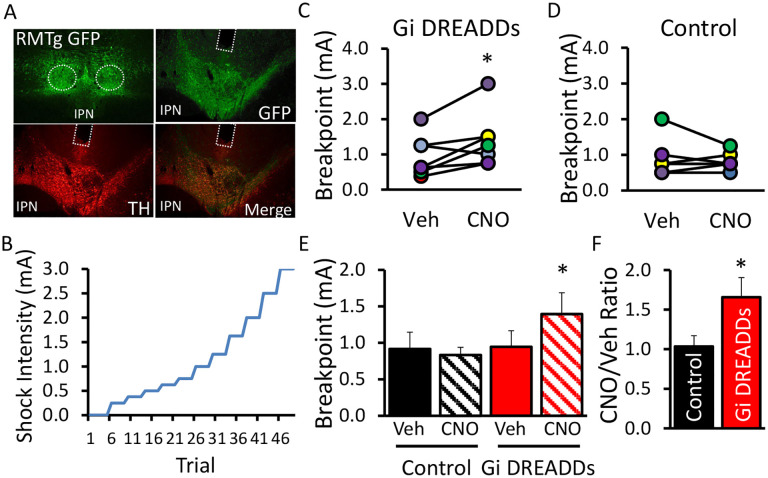
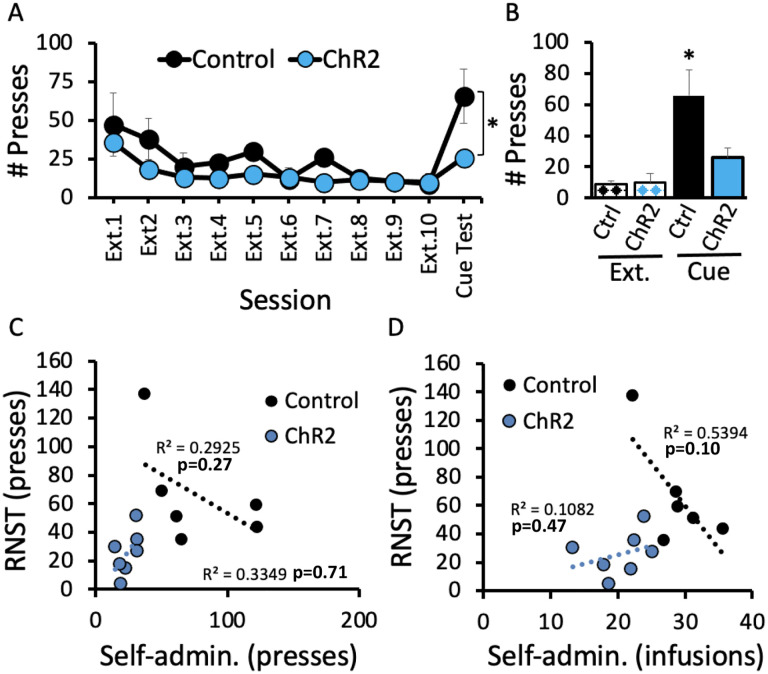
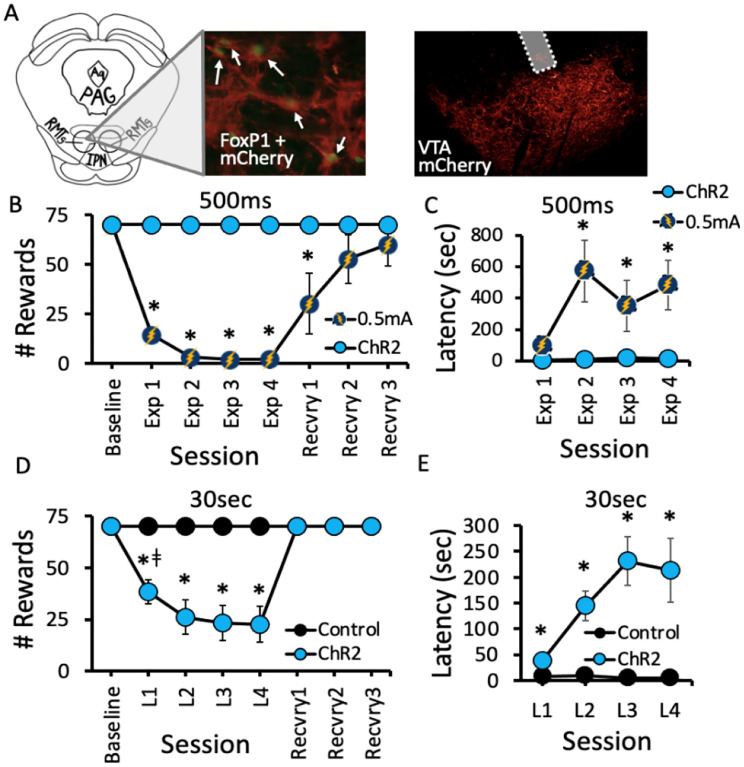
Addiction is marked by aberrant decision-making and an inability to suppress inappropriate and often dangerous behaviors. We previously demonstrated that inactivation of the rostromedial tegmental nucleus (RMTg) in rats causes persistent food seeking despite impending aversive footshock, an effect strikingly similar to the punishment resistance observed in people with a history of protracted drug use [1]. Here, we extend these studies to demonstrate chemogenetic silencing of RMTg axonal projections to the ventral tegmental area (VTA) (RMTg→VTA pathway) causes rats to endure significantly more footshock to receive cocaine infusions. To further test whether activation of this circuit is sufficient to suppress reward seeking in the absence of an overtly aversive stimulus, we used temporally specific optogenetic stimulation of the RMTg→VTA pathway as a "punisher" in place of footshock following lever pressing for either food or cocaine reward. While optical stimulation of the RMTg→VTA pathway robustly suppressed lever pressing for food, we found that stimulation of this circuit had only modest effects on suppressing responding for cocaine infusions. Even though optical RMTg→VTA stimulation was not particularly effective at reducing cocaine use, this experience nevertheless had long-lasting consequences, as reinstatement of drug seeking in response to cocaine-associated cues was profoundly suppressed when tested nearly two weeks later. These results suggest the RMTg may serve as a useful target for producing enduring reductions in drug craving, particularly during periods of abstinence from drug use.
成瘾表现为异常决策以及无法抑制不适当且往往危险的行为。我们之前证明,大鼠中脑内侧被盖核(RMTg)失活会导致尽管即将遭受厌恶的足部电击仍持续寻求食物,这一效应与有长期吸毒史的人所表现出的抗惩罚现象惊人地相似[1]。在此,我们扩展这些研究,以证明对投射到腹侧被盖区(VTA)的RMTg轴突进行化学遗传学沉默(RMTg→VTA通路)会使大鼠为了获得可卡因注射而忍受更多的足部电击。为了进一步测试在没有明显厌恶刺激的情况下激活该回路是否足以抑制奖赏寻求行为,我们在大鼠按压杠杆以获取食物或可卡因奖赏后,使用对RMTg→VTA通路进行时间特异性的光遗传学刺激作为“惩罚”来替代足部电击。虽然对RMTg→VTA通路的光刺激强烈抑制了对食物的杠杆按压,但我们发现刺激该回路对抑制可卡因注射的反应仅有适度影响。尽管光遗传学刺激RMTg→VTA在减少可卡因使用方面并非特别有效,但这种经历仍产生了持久的影响,因为在近两周后进行测试时,对可卡因相关线索的觅药行为恢复受到了显著抑制。这些结果表明,RMTg可能是一个有用的靶点,可用于持久减少药物渴望,尤其是在戒毒期间。