Chronic Kidney Disease Research Center, Shahid Beheshti University of Medical Sciences, Tehran, Iran.
Department of Clinical Pharmacy, School of Pharmacy, Shahid Beheshti University of Medical Sciences, Tehran, 35113-19968, Iran.
J Med Case Rep. 2024 Feb 26;18(1):116. doi: 10.1186/s13256-024-04394-6.
In this manuscript, we report a case of tacrolimus-associated hepatotoxicity in a kidney transplant recipient.
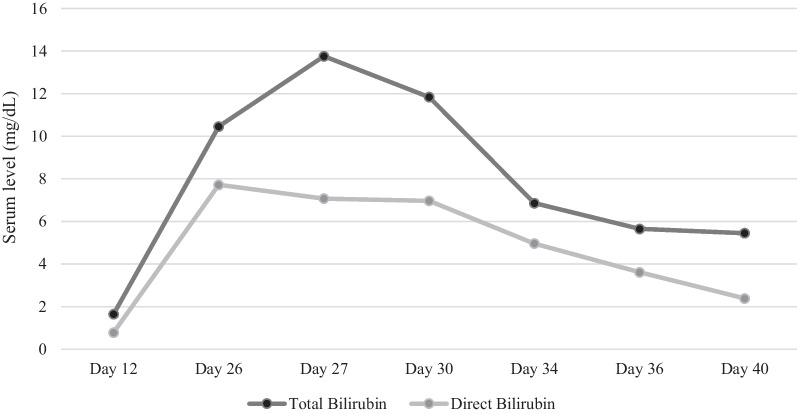
In this case report, a 56 years old Arab male patient who received a kidney transplant presented with icterus, weakness, and lethargy two weeks after transplantation and tacrolimus initiation. In laboratory analysis hyperbilirubinemia and a rise in hepatic enzymes were observed. All possible causes of hepatotoxicity were examined. The panel for infectious causes was negative. Drug-induced liver injury was diagnosed. The patient's immunosuppressive regimen was changed to a cyclosporine-based regimen and after this change bilirubin and hepatic enzymes decreased and the patient was discharged without signs and symptoms of hepatitis.
It seems that the patient's hyperbilirubinemia was due to tacrolimus, and the patient's bilirubin decreased after stopping tacrolimus.
在本手稿中,我们报告了一例肾移植受者中环孢素相关的肝毒性。
在本病例报告中,一名 56 岁的阿拉伯男性患者在移植后两周出现黄疸、乏力和嗜睡,并开始使用他克莫司。在实验室分析中,观察到高胆红素血症和肝酶升高。检查了所有可能导致肝毒性的原因。感染原因检测呈阴性。诊断为药物性肝损伤。患者的免疫抑制方案改为环孢素为基础的方案,在此方案改变后,胆红素和肝酶降低,患者出院时无肝炎的症状和体征。
似乎患者的高胆红素血症是由于他克莫司引起的,停用他克莫司后患者的胆红素水平降低。