Center for Human Nature, Artificial Intelligence, and Neuroscience (CHAIN), Hokkaido University, Sapporo, Japan.
Department of Pathology of Mental Diseases, National Institute of Mental Health, National Center of Neurology and Psychiatry, Kodaira, Japan.
Sci Rep. 2024 Feb 26;14(1):4606. doi: 10.1038/s41598-024-55359-0.
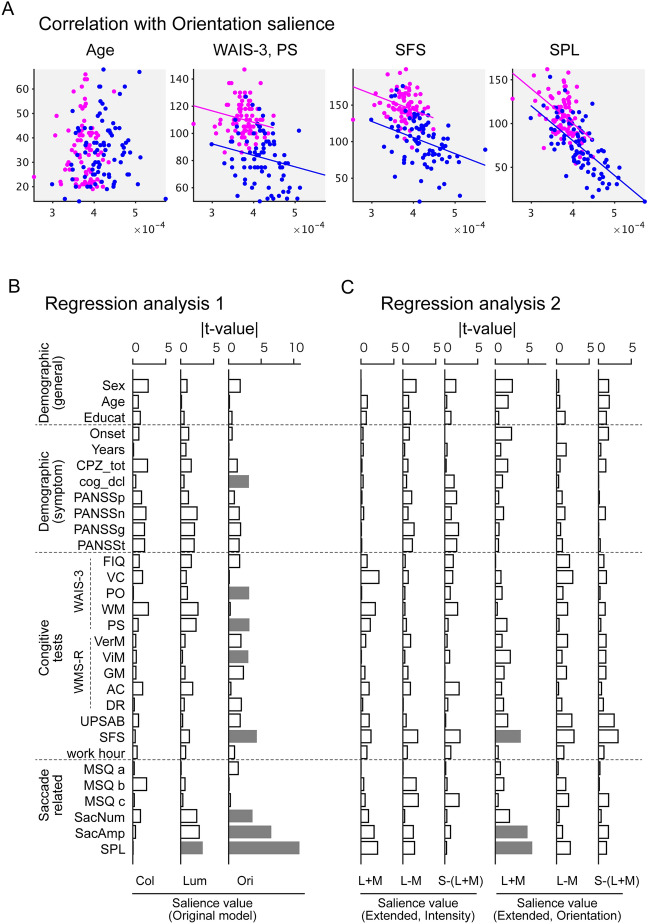
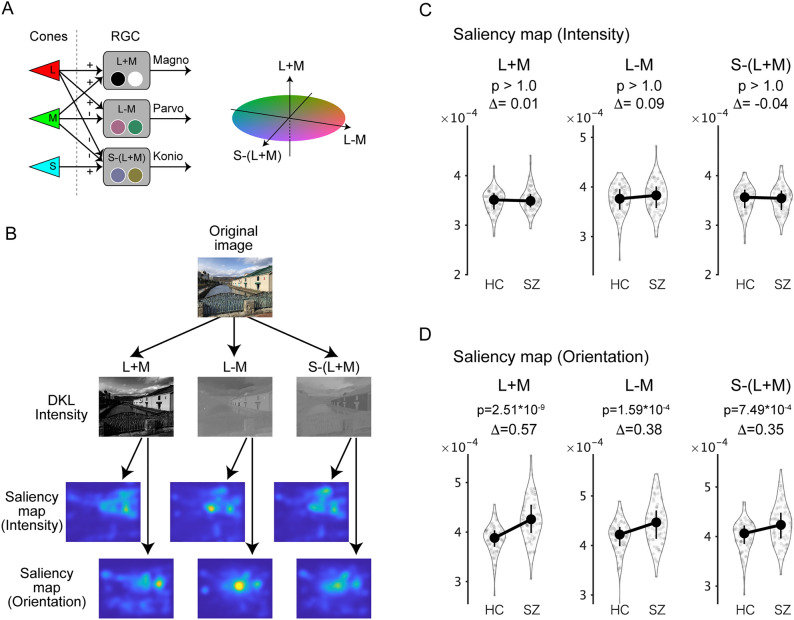
Abnormalities in visual exploration affect the daily lives of patients with schizophrenia. For example, scanpath length during free-viewing is shorter in schizophrenia. However, its origin and its relevance to symptoms are unknown. Here we investigate the possibility that abnormalities in eye movements result from abnormalities in visual or visuo-cognitive processing. More specifically, we examined whether such abnormalities reflect visual salience in schizophrenia. Eye movements of 82 patients and 252 healthy individuals viewing natural and/or complex images were examined using saliency maps for static images to determine the contributions of low-level visual features to salience-guided eye movements. The results showed that the mean value for orientation salience at the gazes of the participants with schizophrenia were higher than that of the healthy control subjects. Further analyses revealed that orientation salience defined by the L + M channel of the DKL color space is specifically affected in schizophrenia, suggesting abnormalities in the magnocellular visual pathway. By looking into the computational stages of the visual salience, we found that the difference between schizophrenia and healthy control emerges at the earlier stage, suggesting functional decline in early visual processing. These results suggest that visual salience is affected in schizophrenia, thereby expanding the concept of the aberrant salience hypothesis of psychosis to the visual domain.
视觉探索异常会影响精神分裂症患者的日常生活。例如,自由观看时的扫视长度在精神分裂症中较短。然而,其起源及其与症状的相关性尚不清楚。在这里,我们研究了眼球运动异常是否源于视觉或视认知加工异常的可能性。更具体地说,我们检查了这些异常是否反映了精神分裂症中的视觉显著性。使用静态图像的显着性图检查了 82 名患者和 252 名健康个体观看自然和/或复杂图像时的眼球运动,以确定低水平视觉特征对视动引导眼球运动的贡献。结果表明,精神分裂症患者注视点的方向显着性平均值高于健康对照组。进一步的分析表明,DKL 颜色空间的 L + M 通道定义的方向显着性在精神分裂症中受到特别影响,表明大细胞视觉通路异常。通过研究视觉显着性的计算阶段,我们发现精神分裂症和健康对照组之间的差异出现在早期阶段,这表明早期视觉处理功能下降。这些结果表明,视觉显着性在精神分裂症中受到影响,从而将异常显着性假说扩展到精神病的视觉领域。