Sliman Hussein, Eitan Amnon, Shiran Avinoam, Zafrir Barak, Karkabai Basheer, Flugelman Moshe Y, Schwartz Naama, Jaffe Ronen
Department of Cardiology, Carmel Medical Center, Haifa, Israel.
Research Authority, Carmel Medical Center, Haifa, Israel.
J Thorac Dis. 2024 Jan 30;16(1):241-246. doi: 10.21037/jtd-23-1391. Epub 2024 Jan 4.
Ethnic minorities may face disparities in access to health care and clinical outcomes. Transcatheter aortic valve replacement (TAVR) has an established role in treatment of patients with severe symptomatic aortic stenosis, however outcome of these procedures among different demographics within the multi-ethnic Israeli society is unknown. We sought to compare mortality following TAVR between Jewish and Arab patients in Israel.
A prospective single-center TAVR registry in northern Israel was analyzed. We compared post-procedural survival among Arab and Jewish patients who underwent TAVR, presenting the estimated hazard ratio (HR) using Cox regression.
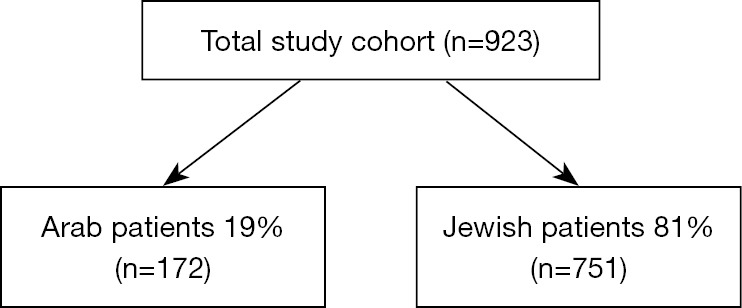
Of 923 subjects who underwent TAVR between 2010-2021, 172 (19%) were Arab and 751 (81%) were Jewish. The Arab patient population was younger (mean 77 81 years, P<0.001), had lower prevalence of coronary artery disease (34%, 43%, P=0.02), hypertension (80% 88%, P<0.01) and calculated procedural mortality (EuroScore II: mean 4.6 4.9, P=0.02), and higher percentage of females (65% 53%, P=0.01), body mass index (mean 30 28, P<0.001) and creatinine clearance (mean 67 59 mL/min, P<0.001). Arab patients had similar post-procedural mortality compared to Jewish patients [7-day mortality: adjusted HR 1.51, 95% confidence interval (CI): 0.39-5.77, P=0.55; 30-day mortality: adjusted HR 1.79, 95% CI: 0.62-5.18, P=0.29; 1-year mortality: adjusted HR 1.24, 95% CI: 0.72-2.12, P=0.43].
Arab patients undergoing TAVR were younger and had lower predicted mortality than Jewish counterparts, however, these characteristics did not translate into improved post-procedural survival.
少数族裔在获得医疗保健和临床结果方面可能面临差异。经导管主动脉瓣置换术(TAVR)在治疗重度症状性主动脉瓣狭窄患者中已确立了其作用,然而,在以色列多民族社会中,不同人口统计学群体的这些手术结果尚不清楚。我们试图比较以色列犹太人和阿拉伯患者接受TAVR后的死亡率。
对以色列北部一个前瞻性单中心TAVR登记处进行分析。我们比较了接受TAVR的阿拉伯和犹太患者术后的生存率,使用Cox回归呈现估计的风险比(HR)。
在2010年至2021年间接受TAVR的923名受试者中,172名(19%)为阿拉伯人,751名(81%)为犹太人。阿拉伯患者群体更年轻(平均77对81岁,P<0.001),冠状动脉疾病患病率较低(34%对43%,P=0.02)、高血压(80%对88%,P<0.01)以及计算得出的手术死亡率(欧洲心脏手术风险评估系统II:平均4.6对4.9,P=0.02),女性比例更高(65%对53%,P=0.01)、体重指数(平均30对28,P<0.001)和肌酐清除率(平均67对59 mL/分钟,P<0.001)。与犹太患者相比,阿拉伯患者术后死亡率相似[7天死亡率:调整后HR 1.51,95%置信区间(CI):0.39 - 5.77,P=0.55;30天死亡率:调整后HR 1.79,95% CI:0.62 - 5.18,P=0.29;1年死亡率:调整后HR 1.24,95% CI:0.72 - 2.12,P=0.43]。
接受TAVR的阿拉伯患者比犹太患者更年轻,预测死亡率更低,然而,这些特征并未转化为术后生存率的改善。