van Schaik Loeke, Blokland Ilse J, van Kammen Klaske, Houdijk Han, Geertzen Jan H B, Dekker Rienk
University of Groningen, University Medical Center Groningen, Department of Rehabilitation Medicine, Groningen.
Department of Human Movement Sciences, Faculty of Behavioural and Movement Sciences, Vrije Universiteit Amsterdam, Amsterdam Movement Sciences, Amsterdam.
Int J Rehabil Res. 2024 Jun 1;47(2):116-121. doi: 10.1097/MRR.0000000000000616. Epub 2024 Feb 26.
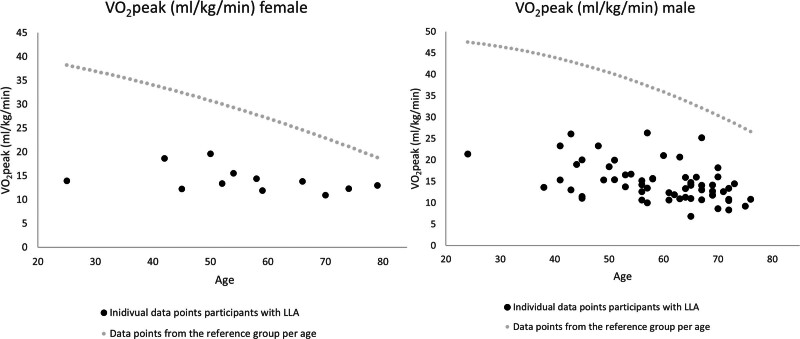
The aim of this study is to gain insight in the cardiorespiratory fitness of persons with lower limb amputation (LLA) during rehabilitation, and in potential factors influencing their cardiorespiratory fitness. We performed a retrospective cohort study using data from cardiopulmonary exercise tests. Included participants were adults with LLA. Main outcome was cardiorespiratory fitness expressed as O 2 peak (ml/min/kg) and was directly determined using breath-by-breath gas analysis. O 2 peak was compared to reference values for able-bodied controls. Multivariate regression analysis was performed to investigate potential factors related to O 2 peak in persons with LLA. Potential factors were age, BMI adjusted, gender, level of amputation, aetiology of amputation, unilateral/bilateral, type of ergometry and use of beta blockers. Data of 74 participants with LLA are presented; 84% male (n = 62), mean age 58.9 (SD 11.6), mean BMI 26.7 (SD 5.6), 44 participants have a LLA above the knee, 30 below the knee. Overall O 2 peak was lower in persons with LLA compared to reference values for able-bodied controls, with mean O 2 peak for the total LLA group of 14.6 ± 4.1 ml/kg/min. In the multivariate regression analysis, only age was a significant predictor for lower O 2 peak (regression coefficient: -0.15, 95% CI [0.23-0.069], r 2 = 0.166). These results indicate that the cardiorespiratory fitness in persons with LLA is low, while they actually need more energy to walk and perform other daily activities. Cardiorespiratory fitness is not closely associated with the analysed demographic or clinical factors and will have to be determined on an individual basis for use in daily practice.
本研究旨在深入了解下肢截肢(LLA)患者在康复期间的心肺适能,以及影响其心肺适能的潜在因素。我们使用心肺运动测试数据进行了一项回顾性队列研究。纳入的参与者为成年LLA患者。主要结局是用氧峰值(毫升/分钟/千克)表示的心肺适能,通过逐次呼吸气体分析直接测定。将氧峰值与健全对照的参考值进行比较。进行多变量回归分析以研究与LLA患者氧峰值相关的潜在因素。潜在因素包括年龄、调整后的体重指数、性别、截肢水平、截肢病因、单侧/双侧、测力计类型和β受体阻滞剂的使用。呈现了74名LLA患者的数据;84%为男性(n = 62),平均年龄58.9(标准差11.6),平均体重指数26.7(标准差5.6),44名参与者的LLA在膝盖以上,30名在膝盖以下。与健全对照的参考值相比,LLA患者的总体氧峰值较低,LLA组总平均氧峰值为14.6±4.1毫升/千克/分钟。在多变量回归分析中,只有年龄是较低氧峰值的显著预测因素(回归系数:-0.15,95%置信区间[0.23 - 0.069],r² = 0.166)。这些结果表明,LLA患者的心肺适能较低,而他们在行走和进行其他日常活动时实际上需要更多能量。心肺适能与所分析的人口统计学或临床因素没有密切关联,在日常实践中必须根据个体情况确定其适用性。