Department of Anthropology, University of Washington, Campus Box 353100, Seattle, WA, 98122, USA.
Center for Studies in Demography and Ecology, University of Washington, Seattle, WA, USA.
AIDS Behav. 2024 May;28(5):1766-1780. doi: 10.1007/s10461-024-04281-7. Epub 2024 Feb 27.
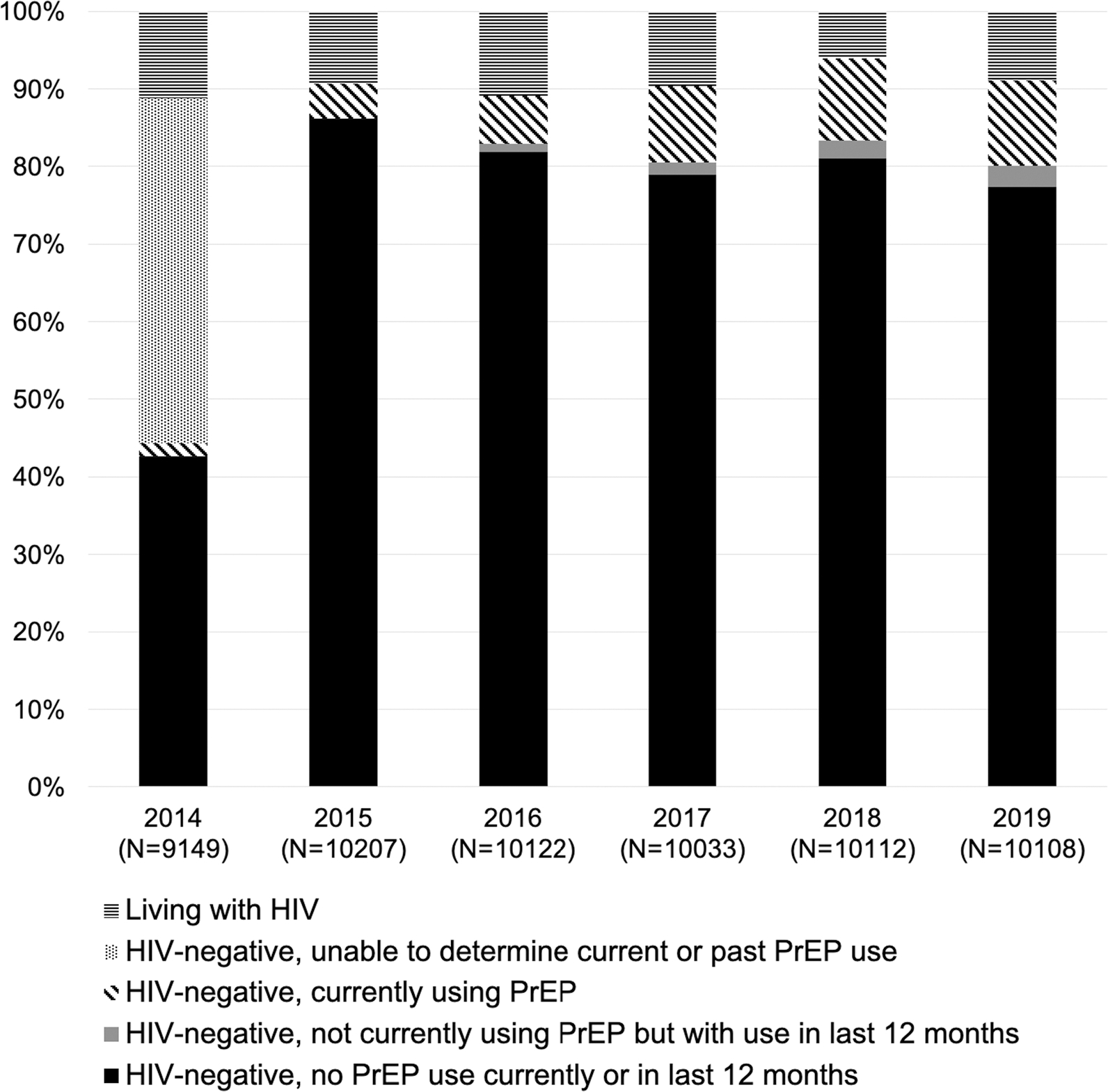
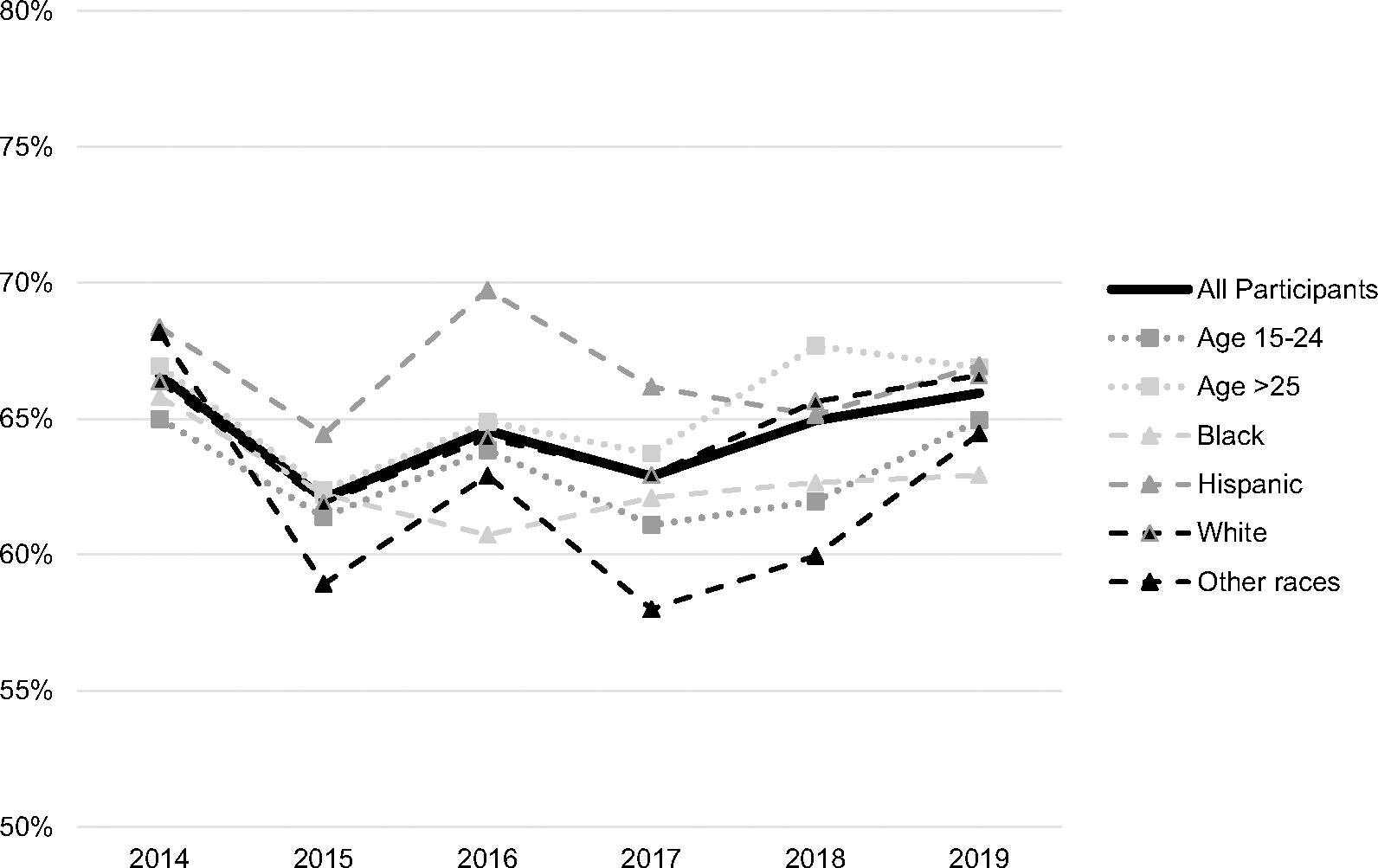
This study measures changes in condomless anal sex (CAS) among HIV-negative men who have sex with men (MSM) who are not taking pre-exposure prophylaxis (PrEP). It considers the 2014-2019 cycles of the American Men's Internet Survey, a serial, cross-sectional web-based survey of US cisgender MSM aged ≥ 15 years, in which ~ 10% of each year's sample is drawn from the previous year. Among those surveyed for 2 years who remained HIV-negative and off PrEP, reports of having any CAS and of CAS partner number were compared across years. We disaggregated by partner HIV status, and considered demographic predictors. The overall population saw a significant 2.2 percentage-point (pp) increase in reports of any CAS year-over-year. Sub-populations with the largest year-on-year increases were 15-24-year-olds (5.0-pp) and Hispanic respondents (5.1-pp), with interaction (young Hispanic respondents = 12.8-pp). On the relative scale, these numbers correspond to 3.2%, 7.2%, 7.3% and 18.7%, respectively. Absolute increases were concentrated among partners reported as HIV-negative. Multivariable analyses for CAS initiation found effects concentrated among Hispanic and White youth and residents of fringe counties of large metropolitan areas. CAS partner number increases were similarly predicted by Hispanic identity and young age. Although condom use remains more common than PrEP use, increasing CAS among MSM not on PrEP suggests potential new HIV transmission pathways. Concentration of increases among 18-24-year-old MSM portends future increases in the proportion of newly diagnosed HIV that occur among youth. Concentration among young Hispanic MSM will likely expand existing disparities. Although reducing barriers to PrEP remains vital, condom promotion for MSM remains a key public health practice and appears to be missing key audiences. LGBTQ+-inclusive sex education is one avenue for enhancing these efforts.
本研究旨在衡量未使用暴露前预防(PrEP)的 HIV 阴性男男性行为者(MSM)中非保护肛交(CAS)行为的变化。研究考虑了美国男性互联网调查(American Men's Internet Survey)在 2014 年至 2019 年期间的四个周期,这是一项针对美国跨性别 MSM 年龄在 15 岁及以上的连续、横断面网络调查,每年约有 10%的样本来自前一年。在连续两年 HIV 检测阴性且未使用 PrEP 的调查对象中,根据年份比较了有任何 CAS 和 CAS 伴侣数量的报告。我们按伴侣的 HIV 状况进行了细分,并考虑了人口统计学预测因素。总体人群中,报告有任何 CAS 的比例在逐年增加 2.2 个百分点(pp)。在一年中报告 CAS 比例增加最大的是 15-24 岁人群(5.0-pp)和西班牙裔受访者(5.1-pp),存在交互作用(年轻西班牙裔受访者=12.8-pp)。在相对规模上,这些数字分别对应 3.2%、7.2%、7.3%和 18.7%。绝对增加集中在报告 HIV 阴性的伴侣中。对 CAS 起始的多变量分析发现,效应主要集中在西班牙裔和白人青年以及大城市边缘县的居民中。CAS 伴侣数量的增加也与西班牙裔身份和年轻年龄有关。尽管避孕套的使用仍然比 PrEP 更普遍,但越来越多的 MSM 未使用 PrEP 发生 CAS 表明可能存在新的 HIV 传播途径。18-24 岁 MSM 中的增加集中预示着未来青年中新诊断 HIV 的比例将会增加。年轻西班牙裔 MSM 的集中可能会扩大现有的差异。尽管减少 PrEP 的障碍仍然至关重要,但为 MSM 推广避孕套仍然是一项关键的公共卫生实践,而且似乎错过了关键受众。将 LGBTQ+包容的性教育作为一种增强这些努力的途径。