Internal Medicine, Texas A&M University School of Medicine / Christus Health, Longview, Texas, USA
Epidemiology, The University of Texas MD Anderson Cancer Center, Houston, Texas, USA.
BMJ Open. 2024 Feb 26;14(2):e070749. doi: 10.1136/bmjopen-2022-070749.
To describe the prevalence of school-based tobacco prevention programme exposure among adolescents in low-income and middle-income countries (LMICs) and its association with psychosocial predictors of smoking.
Analysis of pooled cross-sectional data.
Global Youth Tobacco Survey (GYTS), conducted in 38 LMICs.
This was a pooled analysis of data involving a total of 132 755 adolescent respondents to GYTS in 38 LMICs across Africa, Europe and Central/South America between 2014 and 2017.
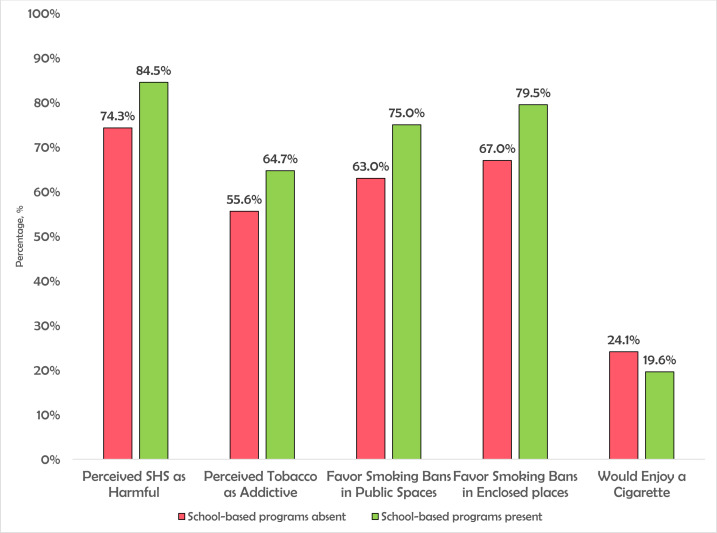
The primary independent variable for this study was self-reported exposure to school-based tobacco prevention programmes in the past year. Five psychosocial determinants of smoking were explored as outcomes: perceived addictiveness of nicotine, perceived harm of secondhand smoke exposure, support for restricting cigarette smoking at public indoor locations, support for restricting cigarette smoking at public outdoor areas and self-reported prediction of enjoying cigarette smoking. Multivariable logistic regression models were used to examine the relationship between exposure to school-based tobacco prevention programmes and study outcomes, controlling for sociodemographic and smoking-related characteristics of respondents.
Overall, 59.1% of adolescents in LMICs self-reported exposure to school-based tobacco prevention programmes. The country-specific prevalence of adolescent exposure to school-based tobacco interventions ranged from 24.9% in the Comoros to 99.3% in Turkmenistan. Exposure to school-based tobacco interventions was significantly associated with greater secondhand smoke harm perceptions (adjusted OR (AOR): 1.69; 95% CI: 1.69 to 1.70), perceptions of addictiveness (AOR: 1.37; 95% CI: 1.36 to 1.37) and supporting tobacco use restrictions indoors (AOR: 1.70; 95% CI: 1.69 to 1.70) and outdoors (AOR: 1.59; 95% CI: 1.59 to 1.60). Exposure to school-based tobacco interventions was associated with lower odds of anticipating enjoying cigarette smoking (AOR: 0.76; 95% CI: 0.76 to 0.76).
Exposure to tobacco prevention programmes in schools is suboptimal in LMICs. Given the protective associations described in this study from school-based tobacco prevention programme exposure, it is imperative that national governments implement school-based programmes into ongoing tobacco control measures.
描述低收入和中等收入国家(LMIC)青少年接受学校烟草预防计划的情况及其与吸烟的社会心理预测因素的关系。
对汇总的横断面数据进行分析。
全球青年烟草调查(GYTS),在 38 个 LMIC 进行。
这是对 2014 年至 2017 年间在非洲、欧洲和中/南美洲 38 个 LMIC 进行的 GYTS 调查中,共有 132755 名青少年应答者的数据进行的汇总分析。
本研究的主要自变量是过去一年中自我报告的学校烟草预防计划暴露情况。探索了五个与吸烟有关的社会心理决定因素作为结果:尼古丁成瘾感知、二手烟暴露危害感知、支持限制公共室内吸烟、支持限制公共户外吸烟以及自我报告对吸烟的享受预测。使用多变量逻辑回归模型,控制受访者的社会人口统计学和与吸烟有关的特征,检查暴露于学校烟草预防计划与研究结果之间的关系。
总体而言,59.1%的 LMIC 青少年报告接触过学校烟草预防计划。各国青少年接触学校烟草干预措施的比例从科摩罗的 24.9%到土库曼斯坦的 99.3%不等。接触学校烟草干预措施与更大的二手烟危害感知(调整后的比值比(AOR):1.69;95%置信区间(CI):1.69 至 1.70)、成瘾感知(AOR:1.37;95%CI:1.36 至 1.37)以及支持室内(AOR:1.70;95%CI:1.69 至 1.70)和室外(AOR:1.59;95%CI:1.59 至 1.60)吸烟限制的关联更为显著。接触学校烟草干预措施与预期享受吸烟的可能性降低有关(AOR:0.76;95%CI:0.76 至 0.76)。
在 LMIC 中,学校的烟草预防计划的接触情况并不理想。考虑到本研究中从学校烟草预防计划接触中描述的保护关联,各国政府必须将学校为基础的方案纳入正在进行的烟草控制措施中。