Wang Yawen, Zhu Zhenhui, Niu Lili, Liu Bingyang, Lin Jingru, Lu Minjie, Xiong Changming, Wang Jiangtao, Cai Yuqi, Wang Hao, Wu Weichun
Department of Echocardiography, State Key Laboratory of Cardiovascular Disease, Fuwai Hospital, National Center for Cardiovascular Diseases, Chinese Academy of Medical Sciences and Peking Union Medical College, Beijing, China.
Department of Cardiology, Pulmonary Vascular Disease Center, State Key Laboratory of Cardiovascular Disease, Fuwai Hospital, National Center for Cardiovascular Diseases, Chinese Academy of Medical Sciences and Peking Union Medical College, Beijing, China.
Quant Imaging Med Surg. 2024 Feb 1;14(2):1699-1715. doi: 10.21037/qims-23-1150. Epub 2024 Jan 18.
Evaluation of the tricuspid valve (TV) is crucial for clinical decision making and post-treatment follow-up in pulmonary hypertension (PH) patients. However, little is known about 4-dimensional (4D) TV geometric remodeling in patients with PH. The aim of this study was to examine the 4D geometry of the TV in PH and its correlation with PH severity.
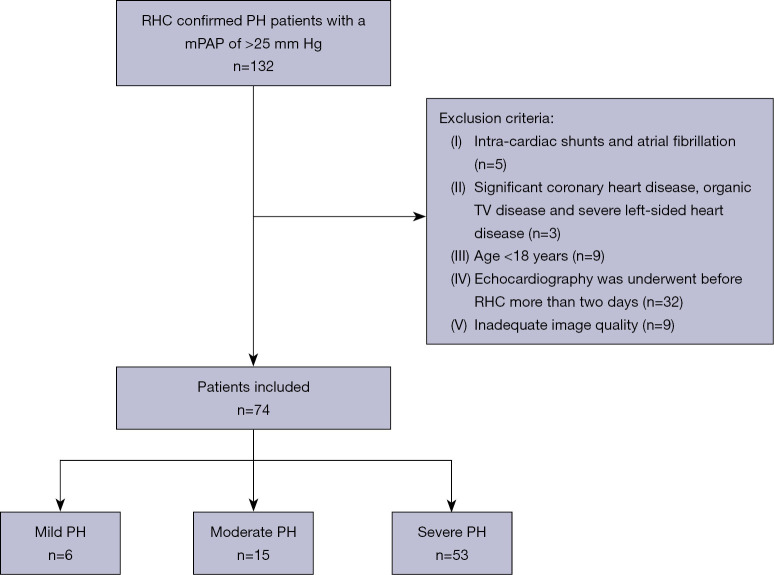
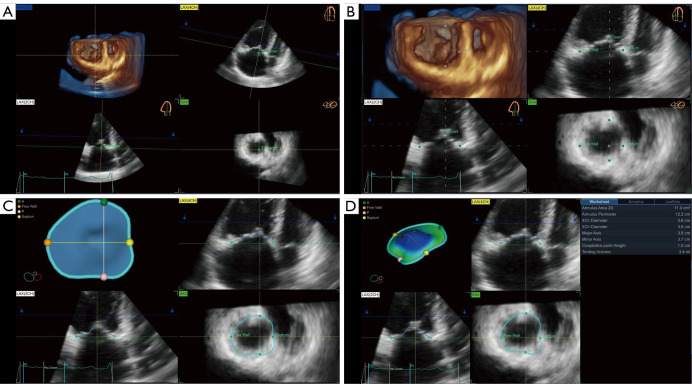
A total of 74 PH patients with mean pulmonary arterial pressure >25 mmHg and 15 age- and gender-matched healthy individuals were consecutively included from September 2017 to December 2018 in National Center for Cardiovascular Diseases, Fuwai Hospital. All participants underwent 2-dimensional (2D) and 4D transthoracic echocardiography and PH patients underwent right heart catheterization (RHC) within 48 hours of echocardiography. TV geometry was analyzed using a dedicated 4D echocardiography from the right ventricular-focused apical view.
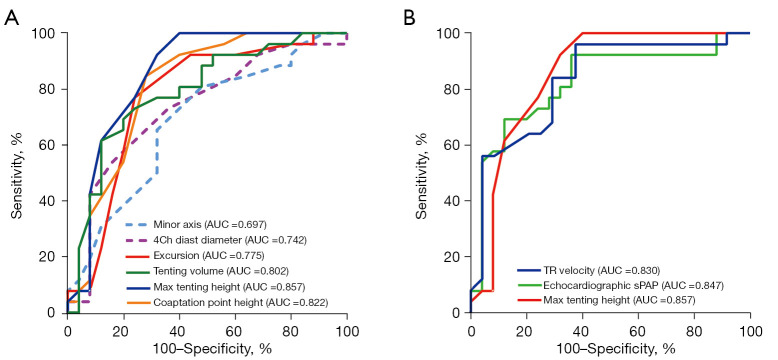
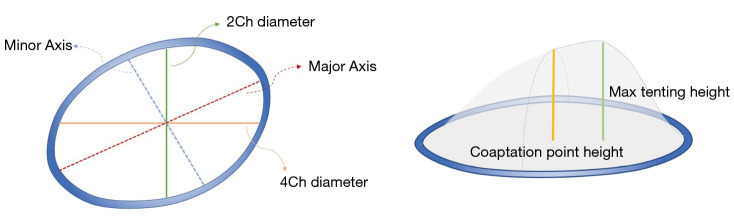
Compared with controls, PH patients had significantly larger 4D tricuspid annular (TA) and TV tenting sizes except in the 2-chamber diameter. In high-quality image cases, maximal tenting height (MTH), coaptation point height, tenting volume and 4-chamber diameter had good or moderate correlation with PH severity graded according to RHC mean pulmonary artery pressure (r=0.705, r=0.644, r=0.602, r=0.472, respectively; P<0.001 for all). In multivariable linear regression analysis, PH severity was independently associated with coaptation point height (F=18.070, P<0.001 with an R=0.647) and MTH (F=25.576, P<0.001 with an R=0.378). Among all 4D TV parameters, MTH had the highest area under the receiver operating characteristic (ROC) curve (AUC) in high-quality image cases [AUC =0.857, 95% confidence interval (CI): 0.743-0.972; P<0.001], comparable to echocardiographic systolic pulmonary arterial pressure (AUC =0.847, 95% CI: 0.733-0.961; P<0.001).
In PH, TV geometric remodeling occurs mainly in TA septal-lateral dimension and TV tenting height. Worsening PH is an independent determinant of TV coaptation point height and MTH, not TA size. MTH shows a great diagnostic potential to detect severe PH.
对于肺动脉高压(PH)患者,三尖瓣(TV)评估对于临床决策和治疗后随访至关重要。然而,关于PH患者的四维(4D)TV几何重塑知之甚少。本研究的目的是研究PH患者TV的4D几何形状及其与PH严重程度的相关性。
2017年9月至2018年12月,在国家心血管病中心阜外医院连续纳入了74例平均肺动脉压>25 mmHg的PH患者以及15例年龄和性别匹配的健康个体。所有参与者均接受二维(2D)和4D经胸超声心动图检查,PH患者在超声心动图检查后48小时内接受右心导管检查(RHC)。使用来自右心室聚焦心尖视图的专用4D超声心动图分析TV几何形状。
与对照组相比,PH患者的4D三尖瓣环(TA)和TV帐篷大小显著更大,但二腔直径除外。在高质量图像病例中,最大帐篷高度(MTH)、瓣叶贴合点高度、帐篷体积和四腔直径与根据RHC平均肺动脉压分级的PH严重程度具有良好或中等的相关性(分别为r = 0.705、r = 0.644、r = 0.602、r = 0.472;均P<0.001)。在多变量线性回归分析中,PH严重程度与瓣叶贴合点高度(F = 18.070,P<0.001,R = 0.647)和MTH(F = 25.576,P<0.001,R = 0.378)独立相关。在所有4D TV参数中,MTH在高质量图像病例中的受试者操作特征(ROC)曲线下面积(AUC)最高[AUC = 0.857,95%置信区间(CI):0.743 - 0.972;P<0.001],与超声心动图收缩期肺动脉压相当(AUC = 0.847,95%CI:0.733 - 0.961;P<0.001)。
在PH中,TV几何重塑主要发生在TA的间隔 - 侧方维度和TV帐篷高度。PH的加重是TV瓣叶贴合点高度和MTH的独立决定因素,而非TA大小。MTH在检测重度PH方面显示出巨大的诊断潜力。