Brendel Jan M, Mangold Tobias, Lescan Mario, Schmehl Jörg, Ghibes Patrick, Grimm Antonia, Greulich Simon, Krumm Patrick, Artzner Christoph, Grözinger Gerd, Estler Arne
Department of Radiology, Diagnostic and Interventional Radiology, Tübingen University Hospital, Hoppe-Seyler-Straße 3, Tübingen, 72076, Germany.
Department of Anesthesiology and Intensive Care Medicine, Tübingen University Hospital, Tübingen, Germany.
CVIR Endovasc. 2024 Feb 28;7(1):23. doi: 10.1186/s42155-024-00435-9.
The Viabahn stent graft has emerged as an integral tool for managing vascular diseases, but there is limited long-term data on its performance in emergency endovascular treatment. This study aimed to assess safety, technical success, and long-term efficacy of the Viabahn stent graft in emergency treatment of arterial injury.
We conducted a retrospective single tertiary centre analysis of patients who underwent Viabahn emergency arterial injury treatment between 2015 and 2020. Indication, intraoperative complications, technical and clinical success, and major adverse events at 30 days were evaluated. Secondary efficacy endpoints were the primary and secondary patency rates assessed by Kaplan-Meier analysis.
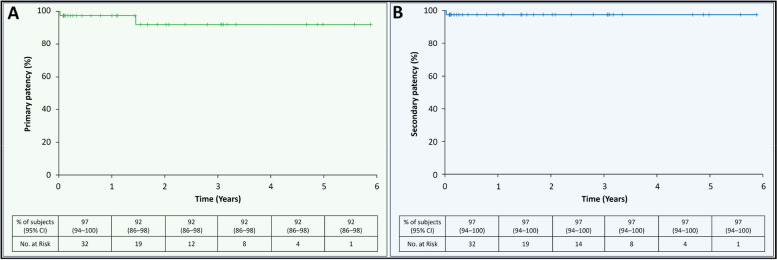
Forty patients (71 ± 13 years, 19 women) were analyzed. Indications for Viabahn emergency treatment were extravasation (65.0%), arterio-venous fistula (22.5%), pseudoaneurysm (10.0%), and arterio-ureteral fistula (2.5%). No intraoperative adverse events occurred, technical and clinical success rates were 100%. One acute stent graft occlusion occurred in the popliteal artery on day 9, resulting in a 30-day device-related major-adverse-event rate of 2.5%. Median follow-up was 402 days [IQR, 43-1093]. Primary patency rate was 97% (95% CI: 94-100) in year 1, and 92% (95% CI: 86-98) from years 2 to 6. One stent graft occlusion occurred in the external iliac artery at 18 months; successful revascularization resulted in secondary patency rates of 97% (95% CI: 94-100) from years 1 to 6.
Using Viabahn stent graft in emergency arterial injury treatment had 100% technical and clinical success rates, a low 30-day major-adverse-event rate of 2.5%, and excellent long-term patency rates.
Viabahn覆膜支架已成为治疗血管疾病的重要工具,但关于其在急诊血管内治疗中的长期数据有限。本研究旨在评估Viabahn覆膜支架在动脉损伤急诊治疗中的安全性、技术成功率和长期疗效。
我们对2015年至2020年间接受Viabahn急诊动脉损伤治疗的患者进行了一项回顾性单中心分析。评估了适应症、术中并发症、技术和临床成功率以及30天时的主要不良事件。次要疗效终点是通过Kaplan-Meier分析评估的初级和次级通畅率。
分析了40例患者(71±13岁,19名女性)。Viabahn急诊治疗的适应症为外渗(65.0%)、动静脉瘘(22.5%)、假性动脉瘤(10.0%)和动脉输尿管瘘(2.5%)。未发生术中不良事件,技术和临床成功率均为100%。第9天腘动脉发生1例急性覆膜支架闭塞,导致30天器械相关主要不良事件发生率为2.5%。中位随访时间为402天[四分位间距,43 - 1093]。第1年初级通畅率为97%(95%CI:94 - 100),第2至6年为92%(95%CI:86 - 98)。18个月时髂外动脉发生1例覆膜支架闭塞;成功的血管再通使第1至6年的次级通畅率达到97%(95%CI:94 - 100)。
在动脉损伤急诊治疗中使用Viabahn覆膜支架的技术和临床成功率均为100%,30天主要不良事件发生率低至2.5%,长期通畅率良好。