School of Basic Medical Sciences, Harbin Medical University, Harbin, Heilongjiang, China.
Department of Pediatrics, The University of Texas MD Anderson Cancer Center, Houston, Texas, USA.
J Immunother Cancer. 2024 Feb 28;12(2):e008318. doi: 10.1136/jitc-2023-008318.
Acute myeloid leukemia (AML) is associated with a dismal prognosis. Immune checkpoint blockade (ICB) to induce antitumor activity in AML patients has yielded mixed results. Despite the pivotal role of B cells in antitumor immunity, a comprehensive assessment of B lymphocytes within AML's immunological microenvironment along with their interaction with ICB remains rather constrained.
We performed an extensive analysis that involved paired single-cell RNA and B-cell receptor (BCR) sequencing on 52 bone marrow aspirate samples. These samples included 6 from healthy bone marrow donors (normal), 24 from newly diagnosed AML patients (NewlyDx), and 22 from 8 relapsed or refractory AML patients (RelRef), who underwent assessment both before and after azacitidine/nivolumab treatment.
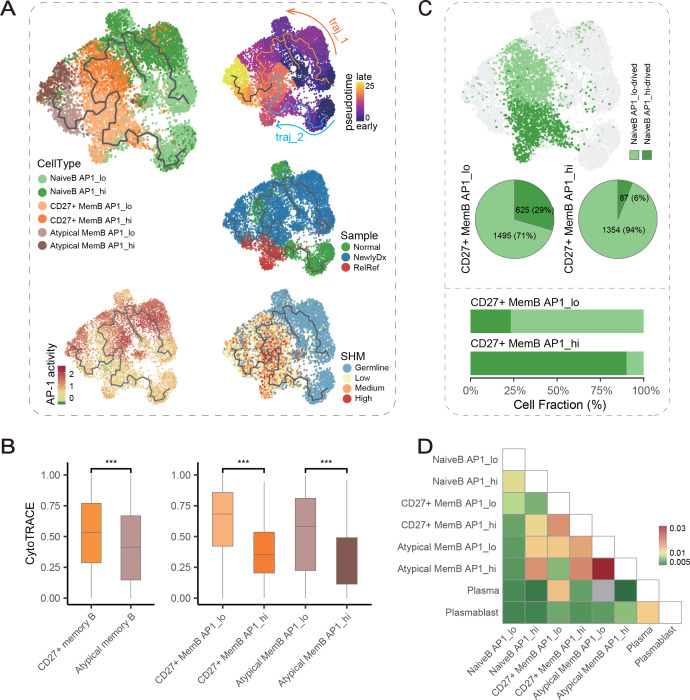
We delineated nine distinct subtypes of B cell lineage in the bone marrow. AML patients exhibited reduced nascent B cell subgroups but increased differentiated B cells compared with healthy controls. The limited diversity of BCR profiles and extensive somatic hypermutation indicated antigen-driven affinity maturation within the tumor microenvironment of RelRef patients. We established a strong connection between the activation or stress status of naïve and memory B cells, as indicated by AP-1 activity, and their differentiation state. Remarkably, atypical memory B cells functioned as specialized antigen-presenting cells closely interacting with AML malignant cells, correlating with AML stemness and worse clinical outcomes. In the AML microenvironment, plasma cells demonstrated advanced differentiation and heightened activity. Notably, the clinical response to ICB was associated with B cell clonal expansion and plasma cell function.
Our findings establish a comprehensive framework for profiling the phenotypic diversity of the B cell lineage in AML patients, while also assessing the implications of immunotherapy. This will serve as a valuable guide for future inquiries into AML treatment strategies.
急性髓系白血病(AML)的预后较差。免疫检查点阻断(ICB)诱导 AML 患者的抗肿瘤活性的效果喜忧参半。尽管 B 细胞在抗肿瘤免疫中起着关键作用,但对 AML 免疫微环境中 B 淋巴细胞的全面评估及其与 ICB 的相互作用仍然相当有限。
我们对 52 例骨髓抽吸样本进行了广泛的单细胞 RNA 和 B 细胞受体(BCR)测序分析。这些样本包括 6 例来自健康骨髓供体(正常)、24 例来自新诊断的 AML 患者(NewlyDx)和 22 例来自 8 例复发或难治性 AML 患者(RelRef),这些患者在接受阿扎胞苷/纳武利尤单抗治疗前后都接受了评估。
我们在骨髓中描绘了九个不同的 B 细胞谱系亚型。AML 患者与健康对照组相比,幼稚 B 细胞亚群减少,但分化的 B 细胞增加。BCR 谱的多样性有限且广泛的体细胞超突变表明,在 RelRef 患者的肿瘤微环境中存在抗原驱动的亲和力成熟。我们建立了幼稚和记忆 B 细胞的激活或应激状态与其分化状态之间的紧密联系,这由 AP-1 活性来指示。值得注意的是,非典型记忆 B 细胞作为与 AML 恶性细胞密切相互作用的专门抗原呈递细胞发挥作用,与 AML 干性和更差的临床结局相关。在 AML 微环境中,浆细胞表现出高度分化和活性增强。值得注意的是,对 ICB 的临床反应与 B 细胞克隆扩增和浆细胞功能相关。
我们的研究结果为 AML 患者 B 细胞谱系表型多样性的分析建立了一个全面的框架,同时评估了免疫治疗的影响。这将为未来 AML 治疗策略的研究提供有价值的指导。