Department of Psychology, Faculty of Arts, School of Arts, The University of Jordan, Amman, Jordan.
School of Health Sciences, Faculty of Biology Medicine and Health, The University of Manchester, Manchester, UK.
Exp Brain Res. 2024 Apr;242(4):843-855. doi: 10.1007/s00221-024-06789-9. Epub 2024 Feb 29.
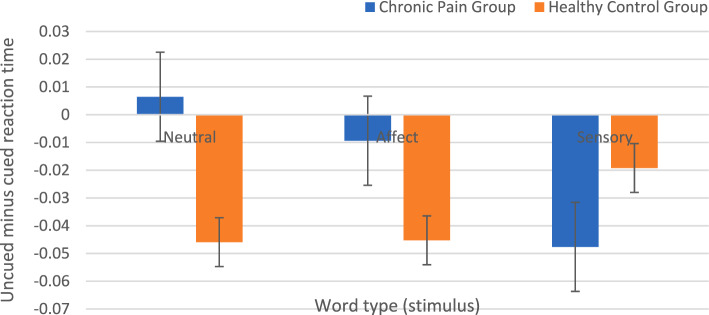
There is some evidence for attentional biases in individuals with chronic pain (CP). Cultural and linguistic differences might affect the manifestation of these processes across populations. However, such attentional biases have not been explored in the Arabic-speaking population. The current study investigated these attentional biases and possible associations with resilience. Two matched groups of Arabic-speaking participants with (58) and without (58) CP were recruited from Jordan and the United Kingdom. They completed emotionally modified versions of the Posner cueing and Stroop tasks, alongside questionnaires. Significant group differences were found for the Posner task, with the CP group exhibiting disengagement revealed by the inhibition of return (IOR) effect for sensory pain-related cues compared to delayed disengagement for the other cue types. The control group showed IOR across cue types. No group differences were found on the Stroop task. The CP group had lower resilience scores than healthy controls, and resilience moderated performance on the Posner task. The study provides preliminary evidence about the attentional processes in the Arabic population; the speed of disengagement is affected in the CP group with early disengagement for sensory pain-related information compared to affect pain and neutral stimuli. Furthermore, resilience levels in the CP and control group moderated the performance on the Posner task, suggesting that it influences attentional allocation. This study can help in understanding how the phenomenon of attention bias intertwines with the cultural and linguistic factors. Future research should further explore attentional dynamics across different time points in this population and the modulatory effect of resilience.
有一些证据表明,慢性疼痛(CP)患者存在注意力偏向。文化和语言差异可能会影响这些过程在不同人群中的表现。然而,在讲阿拉伯语的人群中,尚未探索过这些注意力偏向。本研究调查了这些注意力偏向,以及它们与韧性之间的可能关联。从约旦和英国招募了两组匹配的阿拉伯语母语的 CP 患者(58 名)和非 CP 患者(58 名)。他们完成了情绪修饰后的 Posner 线索和 Stroop 任务以及问卷调查。Posner 任务存在显著的组间差异,CP 组与其他线索类型相比,对感觉相关疼痛线索表现出抑制返回(IOR)效应的脱钩,而其他线索类型则表现出延迟脱钩。对照组在所有线索类型上均表现出 IOR。在 Stroop 任务上未发现组间差异。CP 组的韧性评分低于健康对照组,且韧性适度影响 Posner 任务的表现。该研究提供了有关阿拉伯语人群注意力过程的初步证据;与影响疼痛和中性刺激相比,CP 组对感觉相关疼痛信息的脱钩速度更快。此外,CP 组和对照组的韧性水平适度影响了 Posner 任务的表现,表明它影响了注意力分配。这项研究有助于理解注意力偏向现象如何与文化和语言因素交织在一起。未来的研究应该进一步探讨该人群中不同时间点的注意力动态以及韧性的调节作用。