van Haren Juliette S, Delbressine Frank L M, Schoberer Mark, Te Pas Arjan B, van Laar Judith O E H, Oei S Guid, van der Hout-van der Jagt M Beatrijs
Department of Industrial Design, Eindhoven University of Technology, Eindhoven, Netherlands.
Obstetrics and Gynaecology, Máxima Medical Centre, Veldhoven, Netherlands.
Front Pediatr. 2024 Feb 15;12:1360111. doi: 10.3389/fped.2024.1360111. eCollection 2024.
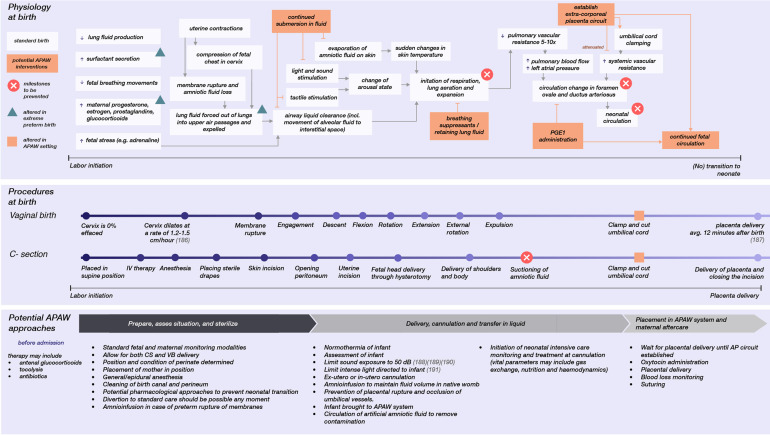
To improve care for extremely premature infants, the development of an extrauterine environment for newborn development is being researched, known as Artificial Placenta and Artificial Womb (APAW) technology. APAW facilitates extended development in a liquid-filled incubator with oxygen and nutrient supply through an oxygenator connected to the umbilical vessels. This setup is intended to provide the optimal environment for further development, allowing further lung maturation by delaying gas exposure to oxygen. This innovative treatment necessitates interventions in obstetric procedures to transfer an infant from the native to an artificial womb, while preventing fetal-to-neonatal transition. In this narrative review we analyze relevant fetal physiology literature, provide an overview of insights from APAW studies, and identify considerations for the obstetric procedure from the native uterus to an APAW system. Lastly, this review provides suggestions to improve sterility, fetal and maternal well-being, and the prevention of neonatal transition.
为改善对极早产儿的护理,一种用于新生儿发育的宫外环境正在研究中,即人工胎盘和人工子宫(APAW)技术。APAW通过连接到脐血管的氧合器在充满液体的培养箱中促进延长发育,并提供氧气和营养供应。这种设置旨在为进一步发育提供最佳环境,通过延迟气体暴露于氧气来促进肺部进一步成熟。这种创新治疗需要在产科手术中进行干预,将婴儿从母体转移到人工子宫,同时防止胎儿向新生儿的过渡。在这篇叙述性综述中,我们分析了相关的胎儿生理学文献,概述了APAW研究的见解,并确定了从母体子宫到APAW系统的产科手术的注意事项。最后,本综述提供了改善无菌状态、胎儿和产妇健康以及预防新生儿过渡的建议。