Hossain Kamal, Roy Choudhury Angshuman, Majumdar Amit
School of Chemical Sciences, Indian Association for the Cultivation of Science, 2A & 2B Raja S. C. Mullick Road, Jadavpur, Kolkata, West Bengal 700032, India.
Department of Chemical Sciences, Indian Institute of Science Education and Research, Mohali, Knowledge City, Sector 81, S. A. S. Nagar, Manauli P.O., Mohali, Punjab 140306, India.
JACS Au. 2024 Feb 7;4(2):771-787. doi: 10.1021/jacsau.3c00790. eCollection 2024 Feb 26.
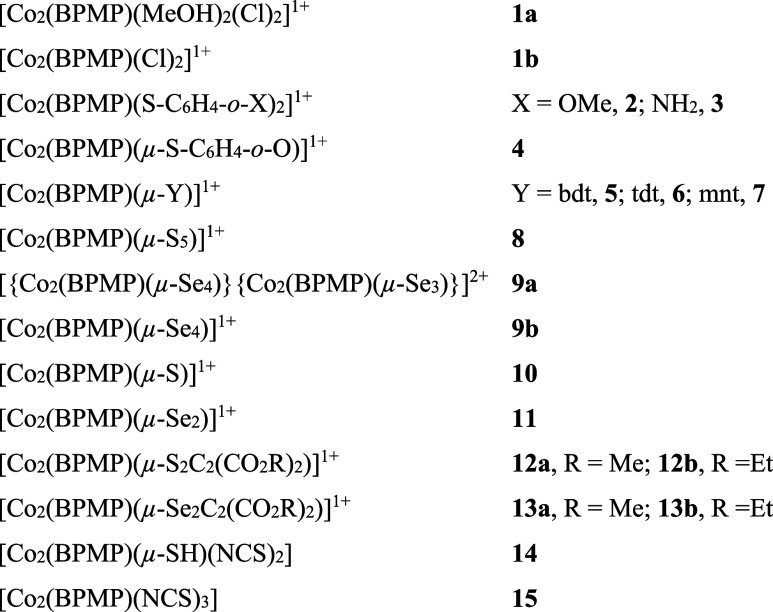
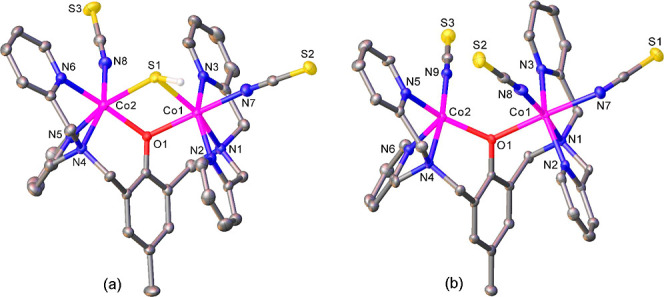
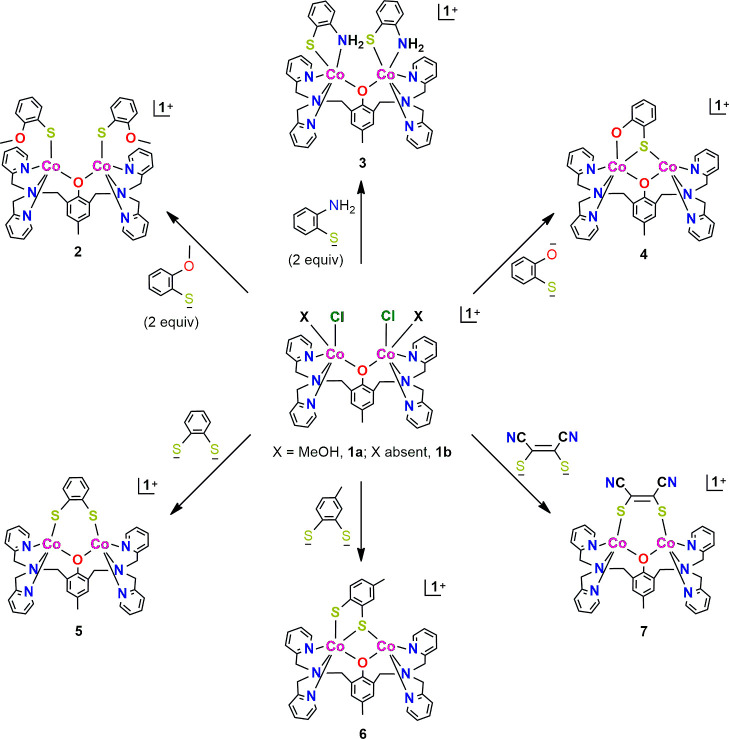
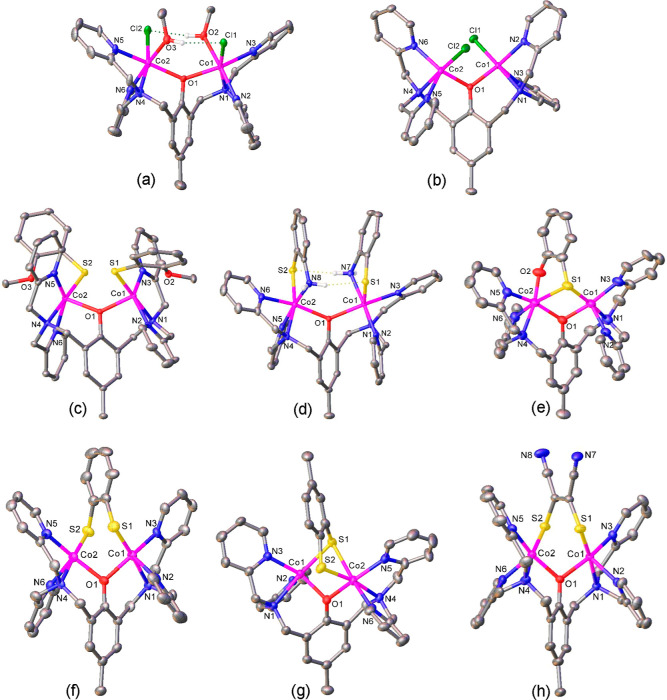
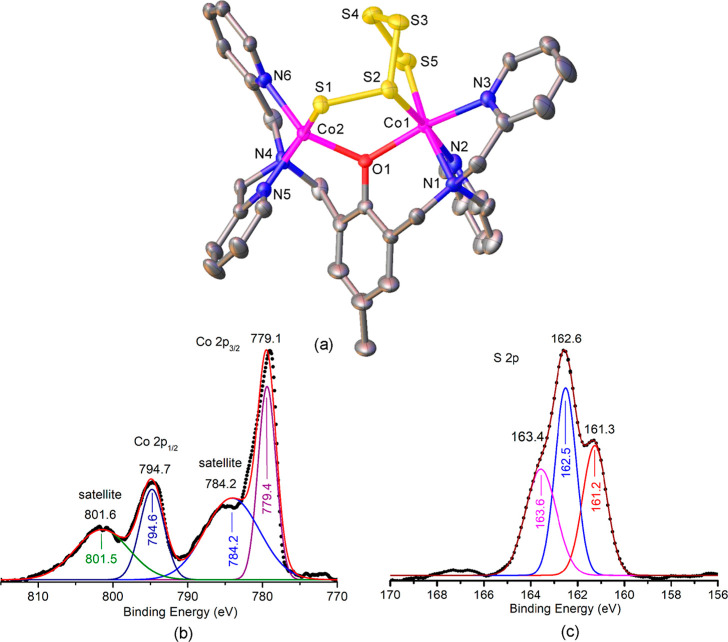
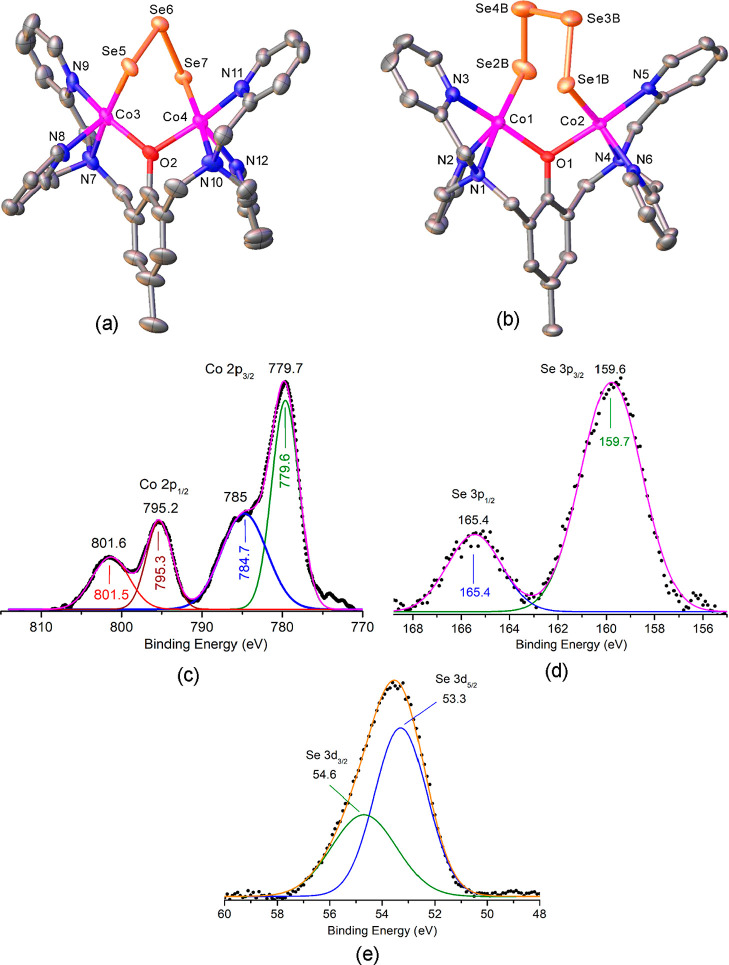
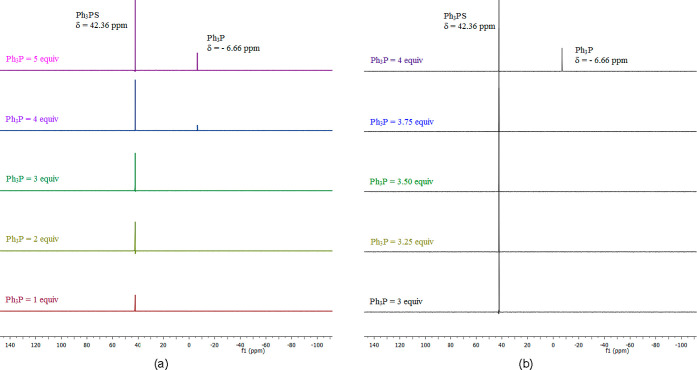
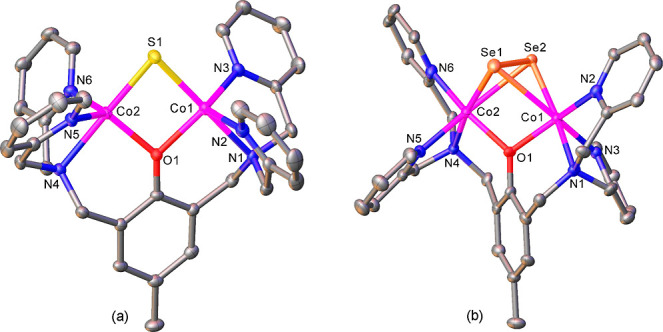
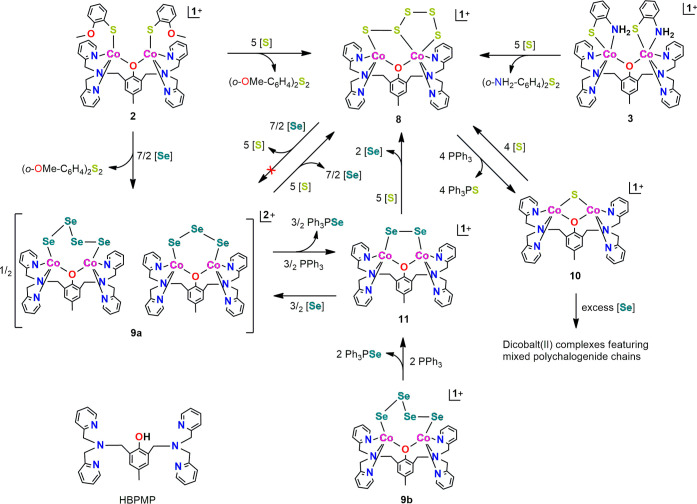
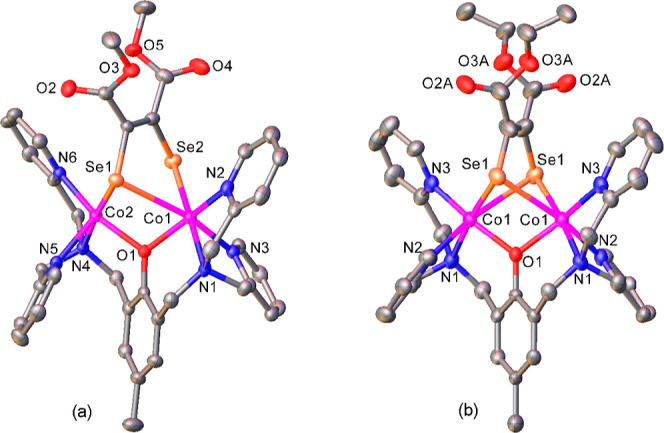
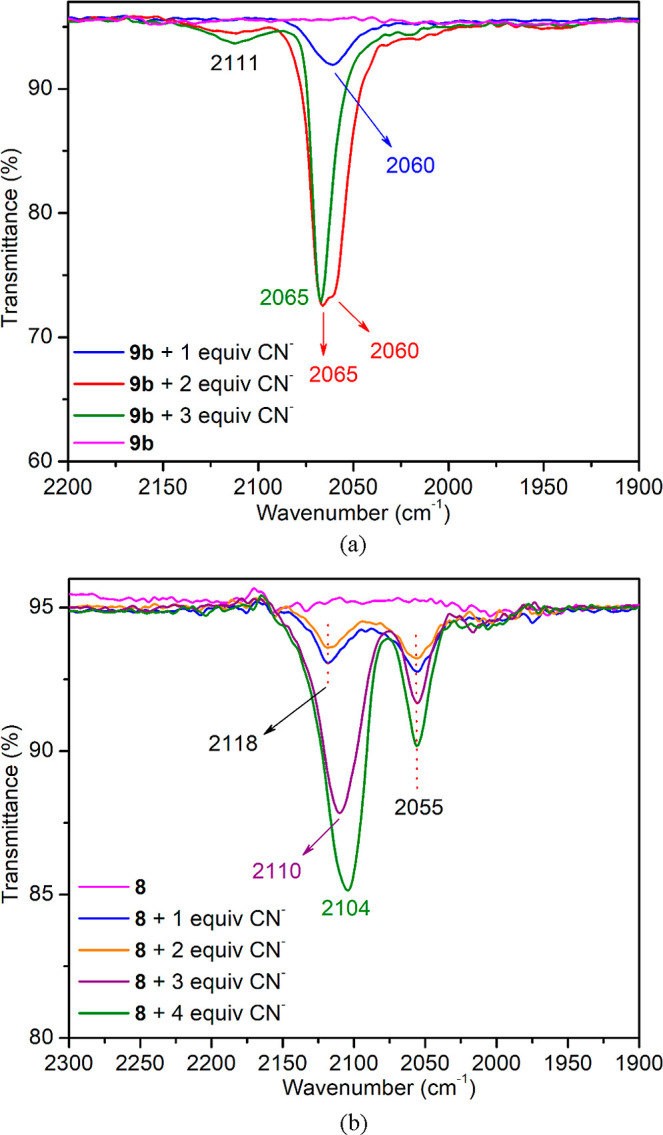
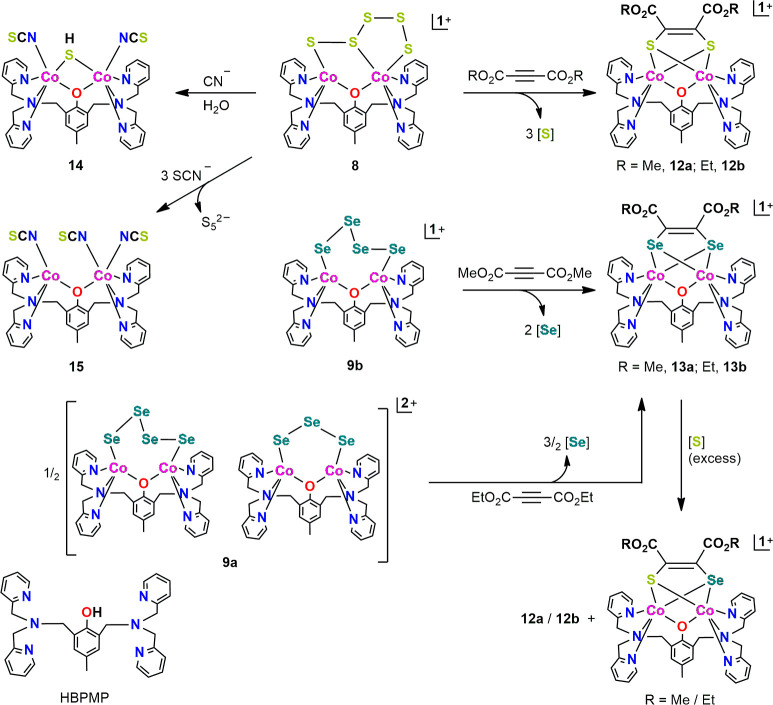
A series of six binuclear Co(II)-thiolate complexes, [Co(BPMP)(S-CH--X)] (X = OMe, ; NH, ), [Co(BPMP)(μ-S-CH--O)] (), and [Co(BPMP)(μ-Y)] (Y = bdt, ; tdt, ; mnt, ), has been synthesized from [Co(BPMP)(MeOH)(Cl)] () and [Co(BPMP)(Cl)] (), where BPMP is the anion of 2,6-bis[[bis(2-pyridylmethyl)amino]methyl]-4-methylphenol. While and could allow the two-electron redox reaction of the two coordinated thiolates with elemental sulfur (S) to generate [Co(BPMP)(μ-S)] (), the complexes, , could not undergo a similar reaction. An analogous redox reaction of with elemental selenium ([Se]) produced [{Co(BPMP)(μ-Se)}{Co(BPMP)(μ-Se)}] () and [Co(BPMP)(μ-Se)] (). Further reaction of these polychalcogenido complexes, and /, with PPh allowed the isolation of [Co(BPMP)(μ-S)] () and [Co(BPMP)(μ-Se)] (), which, in turn, could be converted back to and upon treatment with S and [Se], respectively. Interestingly, while the redox reaction of the polyselenide chains in and with S produced and [Se], the treatment of with [Se] gave back only the starting material (), thus demonstrating the different redox behavior of sulfur and selenium. Furthermore, the reaction of and / with activated alkynes and cyanide (CN) allowed the isolation of the complexes, [Co(BPMP)(μ-EC(COR))] (E = S: , R = Me; , R = Et; E = Se: , R = Me; , R = Et) and [Co(BPMP)(μ-SH)(NCS)] (), respectively. The present work, thus, provides an interesting synthetic strategy, interconversions, and detailed comparative reactivity of binuclear Co(II)-polychalcogenido complexes.
一系列六种双核钴(II)硫醇盐配合物,[Co(BPMP)(S-CH--X)](X = OMe, ;NH, ),[Co(BPMP)(μ-S-CH--O)]( ),以及[Co(BPMP)(μ-Y)](Y = bdt, ;tdt, ;mnt, ),由[Co(BPMP)(MeOH)(Cl)]( )和[Co(BPMP)(Cl)]( )合成,其中BPMP是2,6-双[[双(2-吡啶甲基)氨基]甲基]-4-甲基苯酚的阴离子。虽然 和 能使两个配位硫醇盐与元素硫(S)发生双电子氧化还原反应生成[Co(BPMP)(μ-S)]( ),但配合物 、 不能发生类似反应。 与元素硒([Se])的类似氧化还原反应生成了[{Co(BPMP)(μ-Se)}{Co(BPMP)(μ-Se)}]( )和[Co(BPMP)(μ-Se)]( )。这些多硫属元素配合物 、 与PPh进一步反应,分离得到了[Co(BPMP)(μ-S)]( )和[Co(BPMP)(μ-Se)]( ),反过来,用S和[Se]处理时,它们又可分别转化回 和 。有趣的是,虽然 和 中多硒链与S的氧化还原反应生成了 和[Se],但用[Se]处理 仅得到起始原料( ),从而证明了硫和硒不同的氧化还原行为。此外, 和 与活性炔烃和氰化物(CN)反应,分别分离得到了配合物[Co(BPMP)(μ-EC(COR))](E = S: ,R = Me; ,R = Et;E = Se: ,R = Me; ,R = Et)和[Co(BPMP)(μ-SH)(NCS)]( )。因此,本工作提供了一种有趣的合成策略、双核钴(II)多硫属元素配合物的相互转化以及详细的比较反应活性。