
时间分辨的 P2X4 和 P2X7 在 CD8 T 细胞激活中的作用。
Time-resolved role of P2X4 and P2X7 during CD8 T cell activation.
机构信息
The Calcium Signalling Group, Department of Biochemistry and Molecular Cell Biology, University Medical Centre Hamburg-Eppendorf, Hamburg, Germany.
Department of Immunology, University Medical Centre Hamburg-Eppendorf, Hamburg, Germany.
出版信息
Front Immunol. 2024 Feb 15;15:1258119. doi: 10.3389/fimmu.2024.1258119. eCollection 2024.
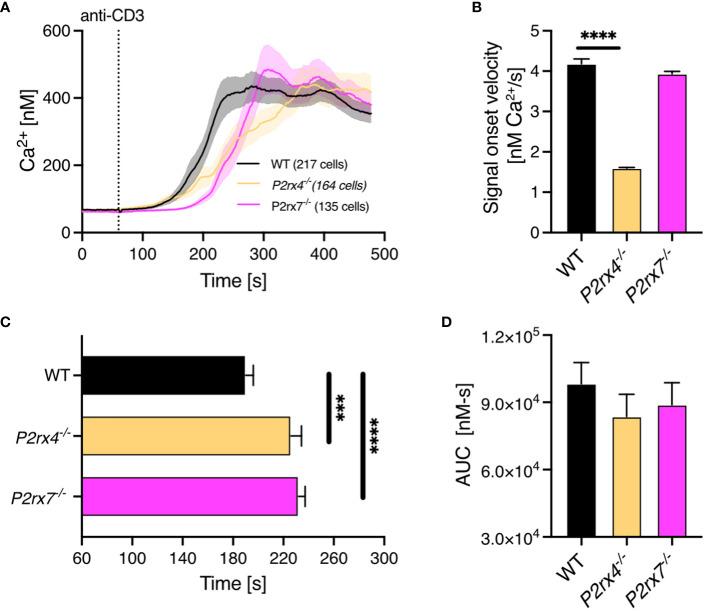
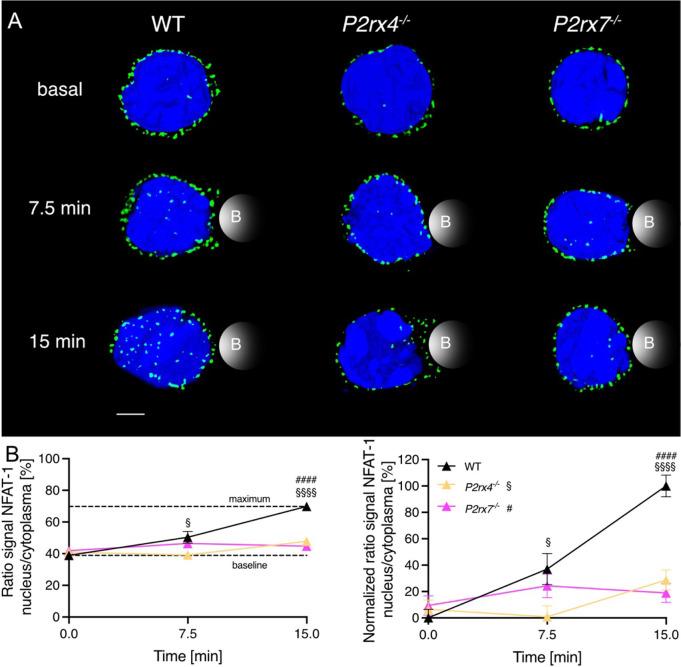
CD8 T cells are a crucial part of the adaptive immune system, responsible for combating intracellular pathogens and tumor cells. The initial activation of T cells involves the formation of highly dynamic Ca microdomains. Recently, purinergic signaling was shown to be involved in the formation of the initial Ca microdomains in CD4 T cells. In this study, the role of purinergic cation channels, particularly P2X4 and P2X7, in CD8 T cell signaling from initial events to downstream responses was investigated, focusing on various aspects of T cell activation, including Ca microdomains, global Ca responses, NFAT-1 translocation, cytokine expression, and proliferation. While Ca microdomain formation was significantly reduced in the first milliseconds to seconds in CD8 T cells lacking P2X4 and P2X7 channels, global Ca responses over minutes were comparable between wild-type (WT) and knockout cells. However, the onset velocity was reduced in P2X4-deficient cells, and P2X4, as well as P2X7-deficient cells, exhibited a delayed response to reach a certain level of free cytosolic Ca concentration ([Ca]). NFAT-1 translocation, a crucial transcription factor in T cell activation, was also impaired in CD8 T cells lacking P2X4 and P2X7. In addition, the expression of IFN-γ, a major pro-inflammatory cytokine produced by activated CD8 T cells, and Nur77, a negative regulator of T cell activation, was significantly reduced 18h post-stimulation in the knockout cells. In line, the proliferation of T cells after 3 days was also impaired in the absence of P2X4 and P2X7 channels. In summary, the study demonstrates that purinergic signaling through P2X4 and P2X7 enhances initial Ca events during CD8 T cell activation and plays a crucial role in regulating downstream responses, including NFAT-1 translocation, cytokine expression, and proliferation on multiple timescales. These findings suggest that targeting purinergic signaling pathways may offer potential therapeutic interventions.
CD8 T 细胞是适应性免疫系统的关键部分,负责对抗细胞内病原体和肿瘤细胞。T 细胞的初始激活涉及高度动态的 Ca 微域的形成。最近,嘌呤能信号转导被证明参与了 CD4 T 细胞初始 Ca 微域的形成。在这项研究中,研究了嘌呤能阳离子通道(特别是 P2X4 和 P2X7)在 CD8 T 细胞信号转导中的作用,从初始事件到下游反应,重点关注 T 细胞激活的各个方面,包括 Ca 微域、全局 Ca 反应、NFAT-1 易位、细胞因子表达和增殖。虽然在缺乏 P2X4 和 P2X7 通道的 CD8 T 细胞中,Ca 微域的形成在最初的几毫秒到几秒钟内显著减少,但在野生型(WT)和敲除细胞之间,分钟级别的全局 Ca 反应是可比的。然而,在 P2X4 缺陷细胞中,起始速度降低,并且 P2X4 和 P2X7 缺陷细胞在达到一定水平的游离细胞溶质 Ca 浓度 ([Ca]) 时反应延迟。NFAT-1 易位是 T 细胞激活中的关键转录因子,在缺乏 P2X4 和 P2X7 的 CD8 T 细胞中也受到损害。此外,在刺激后 18 小时,IFN-γ(一种由激活的 CD8 T 细胞产生的主要促炎细胞因子)和 Nur77(一种 T 细胞激活的负调节剂)的表达在敲除细胞中显著降低。相应地,在缺乏 P2X4 和 P2X7 通道的情况下,T 细胞在 3 天后的增殖也受到损害。总之,该研究表明,嘌呤能信号通过 P2X4 和 P2X7 增强了 CD8 T 细胞激活过程中的初始 Ca 事件,并在调节下游反应方面发挥了关键作用,包括 NFAT-1 易位、细胞因子表达和增殖,作用于多个时间尺度。这些发现表明,靶向嘌呤能信号通路可能提供潜在的治疗干预措施。



 Zotero 插件