Department of Respiratory Medicine, Graduate School of Biomedical Sciences, Nagasaki University, Nagasaki, Japan.
Department of Respiratory Medicine, Nagasaki University Hospital, Nagasaki, Japan.
Microbiol Spectr. 2024 Apr 2;12(4):e0361423. doi: 10.1128/spectrum.03614-23. Epub 2024 Mar 1.
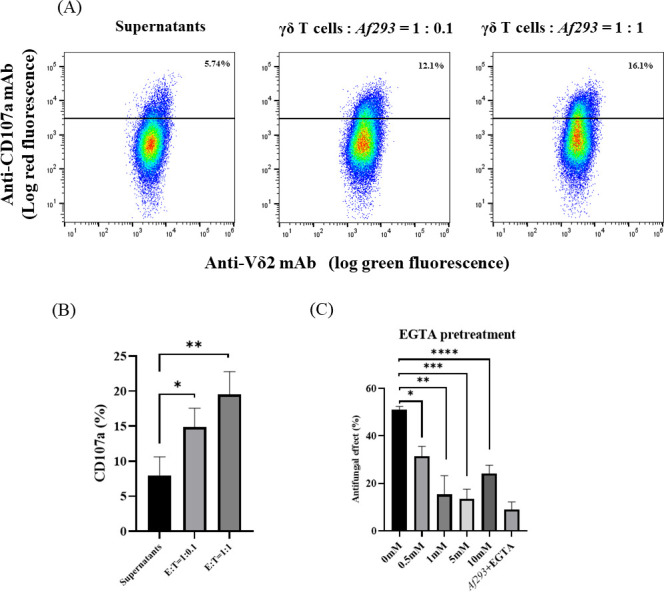
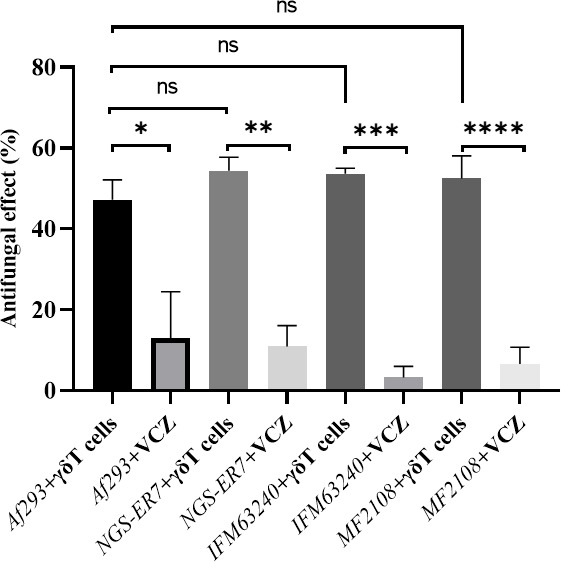
Invasive aspergillosis (IA) and mucormycosis are life-threatening diseases, especially among immunocompromised patients. Drug-resistant strains have been isolated worldwide, which can pose a serious clinical problem. As IA mainly occurs in patients with compromised immune systems, the ideal therapeutic approach should aim to bolster the immune system. In this study, we focused on Vγ9Vδ2 T cells that exhibit immune effector functions and examined the possibility of harnessing this unconventional T cell subset as a novel therapeutic modality for IA. A potent antifungal effect was observed when () hyphae were challenged by Vγ9Vδ2 T cells derived from peripheral blood. In addition, Vγ9Vδ2 T cells exhibited antifungal activity against hyphae of all spp., , and but not against their conidia. Furthermore, Vγ9Vδ2 T cells also exhibited antifungal activity against azole-resistant , indicating that Vγ9Vδ2 T cells could be used for treating drug-resistant . The antifungal activity of Vγ9Vδ2 T cells depended on cell-to-cell contact with hyphae, and degranulation characterized by CD107a mobilization seems essential for this activity against . Vγ9Vδ2 T cells could be developed as a novel modality for treating IA or mucormycosis.
Invasive aspergillosis (IA) and mucormycosis are often resistant to treatment with conventional antifungal agents and have a high mortality rate. Additionally, effective antifungal treatment is hindered by drug toxicity, given that both fungal and human cells are eukaryotic, and antifungal agents are also likely to act on human cells, resulting in adverse effects. Therefore, the development of novel therapeutic agents specifically targeting fungi is challenging. This study demonstrated the antifungal activity of Vγ9Vδ2 T cells against various spp. and several and discussed the mechanism underlying their antifungal activity. We indicate that adoptive immunotherapy using Vγ9Vδ2 T cells may offer a new therapeutic approach to IA.
侵袭性曲霉病(IA)和毛霉病是危及生命的疾病,尤其是在免疫功能低下的患者中。在世界各地已经分离出耐药菌株,这可能会造成严重的临床问题。由于 IA 主要发生在免疫系统受损的患者中,因此理想的治疗方法应该旨在增强免疫系统。在这项研究中,我们专注于具有免疫效应功能的 Vγ9Vδ2 T 细胞,并研究了利用这种非常规 T 细胞亚群作为治疗 IA 的新方法的可能性。当来自外周血的 Vγ9Vδ2 T 细胞受到挑战时,观察到对()菌丝具有强大的抗真菌作用。此外,Vγ9Vδ2 T 细胞对所有 spp.、、和的菌丝具有抗真菌活性,但对其孢子没有活性。此外,Vγ9Vδ2 T 细胞还对唑类耐药的具有抗真菌活性,表明 Vγ9Vδ2 T 细胞可用于治疗耐药。Vγ9Vδ2 T 细胞的抗真菌活性取决于与菌丝的细胞间接触,并且脱颗粒作用(以 CD107a 动员为特征)对于针对的这种活性似乎是必需的。Vγ9Vδ2 T 细胞可以开发为治疗 IA 或毛霉病的新方法。
侵袭性曲霉病(IA)和毛霉病通常对常规抗真菌药物治疗具有抗性,死亡率很高。此外,由于真菌和人类细胞都是真核细胞,并且抗真菌药物也可能作用于人类细胞,从而导致不良反应,因此有效的抗真菌治疗受到限制。因此,开发专门针对真菌的新型治疗剂具有挑战性。这项研究证明了 Vγ9Vδ2 T 细胞对各种 spp. 和几种和的抗真菌活性,并讨论了其抗真菌活性的机制。我们表明,使用 Vγ9Vδ2 T 细胞的过继免疫疗法可能为 IA 提供一种新的治疗方法。