Department of Biology, University of Oxford, 11a Mansfield Road, Oxford OX1 3SZ, UK; Division of Infectious Diseases, Emory University School of Medicine, 1760 Haygood Drive, Atlanta, GA 30322, USA.
Division of Infectious Diseases, Emory University School of Medicine, 1760 Haygood Drive, Atlanta, GA 30322, USA.
Curr Biol. 2024 Mar 25;34(6):1357-1363.e3. doi: 10.1016/j.cub.2024.02.015. Epub 2024 Mar 1.
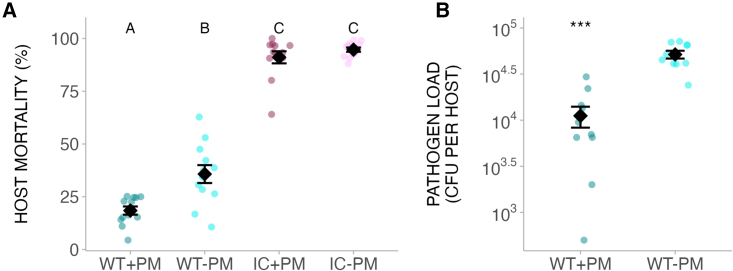
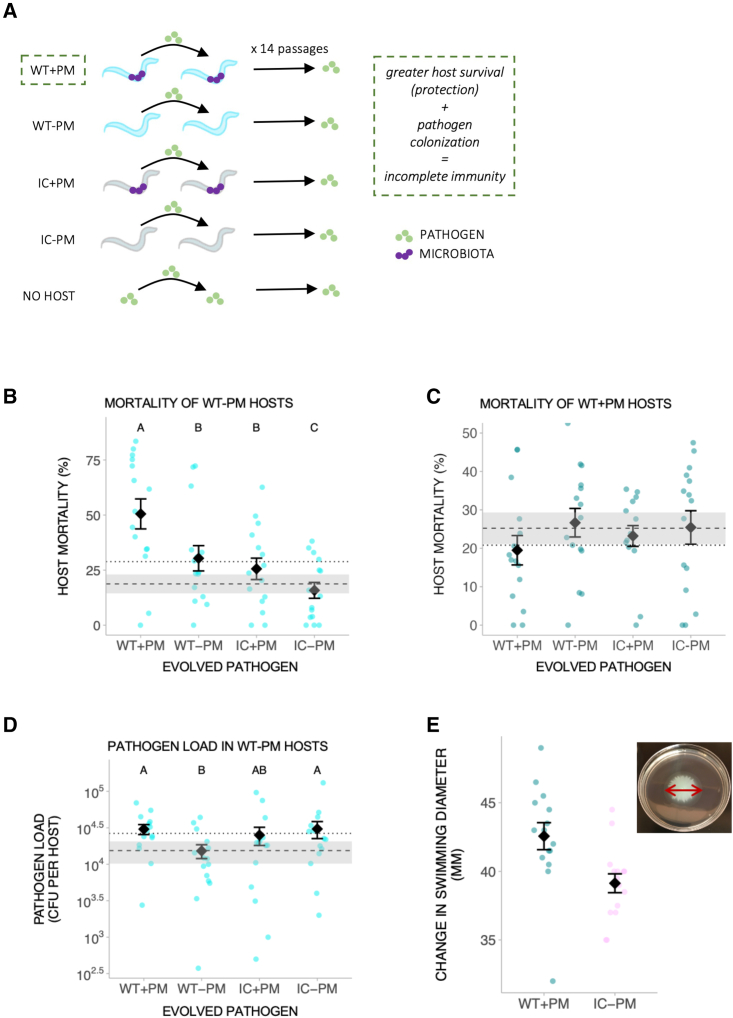
Incomplete immunity in recovered hosts is predicted to favor more virulent pathogens upon re-infection in the population. The microbiota colonizing animals can generate a similarly long-lasting, partial immune response, allowing for infection but dampened disease severity. We tracked the evolutionary trajectories of a widespread pathogen (Pseudomonas aeruginosa), experimentally passaged through populations of nematodes immune-primed by a natural microbiota member (P. berkeleyensis). This bacterium can induce genes regulated by a mitogen-activated protein kinase (MAPK) signaling pathway effective at conferring protection against pathogen-induced death despite infection. Across host populations, this incomplete immunity selected for pathogens more than twice as likely to kill as those evolved in non-primed (i.e., naive) or immune-compromised (mutants with a knockout of the MAPK ortholog) control populations. Despite the higher virulence, pathogen molecular evolution in immune-primed hosts was slow and constrained. In comparison, evolving pathogens in immune-compromised hosts were characterized by substantial genomic differentiation and attenuated virulence. These findings directly attribute the incomplete host immunity induced from microbiota as a significant force shaping the virulence and evolutionary dynamics of novel infectious diseases.
在已康复的宿主中,不完全免疫预计会导致再次感染时人群中出现更具毒性的病原体。定植在动物体内的微生物群落可以产生类似的持久、部分免疫反应,从而允许感染,但减轻疾病严重程度。我们跟踪了一种广泛存在的病原体(铜绿假单胞菌)的进化轨迹,该病原体通过受一种天然微生物群落成员(P. berkeleyensis)免疫刺激的线虫群体进行了实验传代。这种细菌可以诱导丝裂原激活的蛋白激酶(MAPK)信号通路调控的基因,尽管感染了,但对病原体诱导的死亡有有效的保护作用。在宿主群体中,这种不完全免疫选择了比在未免疫(即未受刺激)或免疫受损(MAPK 同源物敲除突变体)对照组中进化的病原体更有可能杀死宿主的病原体的可能性要高出两倍以上。尽管毒力更高,但免疫刺激宿主中的病原体分子进化速度较慢且受到限制。相比之下,在免疫受损宿主中进化的病原体具有显著的基因组分化和减弱的毒力。这些发现直接将由微生物群落诱导的不完全宿主免疫归因于塑造新传染病的毒力和进化动态的重要力量。