Population Health and Immunity Division, The Walter and Eliza Hall Institute of Medical Research, Melbourne, VIC, Australia; Methods and Implementation Support for Clinical and Health research Hub, Faculty of Medicine, Dentistry and Health Sciences, The University of Melbourne, Melbourne, VIC, Australia.
Population Health and Immunity Division, The Walter and Eliza Hall Institute of Medical Research, Melbourne, VIC, Australia; Medical Biology, Faculty of Medicine, Dentistry and Health Sciences, The University of Melbourne, Melbourne, VIC, Australia; Clinical Haematology, The Austin Hospital, Heidelberg, VIC, Australia.
Lancet Haematol. 2024 Apr;11(4):e253-e264. doi: 10.1016/S2352-3026(24)00030-9. Epub 2024 Feb 29.
Detection of anaemia is crucial for clinical medicine and public health. Current WHO anaemia definitions are based on statistical thresholds (fifth centiles) set more than 50 years ago. We sought to establish evidence for the statistical haemoglobin thresholds for anaemia that can be applied globally and inform WHO and clinical guidelines.
In this analysis we identified international data sources from populations in the USA, England, Australia, China, the Netherlands, Canada, Ecuador, and Bangladesh with sufficient clinical and laboratory information collected between 1998 and 2020 to obtain a healthy reference sample. Individuals with clinical or biochemical evidence of a condition that could reduce haemoglobin concentrations were excluded. We estimated haemoglobin thresholds (ie, 5th centiles) for children aged 6-23 months, 24-59 months, 5-11 years, and 12-17 years, and adults aged 18-65 years (including during pregnancy) for individual datasets and pooled across data sources. We also collated findings from three large-scale genetic studies to summarise genetic variants affecting haemoglobin concentrations in different ancestral populations.
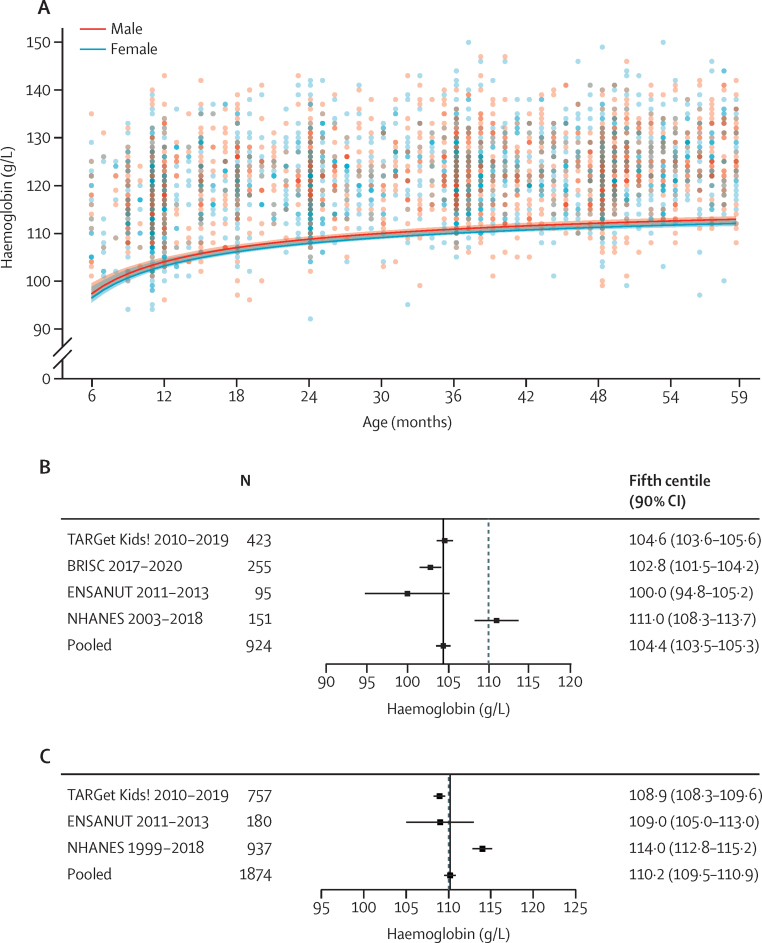
We identified eight data sources comprising 18 individual datasets that were eligible for inclusion in the analysis. In pooled analyses, the haemoglobin fifth centile was 104·4 g/L (90% CI 103·5-105·3) in 924 children aged 6-23 months, 110·2 g/L (109·5-110·9) in 1874 children aged 24-59 months, and 114·4 g/L (113·6-115·2) in 1839 children aged 5-11 years. Values diverged by sex in adolescents and adults. In pooled analyses, the fifth centile was 122·2 g/L (90% CI 121·3-123·1) in 1741 female adolescents aged 12-17 years and 128·2 g/L (126·4-130·0) in 1103 male adolescents aged 12-17 years. In pooled analyses of adults aged 18-65 years, the fifth centile was 119·7 g/L (90% CI 119·1-120·3) in 3640 non-pregnant females and 134·9 g/L (134·2-135·6) in 2377 males. Fifth centiles in pregnancy were 110·3 g/L (90% CI 109·5-111·0) in the first trimester (n=772) and 105·9 g/L (104·0-107·7) in the second trimester (n=111), with insufficient data for analysis in the third trimester. There were insufficient data for adults older than 65 years. We did not identify ancestry-specific high prevalence of non-clinically relevant genetic variants that influence haemoglobin concentrations.
Our results enable global harmonisation of clinical and public health haemoglobin thresholds for diagnosis of anaemia. Haemoglobin thresholds are similar between sexes until adolescence, after which males have higher thresholds than females. We did not find any evidence that thresholds should differ between people of differering ancestries.
World Health Organization and the Bill & Melinda Gates Foundation.
贫血的检测对临床医学和公共卫生至关重要。目前的世界卫生组织贫血定义是基于 50 多年前设定的统计阈值(第五百分位)。我们试图为可以在全球范围内应用的贫血统计血红蛋白阈值建立证据,并为世界卫生组织和临床指南提供信息。
在这项分析中,我们从美国、英国、澳大利亚、中国、荷兰、加拿大、厄瓜多尔和孟加拉国的国际数据来源中确定了足够的临床和实验室信息,这些信息是在 1998 年至 2020 年之间收集的,以获得健康参考样本。排除有临床或生化证据表明存在可能降低血红蛋白浓度的疾病的个体。我们估计了儿童(6-23 个月、24-59 个月、5-11 岁和 12-17 岁)、成年(18-65 岁,包括怀孕期间)的血红蛋白阈值(即第 5 百分位),这些是根据个体数据集进行估计的,并根据数据源进行了汇总。我们还整理了三项大型遗传研究的结果,以总结不同祖先人群中影响血红蛋白浓度的遗传变异。
我们确定了八项符合纳入分析条件的数据源,其中包括 18 个独立数据集。在汇总分析中,924 名 6-23 个月大的儿童的血红蛋白第 5 百分位为 104.4g/L(90%CI 103.5-105.3),1874 名 24-59 个月大的儿童为 110.2g/L(109.5-110.9),1839 名 5-11 岁的儿童为 114.4g/L(113.6-115.2)。在青少年和成年人中,性别差异较大。在汇总分析中,1741 名 12-17 岁的女性青少年第 5 百分位为 122.2g/L(90%CI 121.3-123.1),1103 名 12-17 岁的男性青少年为 128.2g/L(126.4-130.0)。在 18-65 岁的成年人群中,非怀孕女性的第 5 百分位为 119.7g/L(90%CI 119.1-120.3),男性为 134.9g/L(134.2-135.6)。在妊娠早期(n=772)和妊娠中期(n=111),第 5 百分位分别为 110.3g/L(90%CI 109.5-111.0)和 105.9g/L(104.0-107.7),但在妊娠晚期的数据不足。我们没有发现任何证据表明年龄在 65 岁以上的成年人的血红蛋白阈值存在种族特异性差异。
我们的结果使临床和公共卫生贫血诊断的血红蛋白阈值在全球范围内实现了统一。在青春期之前,男女之间的血红蛋白阈值相似,之后男性的血红蛋白阈值高于女性。我们没有发现任何证据表明不同种族之间的阈值应该有所不同。
世界卫生组织和比尔及梅琳达·盖茨基金会。