Chen Feifei, Zhang Chong, Hu Yaping
Department of Obstetrics, Maternal and Child Health Hospital of Hubei Province, Tongji Medical College, Huazhong University of Science and Technology, Wuhan, Hubei, China (mainland).
Med Sci Monit. 2024 Mar 4;30:e943072. doi: 10.12659/MSM.943072.
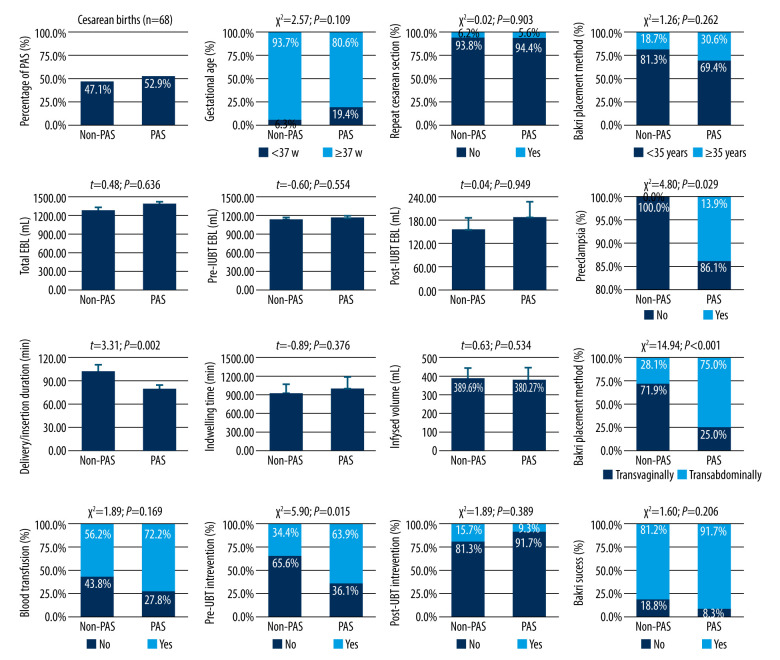
BACKGROUND The incidence of placenta accreta spectrum disorder (PAS) has been increasing in past decades, and women with PAS are a high-risk maternal population. This study aimed to explore the performance of Bakri intrauterine balloon tamponade (IUBT) in the treatment of postpartum hemorrhage (PPH), among those with and without PAS. MATERIAL AND METHODS The outcomes of 198 women who underwent treatment for PPH using IUBT were retrospectively analyzed. The demographics and maternal outcomes were analyzed for vaginal and cesarean births, with PAS and without PAS. RESULTS Compared to women with vaginal births (n=130), women who underwent cesarean births (n=68) showed a higher proportion of age ≥35 years (χ²=6.85, P=0.013), multiple births (χ²=13.60, P<0.001), preeclampsia (χ²=9.81, P=0.002), use of transabdominal IUBT (χ²=84.12, P<0.001) and pre-IUBT interventions (χ²=41.61, P<0.001), but had less infused volume of physiological saline (t=6.41, P<0.001). Women with PAS (n=105) showed a higher rate of pre-IUBT intervention (χ²=4.96, P=0.029) and transabdominal IUBT placement (χ²=9.37, P=0.002) than non-PAS women (n=93). The 36 women with PAS (n=36) showed a higher rate of preeclampsia (χ²=4.80, P=0.029), pre-IUBT intervention (χ²=5.90, P=0.015), and transabdominal IUBT placement (χ²=14.94, P<0.001) and a shorter duration from delivery to Bakri insertion (χ²=3.31, P=0.002), than non-PAS women (n=32). CONCLUSIONS PAS was a major cause of PPH at 198 vaginal and cesarean births. An accurate and timely pre-IUBT intervention and Bakri IUBT placement was critical for controlling PPH in cesarean births, especially in women with PAS.
在过去几十年中,胎盘植入谱系障碍(PAS)的发病率一直在上升,患有PAS的女性是高危孕产妇群体。本研究旨在探讨Bakri宫内球囊填塞术(IUBT)在治疗产后出血(PPH)方面,在有和没有PAS的患者中的效果。
回顾性分析了198例接受IUBT治疗PPH的女性的结局。分析了经阴道分娩和剖宫产分娩、有PAS和无PAS患者的人口统计学和孕产妇结局。
与经阴道分娩的女性(n = 130)相比,剖宫产分娩的女性(n = 68)年龄≥35岁的比例更高(χ² = 6.85,P = 0.013)、多胎妊娠比例更高(χ² = 13.60,P < 0.001)、子痫前期比例更高(χ² = 9.81,P = 0.002)、使用经腹IUBT的比例更高(χ² = 84.12,P < 0.001)以及IUBT前干预比例更高(χ² = 41.61,P < 0.001),但生理盐水输注量更少(t = 6.41,P < 0.001)。与无PAS的女性(n = 93)相比,有PAS的女性(n = 105)IUBT前干预率(χ² = 4.96,P = 0.029)和经腹IUBT放置率(χ² = 9.37,P = 0.002)更高。36例有PAS的女性(n = 36)子痫前期发生率(χ² = 4.80,P = 0.029)、IUBT前干预率(χ² = 5.90,P = 0.015)和经腹IUBT放置率(χ² = 14.94,P < 0.001)更高,且从分娩到插入Bakri的时间更短(χ² = 3.31,P = 0.002),高于无PAS的女性(n = 32)。
PAS是198例经阴道和剖宫产分娩中PPH的主要原因。准确及时的IUBT前干预和Bakri IUBT放置对于控制剖宫产分娩中的PPH至关重要,尤其是对于有PAS的女性。