Saini Priya, Grover Vishakha, Sood Shaveta, Jain Ashish, Kalra Parveen
Department of Periodontology, Dr. Harvansh Singh Judge Institute of Dental Sciences and Hospital, Panjab University, Chandigarh, India.
Department of Production and Industrial Engineering, Punjab Engineering College, Chandigarh, India.
J Indian Soc Periodontol. 2023 Nov-Dec;27(6):590-599. doi: 10.4103/jisp.jisp_585_22. Epub 2024 Jan 24.
The aim of this study was to evaluate and compare the stress distribution patterns in immediately placed and loaded conventional and customized three-dimensional (3D) printed dental implants by 3D finite element analysis.
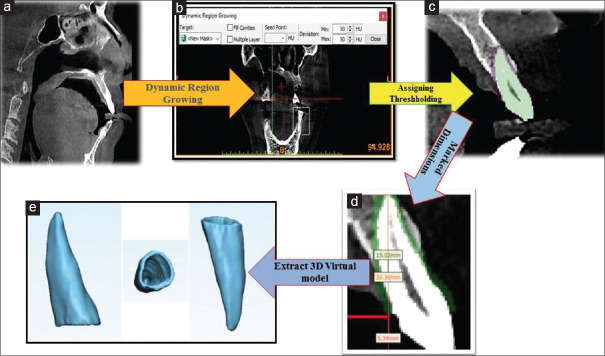
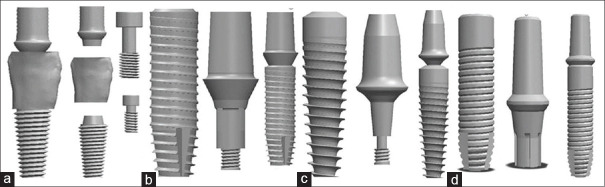
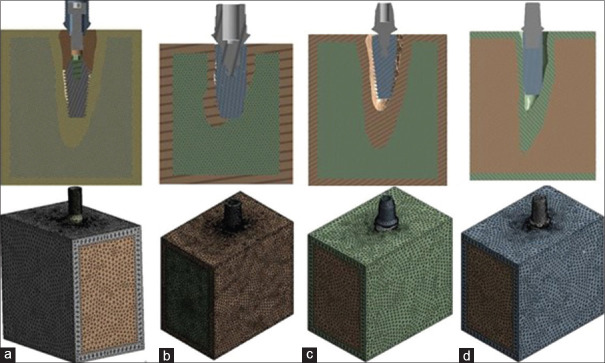
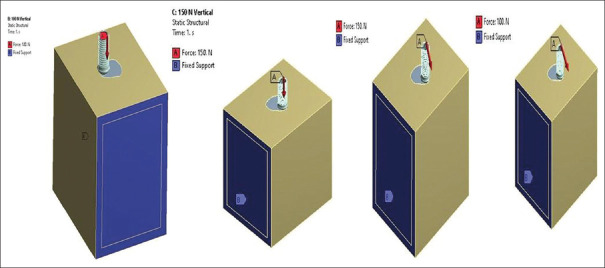
Twelve 3D finite element models [Group A-3 models; Group B-9 models] with 72 test conditions which were modeled and compared from customized 3D printed dental implants [Group A] and 3 commercially available implant systems [Group B] (Straumann, Ankylos, and Astratech) using "SolidWorks". All models were embedded in extraction socket models of the maxillary central incisor (CI) and Canine (C), Mandibular 1 Premolar. An occlusal loading by axial and nonaxial force of 100 N and 150 N at 30° and 45° was applied on the abutment using the "ANSYS" Suite. Customized 3D printed dental implant (Group A) for maxilla (Max.) CI, Max. C, and mandibular 1 premolar (PM) socket model was compared with three commercial available dental implant systems (Group B) for Max. CI, Max. C, and mandible (Mand.) 1 PM socket model to understand the stress distribution patterns.
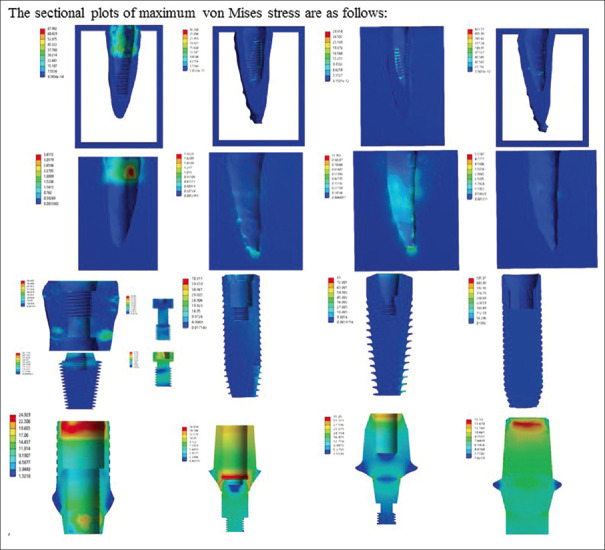
With increasing oblique loads, von Mises stresses were reduced for the customized group as compared to conventional implants. Increased axial loads caused proportionate increase in the stresses for both groups, yet remained under the physiologic limits in all test conditions. Higher stresses were observed in cortical bone than in cancellous bone at bone-implant contact in general. Marked reduction in von Mises stress was observed at the boundary between compact and cancellous bone. Customized 3D printed implants performed better for oblique loads and comparable for axial load stress distribution in comparison to conventional implant systems in Max. CI and C, Mand. 1 PM.
Thus, customized 3D printed implants appear a promising alternative for immediately placed immediately loaded protocols, with additional benefits in specific clinical situations.
本研究旨在通过三维有限元分析评估和比较即刻植入并加载的传统型和定制型三维打印牙科种植体的应力分布模式。
使用“SolidWorks”软件构建了12个三维有限元模型[组A - 3个模型;组B - 9个模型],共72种测试条件,这些模型来自定制型三维打印牙科种植体[组A]和3种市售种植系统[组B](士卓曼、安多健和阿斯特拉泰克)并进行比较。所有模型均嵌入上颌中切牙(CI)、尖牙(C)以及下颌第一前磨牙的拔牙窝模型中。使用“ANSYS”软件套件,在基台上施加100 N和150 N的轴向和非轴向力,力的角度分别为30°和45°,以模拟咬合加载。将上颌CI、上颌C和下颌第一前磨牙拔牙窝模型的定制型三维打印牙科种植体(组A)与上颌CI、上颌C和下颌第一前磨牙拔牙窝模型的三种市售牙科种植系统(组B)进行比较,以了解应力分布模式。
随着斜向载荷增加,与传统种植体相比,定制组的冯·米塞斯应力降低。轴向载荷增加导致两组应力成比例增加,但在所有测试条件下均保持在生理极限范围内。一般来说,在骨 - 种植体接触处,皮质骨中的应力高于松质骨。在密质骨和松质骨的边界处观察到冯·米塞斯应力明显降低。与传统种植系统相比,定制型三维打印种植体在斜向载荷下表现更好,在上颌CI、C和下颌第一前磨牙的轴向载荷应力分布方面表现相当。
因此,定制型三维打印种植体对于即刻植入即刻加载方案似乎是一种有前景的替代方案,在特定临床情况下还有额外的优势。