Gonzalez-Aragon Daniel, Rivadeneira Marcelo M, Lara Carlos, Torres Felipe I, Vásquez Julio A, Broitman Bernardo R
Doctorado en Ciencias, mención en Biodiversidad y Biorecursos, Facultad de Ciencias Universidad Católica de la Santísima Concepción Concepcion Chile.
Instituto Milenio en Socio-Ecología Costera (SECOS) Santiago Chile.
Ecol Evol. 2024 Mar 1;14(3):e10901. doi: 10.1002/ece3.10901. eCollection 2024 Mar.
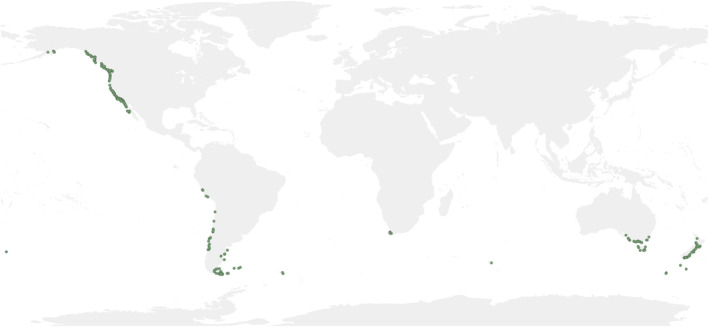
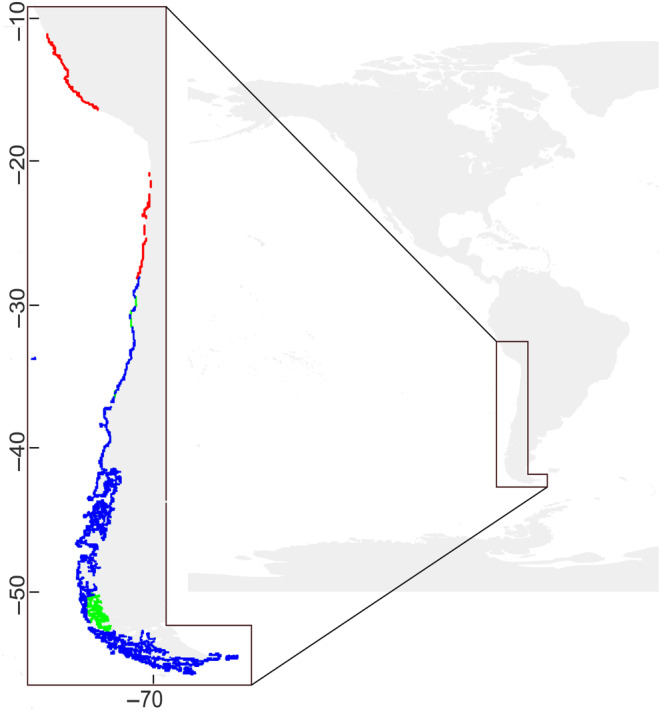
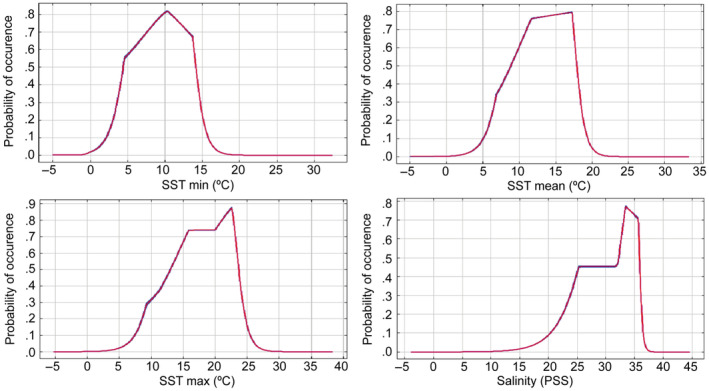
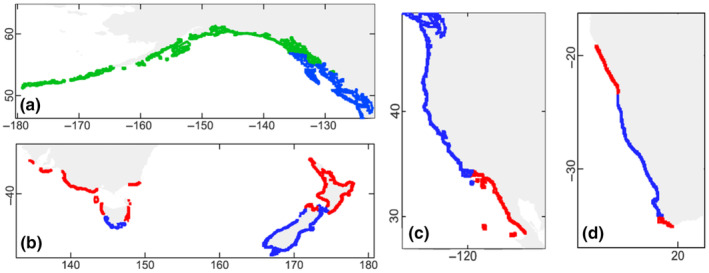
Worldwide climate-driven shifts in the distribution of species is of special concern when it involves habitat-forming species. In the coastal environment, large Laminarian algae-kelps-form key coastal ecosystems that support complex and diverse food webs. Among kelps, is the most widely distributed habitat-forming species and provides essential ecosystem services. This study aimed to establish the main drivers of future distributional changes on a global scale and use them to predict future habitat suitability. Using species distribution models (SDM), we examined the changes in global distribution of . under different emission scenarios with a focus on the Southeast Pacific shores. To constrain the drivers of our simulations to the most important factors controlling kelp forest distribution across spatial scales, we explored a suite of environmental variables and validated the predictions derived from the SDMs. Minimum sea surface temperature was the single most important variable explaining the global distribution of suitable habitat for . . Under different climate change scenarios, we always observed a decrease of suitable habitat at low latitudes, while an increase was detected in other regions, mostly at high latitudes. Along the Southeast Pacific, we observed an upper range contraction of -17.08° S of latitude for 2090-2100 under the RCP8.5 scenario, implying a loss of habitat suitability throughout the coast of Peru and poleward to -27.83° S in Chile. Along the area of Northern Chile where a complete habitat loss is predicted by our model, natural stands are under heavy exploitation. The loss of habitat suitability will take place worldwide: Significant impacts on marine biodiversity and ecosystem functioning are likely. Furthermore, changes in habitat suitability are a harbinger of massive impacts in the socio-ecological systems of the Southeast Pacific.
当物种分布的全球气候驱动变化涉及到形成栖息地的物种时,就会引发特别关注。在沿海环境中,大型褐藻——海带——形成了关键的沿海生态系统,支撑着复杂多样的食物网。在海带中,是分布最广泛的形成栖息地的物种,并提供重要的生态系统服务。本研究旨在确定全球范围内未来分布变化的主要驱动因素,并利用这些因素预测未来的栖息地适宜性。我们使用物种分布模型(SDM),研究了在不同排放情景下的全球分布变化,重点关注东南太平洋海岸。为了将模拟的驱动因素限制在跨空间尺度控制海带森林分布的最重要因素上,我们探索了一系列环境变量,并验证了从SDM得出的预测。最低海表面温度是解释适宜栖息地全球分布的单一最重要变量。在不同的气候变化情景下,我们总是观察到低纬度地区适宜栖息地的减少,而在其他地区,主要是高纬度地区,适宜栖息地有所增加。在东南太平洋沿岸,在RCP8.5情景下,我们观察到2090 - 2100年的纬度上限收缩了17.08°S,这意味着秘鲁海岸以及智利向南至27.83°S的整个海岸栖息地适宜性丧失。在我们的模型预测将完全丧失栖息地的智利北部地区,天然林正遭受过度开发。栖息地适宜性的丧失将在全球范围内发生:可能对海洋生物多样性和生态系统功能产生重大影响。此外,栖息地适宜性的变化是东南太平洋社会生态系统受到巨大影响的先兆。