Davies Jade, Romualdez Anna Melissa, Malyan Danae, Heasman Brett, Livesey Adam, Walker Amy, Pellicano Elizabeth, Remington Anna
UCL Centre for Research in Autism and Education (CRAE), University College London, London, United Kingdom.
School of Education, Language and Psychology, York St John University, York, United Kingdom.
Autism Adulthood. 2024 Mar 1;6(1):72-85. doi: 10.1089/aut.2022.0087. Epub 2024 Feb 28.
A growing body of research has sought to understand autistic people's research priorities. Several of these studies have identified employment as a key research priority. Yet, there have been a few attempts to identify specific, actionable priorities within this area.
Using an online survey, we asked 197 autistic people in the United Kingdom about their priorities for future autism-employment research.
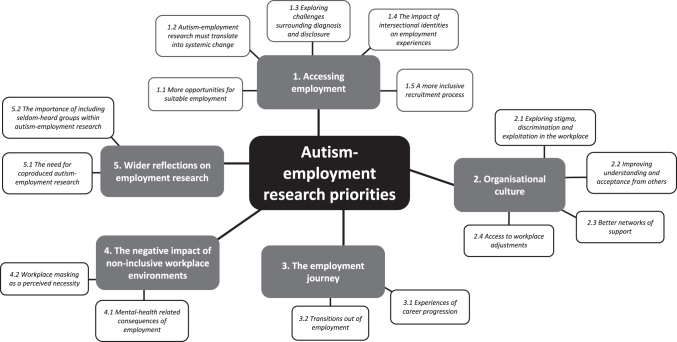
Participants spoke of their challenges in gaining and sustaining meaningful employment and called for researchers to conduct research that results in direct improvements to employment experiences. Regarding their research priorities, participants indicated a need for research covering all aspects of the employment lifecycle from accessing employment to transitioning out of employment. Importantly, participants also discussed such research should be conducted: with autistic people as co-researchers and ensuring a diverse range of autistic people are listened to.
While much existing autism-employment research appears to align with the priorities outlined in this study, seemingly minimal attention has been paid to later stages of the work lifecycle (e.g., progressing into more senior job roles or transitioning out of work). By identifying disparities between autistic people's priorities and the research being conducted, we can support autistic people to drive the research agenda and ensure autism-employment research positively impacts the community it aims to serve.
越来越多的研究致力于了解自闭症患者的研究重点。其中几项研究已将就业确定为关键的研究重点。然而,在这一领域内,很少有人尝试确定具体的、可付诸行动的重点。
我们通过在线调查,询问了197名英国自闭症患者关于他们对未来自闭症就业研究的重点。
参与者谈到了他们在获得和维持有意义的就业方面所面临的挑战,并呼吁研究人员开展能直接改善就业体验的研究。关于他们的研究重点,参与者表示需要开展涵盖就业生命周期各个方面的研究,从获得就业到离职过渡。重要的是,参与者还讨论了此类研究应如何开展:让自闭症患者作为共同研究人员,并确保听取各种不同自闭症患者的意见。
虽然现有的许多自闭症就业研究似乎与本研究中概述的重点一致,但对于工作生命周期的后期阶段(例如,晋升到更高级的工作岗位或离职过渡),似乎关注极少。通过确定自闭症患者的重点与正在进行的研究之间的差异,我们可以支持自闭症患者推动研究议程,并确保自闭症就业研究对其旨在服务的社区产生积极影响。