Department of Medicine, Division of Gastroenterology and Hepatology, University of Wisconsin School of Medicine and Public Health, Madison, Wisconsin, USA.
Department of Medical Microbiology and Immunology, University of Wisconsin School of Medicine and Public Healthon, Madison, Wisconsin, USA.
Infect Immun. 2024 Sep 10;92(9):e0047823. doi: 10.1128/iai.00478-23. Epub 2024 Mar 4.
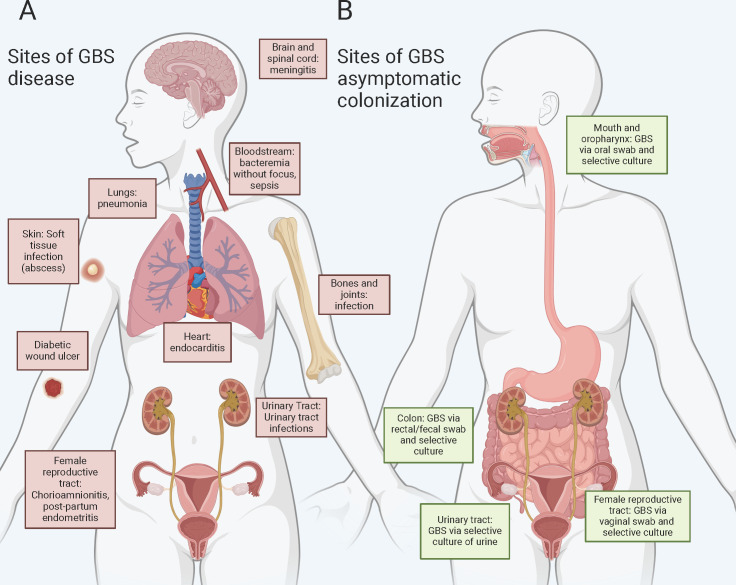
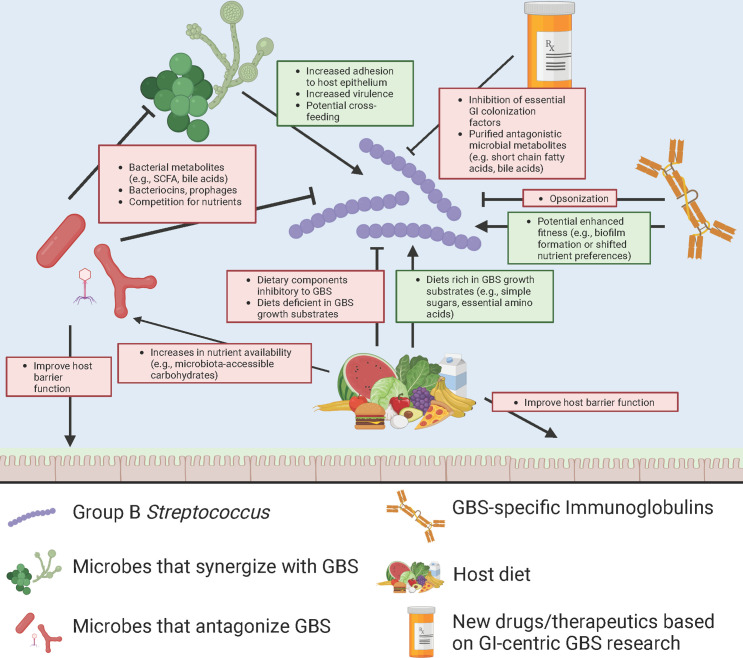
(Group B , GBS) is a Gram-positive bacterial species that causes disease in humans across the lifespan. While antibiotics are used to mitigate GBS infections, it is evident that antibiotics disrupt human microbiomes (which can predispose people to other diseases later in life), and antibiotic resistance in GBS is on the rise. Taken together, these unintended negative impacts of antibiotics highlight the need for precision approaches for minimizing GBS disease. One possible approach involves selectively depleting GBS in its commensal niches before it can cause disease at other body sites or be transmitted to at-risk individuals. One understudied commensal niche of GBS is the adult gastrointestinal (GI) tract, which may predispose colonization at other body sites in individuals at risk for GBS disease. However, a better understanding of the host-, microbiome-, and GBS-determined variables that dictate GBS GI carriage is needed before precise GI decolonization approaches can be developed. In this review, we synthesize current knowledge of the diverse body sites occupied by GBS as a pathogen and as a commensal. We summarize key molecular factors GBS utilizes to colonize different host-associated niches to inform future efforts to study GBS in the GI tract. We also discuss other GI commensals that are pathogenic in other body sites to emphasize the broader utility of precise de-colonization approaches for mitigating infections by GBS and other bacterial pathogens. Finally, we highlight how GBS treatments could be improved with a more holistic understanding of GBS enabled by continued GI-focused study.
(Group B, GBS) 是一种革兰氏阳性细菌物种,可在人类整个生命周期中引起疾病。虽然抗生素被用于减轻 GBS 感染,但很明显,抗生素会破坏人类微生物组(这可能使人们更容易在以后的生活中患上其他疾病),而且 GBS 的抗生素耐药性正在上升。抗生素的这些意外负面影响共同凸显了需要采取精确方法来最大限度地减少 GBS 疾病。一种可能的方法是在 GBS 在其他身体部位引起疾病或传播给高危个体之前,选择性地在其共生生态位中耗尽 GBS。GBS 的一个研究较少的共生生态位是成人胃肠道 (GI) 道,这可能使易患 GBS 疾病的个体在其他身体部位定植。然而,在能够开发精确的 GI 去定植方法之前,需要更好地了解决定 GBS GI 携带的宿主、微生物组和 GBS 决定的变量。在这篇综述中,我们综合了当前关于 GBS 作为病原体和共生体占据的不同身体部位的知识。我们总结了 GBS 用于定植不同宿主相关生态位的关键分子因素,为未来在 GI 道中研究 GBS 提供信息。我们还讨论了在其他身体部位具有致病性的其他 GI 共生体,以强调精确去定植方法在减轻 GBS 和其他细菌病原体感染方面的更广泛应用。最后,我们强调了通过继续关注 GI 的研究,如何通过更全面地了解 GBS 来改善 GBS 治疗方法。