Ikeda Riko, Matsuoka Yoh, Inoue Masaharu, Ishikawa Ayataka, Akagi Kiwamu, Kageyama Yukio
Department of Urology Saitama Cancer Center Saitama Japan.
Department of Pathology Saitama Cancer Center Saitama Japan.
IJU Case Rep. 2023 Dec 8;7(2):115-119. doi: 10.1002/iju5.12679. eCollection 2024 Mar.
The efficacy of olaparib for treatment-related neuroendocrine prostate cancer is unknown. Here, we report a case of treatment-related neuroendocrine prostate cancer with a mutation that was treated with olaparib with 1-year efficacy.
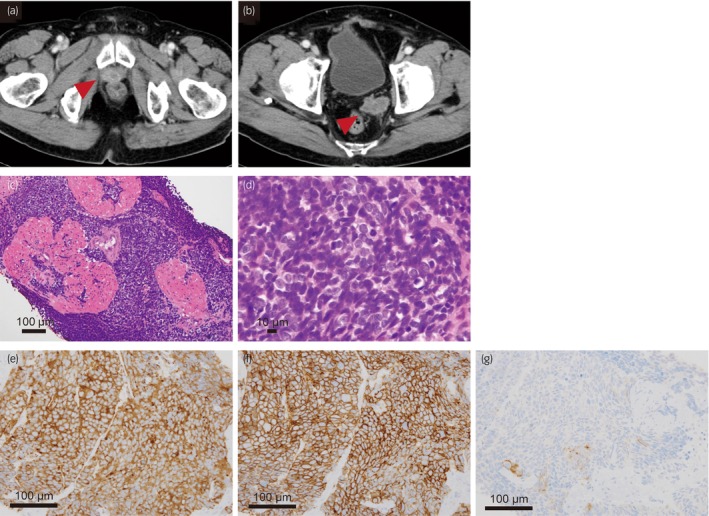
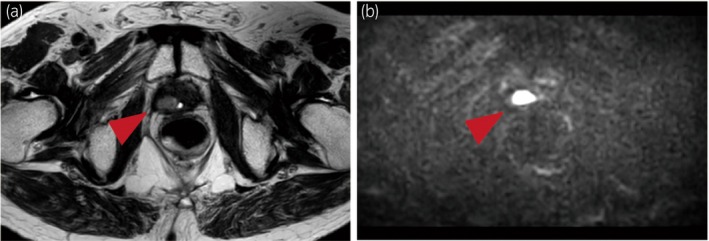
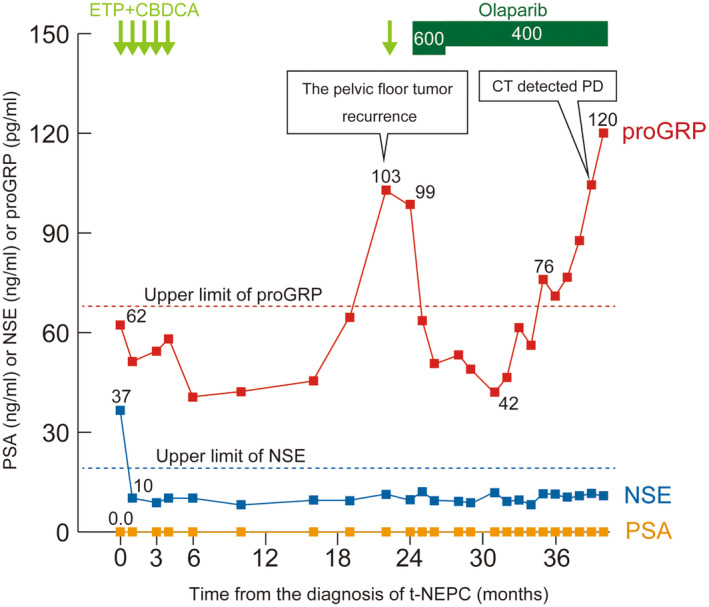
A 75-year-old man initially diagnosed with prostate adenocarcinoma developed treatment-related neuroendocrine prostate cancer after 10-year androgen deprivation therapy. Despite the initial temporary effects of etoposide and carboplatin, the patient experienced prostate bed tumor recurrence 1 year after chemotherapy cessation. FoundationOne® detected a gene mutation, and olaparib was initiated after repeating one chemotherapy course using the same chemotherapeutic agents. The patient received olaparib with sustained tumor regression for 1 year without severe side effects.
Olaparib may be the treatment of choice for treatment-related neuroendocrine prostate cancer in patients with mutations.
奥拉帕利治疗相关性神经内分泌前列腺癌的疗效尚不清楚。在此,我们报告一例治疗相关性神经内分泌前列腺癌患者,该患者存在一种突变,接受奥拉帕利治疗,疗效达1年。
一名75岁男性最初被诊断为前列腺腺癌,在接受10年雄激素剥夺治疗后发生治疗相关性神经内分泌前列腺癌。尽管依托泊苷和卡铂最初有暂时疗效,但患者在化疗停止1年后出现前列腺床肿瘤复发。FoundationOne®检测到一种基因突变,在使用相同化疗药物重复一个化疗疗程后开始使用奥拉帕利。该患者接受奥拉帕利治疗后肿瘤持续消退1年,且无严重副作用。
对于存在特定突变的治疗相关性神经内分泌前列腺癌患者,奥拉帕利可能是治疗的选择。