TB Centre, Department of Infectious Disease Epidemiology and International Health, London School of Hygiene and Tropical Medicine (LSHTM), London, United Kingdom.
KNCV Tuberculosis Plus, Dar es Salaam, Tanzania.
Front Public Health. 2024 Feb 20;12:1327971. doi: 10.3389/fpubh.2024.1327971. eCollection 2024.
Digital adherence technologies (DATs) can offer alternative approaches to support tuberculosis treatment medication adherence. Evidence on their feasibility and acceptability in high TB burden settings is limited. We conducted a cross-sectional survey among adults with drug-sensitive tuberculosis (DS-TB), participating in pragmatic cluster-randomized trials for the Adherence Support Coalition to End TB project in Ethiopia (PACTR202008776694999), the Philippines, South Africa and Tanzania (ISRCTN 17706019).
From each country we selected 10 health facilities implementing the DAT intervention (smart pillbox or medication labels, with differentiated care support), ensuring inclusion of urban/rural and public/private facilities. Adults on DS-TB regimen using a DAT were randomly selected from each facility. Feasibility of the DATs was assessed using a standardized tool. Acceptability was measured using a 5-point Likert-scale, using the Capability, Opportunity, Motivation, Behavior (COM-B) model. Mean scores of Likert-scale responses within each COM-B category were estimated, adjusted for facility-level clustering. Data were summarized by country and DAT type.
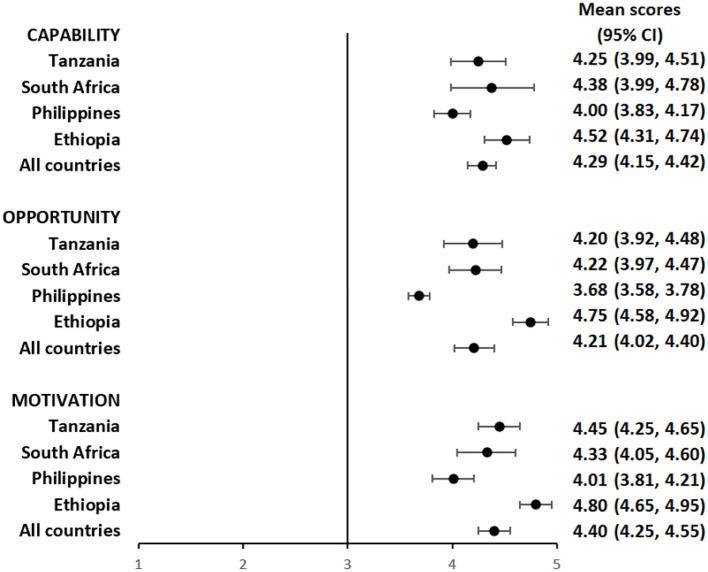
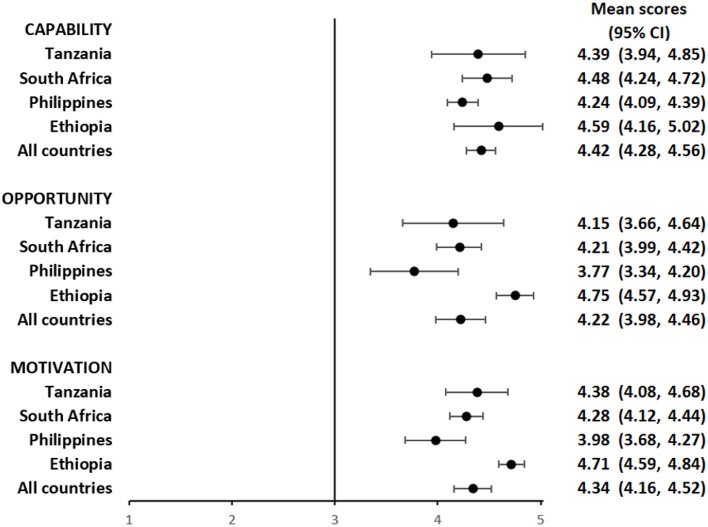
Participants using either the pillbox ( = 210) or labels ( = 169) were surveyed. Among pillbox users, phone ownership (79%), use of pillbox reminders (87%) and taking treatment without the pillbox (22%) varied by country. Among label users, phone ownership (81%), paying extra to use the labels (8%) and taking treatment without using labels (41%) varied by country. Poor network, problems with phone charging and access, not having the pillbox and forgetting to send text were reasons for not using DATs. Overall, people with TB had a favorable impression of both DATs, with mean composite scores between 4·21 to 4·42 across COM-B categories. Some disclosure concerns were reported.
From client-perspective, pillboxes and medication labels with differentiated care support were feasible to implement and acceptable in variety of settings. However, implementation challenges related to network, phone access, stigma, additional costs to people with TB to use DATs need to be addressed.
数字依从技术(DATs)可以提供支持结核病治疗药物依从性的替代方法。在高结核病负担环境中,关于其可行性和可接受性的证据有限。我们在埃塞俄比亚(PACTR202008776694999)、菲律宾、南非和坦桑尼亚参与务实的集群随机试验的药物敏感结核病(DS-TB)成人中进行了一项横断面调查,以支持依从性支持联盟结束结核病项目。
我们从每个国家中选择了 10 个实施 DAT 干预(智能药盒或药物标签,辅以差异化护理支持)的卫生机构,确保纳入了城市/农村和公立/私立机构。从每个机构中随机选择正在使用 DAT 的 DS-TB 方案的成年人。使用标准化工具评估 DAT 的可行性。使用能力、机会、动机、行为(COM-B)模型的 5 点李克特量表测量可接受性。对每个 COM-B 类别内的李克特量表反应的平均得分进行了估计,并针对机构层面的聚类进行了调整。按国家和 DAT 类型总结数据。
对使用药盒(=210)或标签(=169)的参与者进行了调查。在药盒使用者中,电话拥有率(79%)、使用药盒提醒(87%)和不服药盒服药(22%)因国家而异。在标签使用者中,电话拥有率(81%)、额外付费使用标签(8%)和不服药标签服药(41%)因国家而异。网络不佳、手机充电和访问问题、没有药盒和忘记发短信是不使用 DATs 的原因。总的来说,结核病患者对两种 DAT 都有较好的印象,COM-B 各类别平均综合评分为 4.21 至 4.42。有报道称存在一些披露问题。
从客户角度来看,具有差异化护理支持的药盒和药物标签易于实施且在各种环境中均可接受。但是,与网络、手机访问、污名化、结核病患者使用 DATs 的额外费用相关的实施挑战需要解决。