Case Western Reserve University School of Medicine, Cleveland, OH, USA.
Cleveland Clinic Cole Eye Institute Center for Ophthalmic Bioinformatics, Cleveland, OH, USA.
Eye (Lond). 2024 Jun;38(9):1687-1693. doi: 10.1038/s41433-024-02998-2. Epub 2024 Mar 6.
Anti-vascular endothelial growth factor (VEGF) injections are often administered less frequently in real-world treatment of diabetic macular oedema (DMO) than what was studied in clinical trials. This study aims to characterise real-world DMO treatment patterns and the effect of treatment intervals on patient outcomes.
STUDY DESIGN/PATIENTS AND METHODS: This was a retrospective study of 291 patients with DMO treated with anti-VEGF therapy. 12- and 24-month best visual acuity (BVA) and central subfield thickness (CST) were compared between injection interval groups, which were determined by averaging the two most recent injection intervals. Multiple linear regressions were performed to identify factors associated with injection interval, BVA, and CST.
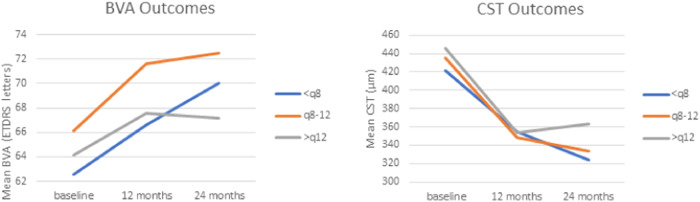
48.8% of patients received injections less than or equal to every 8 weeks (≤ q8w), 27.5% between every 8 to 12 weeks (q8-12w), and 23.7% greater than every 12 weeks (> q12w). Baseline CST was similar (p = 0.32), but BVA differed significantly in q8-12w patients (p = 0.0095). BVA and CST at 12 months were similar, but q8-12w patients experienced greater 12-month BVA improvement (7.36 ± 12.4 letters) than > q12w patients (1.26 ± 12.3 letters; p = 0.0056). 24-month BVA and CST changes were similar between groups (p = 0.30 and 0.87). Baseline BVA, HbA1c, and sex were associated with 12-month BVA, and baseline BVA and CST were associated with 12-month CST.
Many patients experienced improvements in BVA and CST over 12 months of treatment despite receiving less frequent anti-VEGF therapy than recommended in the pivotal trials. The present study showed that extended treatment intervals with bevacizumab were effective in preserving vision of many individuals with high baseline BVA.
在糖尿病黄斑水肿(DMO)的实际治疗中,抗血管内皮生长因子(VEGF)注射的频率往往低于临床试验研究的频率。本研究旨在描述 DMO 的实际治疗模式以及治疗间隔对患者结局的影响。
研究设计/患者和方法:这是一项回顾性研究,共纳入 291 例接受抗 VEGF 治疗的 DMO 患者。通过平均最近两次注射间隔来确定注射间隔组,并比较 12 个月和 24 个月时最佳视力(BCVA)和中央视网膜神经纤维层厚度(CST)。采用多元线性回归分析确定与注射间隔、BCVA 和 CST 相关的因素。
48.8%的患者接受了≤每 8 周(≤q8w)的注射,27.5%的患者接受了每 8-12 周(q8-12w)的注射,23.7%的患者接受了每 12 周以上(>q12w)的注射。q8-12w 组患者的基线 CST 相似(p=0.32),但 BCVA 差异有统计学意义(p=0.0095)。12 个月时 BCVA 和 CST 相似,但 q8-12w 组患者的 12 个月 BCVA 改善更显著(7.36±12.4 个字母),而>q12w 组患者的改善更不显著(1.26±12.3 个字母;p=0.0056)。两组患者的 24 个月 BCVA 和 CST 变化相似(p=0.30 和 0.87)。基线 BCVA、HbA1c 和性别与 12 个月时的 BCVA 相关,而基线 BCVA 和 CST 与 12 个月时的 CST 相关。
尽管接受的抗 VEGF 治疗频率低于关键试验推荐的频率,但许多患者在 12 个月的治疗期间仍能改善 BCVA 和 CST。本研究表明,对于基线 BCVA 较高的许多患者,延长贝伐单抗治疗间隔时间是有效的,可以保持视力。