Xie Wei, Zhong Yu-Sen, Li Xue-Jian, Kang You-Kun, Peng Qian-Yu, Ying Hua-Zhong
Key Laboratory of Experimental Animal and Safety Evaluation, Hangzhou Medical College, Hangzhou, China.
Front Microbiol. 2024 Feb 21;15:1360225. doi: 10.3389/fmicb.2024.1360225. eCollection 2024.
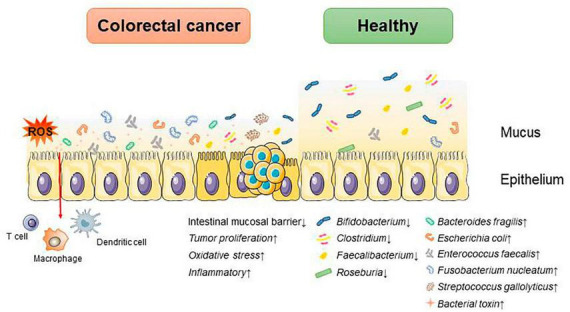
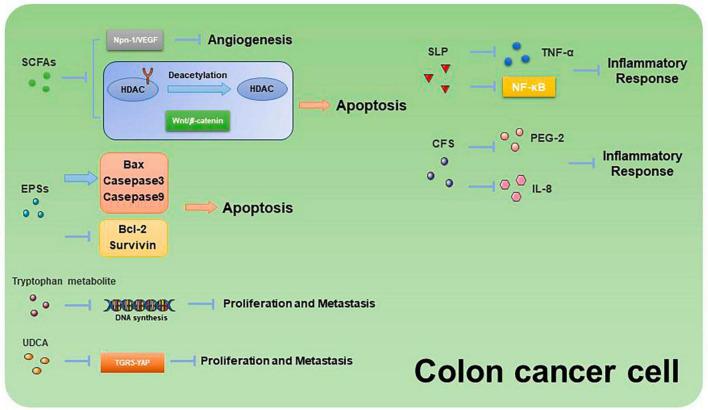
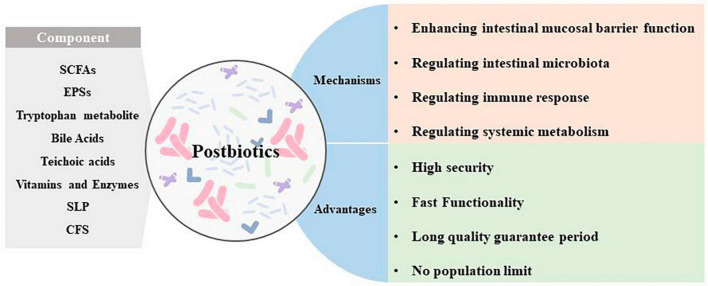
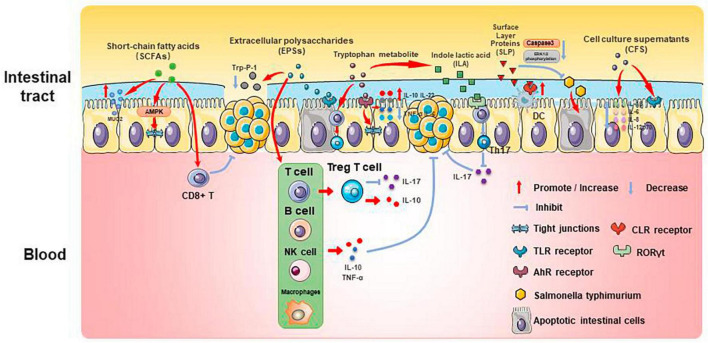
Colorectal cancer (CRC) is a common malignancy affecting the gastrointestinal tract worldwide. The etiology and progression of CRC are related to factors such as environmental influences, dietary structure, and genetic susceptibility. Intestinal microbiota can influence the integrity of the intestinal mucosal barrier and modulate intestinal immunity by secreting various metabolites. Dysbiosis of the intestinal microbiota can affect the metabolites of the microbial, leading to the accumulation of toxic metabolites, which can trigger chronic inflammation or DNA damage and ultimately lead to cellular carcinogenesis and the development of CRC. Postbiotics are preparations of inanimate microorganisms or their components that are beneficial to the health of the host, with the main components including bacterial components (e.g., exopolysaccharides, teichoic acids, surface layer protein) and metabolites (e.g., short-chain fatty acids, tryptophan metabolite, bile acids, vitamins and enzymes). Compared with traditional probiotics, it has a more stable chemical structure and higher safety. In recent years, it has been demonstrated that postbiotics are involved in regulating intestinal microecology and improving the progression of CRC, which provides new ideas for the prevention and diagnosis of CRC. In this article, we review the changes in intestinal microbiota in different states of the gut and the mechanisms of anti-tumor activity of postbiotic-related components, and discuss the potential significance of postbiotics in the diagnosis and treatment of CRC. This reviews the changes and pathogenesis of intestinal microbiota in the development of CRC, and summarizes the relevant mechanisms of postbiotics in resisting the development of CRC in recent years, as well as the advantages and limitations of postbiotics in the treatment process of CRC.
结直肠癌(CRC)是一种影响全球胃肠道的常见恶性肿瘤。CRC的病因和进展与环境影响、饮食结构和遗传易感性等因素有关。肠道微生物群可通过分泌各种代谢产物影响肠道黏膜屏障的完整性并调节肠道免疫。肠道微生物群的失调会影响微生物的代谢产物,导致有毒代谢产物的积累,进而引发慢性炎症或DNA损伤,最终导致细胞癌变和CRC的发生。后生元是对宿主健康有益的无生命微生物或其成分的制剂,主要成分包括细菌成分(如胞外多糖、磷壁酸、表层蛋白)和代谢产物(如短链脂肪酸、色氨酸代谢产物、胆汁酸、维生素和酶)。与传统益生菌相比,它具有更稳定的化学结构和更高的安全性。近年来,已证明后生元参与调节肠道微生态并改善CRC的进展,这为CRC的预防和诊断提供了新思路。在本文中,我们综述了肠道不同状态下肠道微生物群的变化以及后生元相关成分的抗肿瘤活性机制,并讨论了后生元在CRC诊断和治疗中的潜在意义。本文综述了CRC发生发展过程中肠道微生物群的变化及发病机制,总结了近年来后生元抗CRC发生发展的相关机制以及后生元在CRC治疗过程中的优势与局限性。