Department of Ophthalmology, College of Medicine, King Saud University, Riyadh, Saudi Arabia.
Department of Pathology and Laboratory Medicine, College of Medicine, King Saud University, Riyadh, Saudi Arabia.
Arq Bras Oftalmol. 2024 Mar 4;87(2):e20220241. doi: 10.5935/0004-2749.2022-0241. eCollection 2024.
We aimed to study reported cases of nasopharyngeal carcinoma presenting with ophthalmic manifestations with and without a prior diagnosis of nasopharyngeal carcinoma.
We conducted a systematic review following the Preferred Reporting Items for Systematic Reviews and Meta-Analyses (PRISMA). A literature search was conducted using the MEDLINE database in PubMed and Google Scholar. We included patients with a previous diagnosis of nasopharyngeal carcinoma in Group I and those without a prior diagnosis of nasopharyngeal carcinoma in Group II. Data included demographics, clinical presentation, history of nasopharyngeal carcinoma, treatment, histopathological description, World Health Organization classification, and outcome.
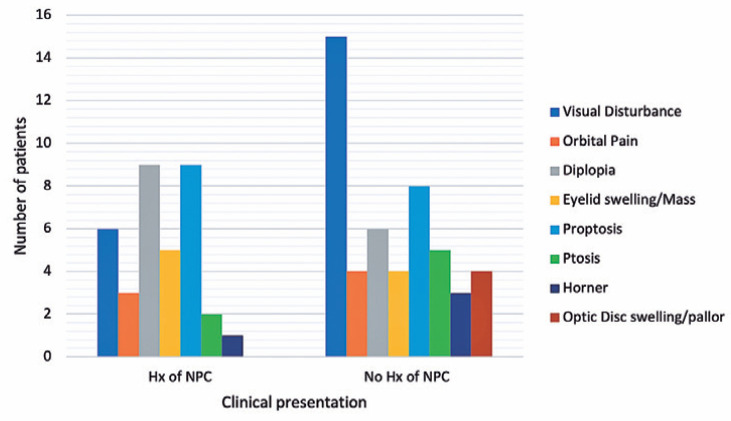
Fifty-eight patients (26 in Group I and 32 in Group II) were included. The male-to-female ratio was 3:1. The mean age of the patients (53.3 ± 11.7 years and 54.8 ± 16.2 years, respectively) and gender did not differ significantly between the two groups. The most common ocular presentations were diplopia and proptosis in the first group (each in 34.6%), whereas visual disturbance was most common in the second group (46.9%). Treatment options and World Health Organization grading were comparable. The outcome in 38 patients (after a comparable follow-up period) was significantly better in group II (p=0.003). There was no statistically significant difference in the outcome of 23 patients in correlation with World Health Organization grades II versus III irrespective of group (p=0.094).
The demographics of patients with nasopharyngeal carcinoma presenting with ophthalmic manifestations were similar between the two study groups, with a wide age range and male predominance. Patients presenting initially to ophthalmologists with no history of nasopharyngeal carcinoma have a more favorable outcome. World Health Organization grading may have less value as a prognostic indicator.
我们旨在研究报告的伴有和不伴有鼻咽癌既往诊断的鼻咽癌眼部表现病例。
我们按照系统评价和荟萃分析的首选报告项目(PRISMA)进行了系统综述。使用 MEDLINE 数据库在 PubMed 和 Google Scholar 中进行文献检索。我们将既往诊断为鼻咽癌的患者纳入组 I,而将无鼻咽癌既往诊断的患者纳入组 II。数据包括人口统计学、临床表现、鼻咽癌病史、治疗、组织病理学描述、世界卫生组织(WHO)分类和结局。
共纳入 58 例患者(组 I 26 例,组 II 32 例)。男女比例为 3:1。两组患者的平均年龄(分别为 53.3±11.7 岁和 54.8±16.2 岁)和性别无显著差异。第一组最常见的眼部表现为复视和眼球突出(各占 34.6%),而第二组最常见的眼部表现为视力障碍(占 46.9%)。治疗选择和 WHO 分级相当。在 38 例(随访时间相当)患者中,组 II 的结局明显更好(p=0.003)。无论组别如何,23 例患者的 WHO 分级 II 与 III 级之间的结局无统计学显著差异(p=0.094)。
伴有眼部表现的鼻咽癌患者的人口统计学特征在两组研究中相似,年龄范围广泛,男性居多。最初就诊于眼科且无鼻咽癌病史的患者结局更有利。WHO 分级可能作为预后指标的价值较低。