Longhi Giulia, Argentini Chiara, Fontana Federico, Tarracchini Chiara, Mancabelli Leonardo, Lugli Gabriele Andrea, Alessandri Giulia, Lahner Edith, Pivetta Giulia, Turroni Francesca, Ventura Marco, Milani Christian
Laboratory of Probiogenomics, Department of Chemistry, Life Sciences, and Environmental Sustainability, University of Parma, Parma 43124, Italy.
GenProbio Srl, Parma 43124, Italy.
Microbiome Res Rep. 2023 Nov 15;3(1):4. doi: 10.20517/mrr.2023.02. eCollection 2024.
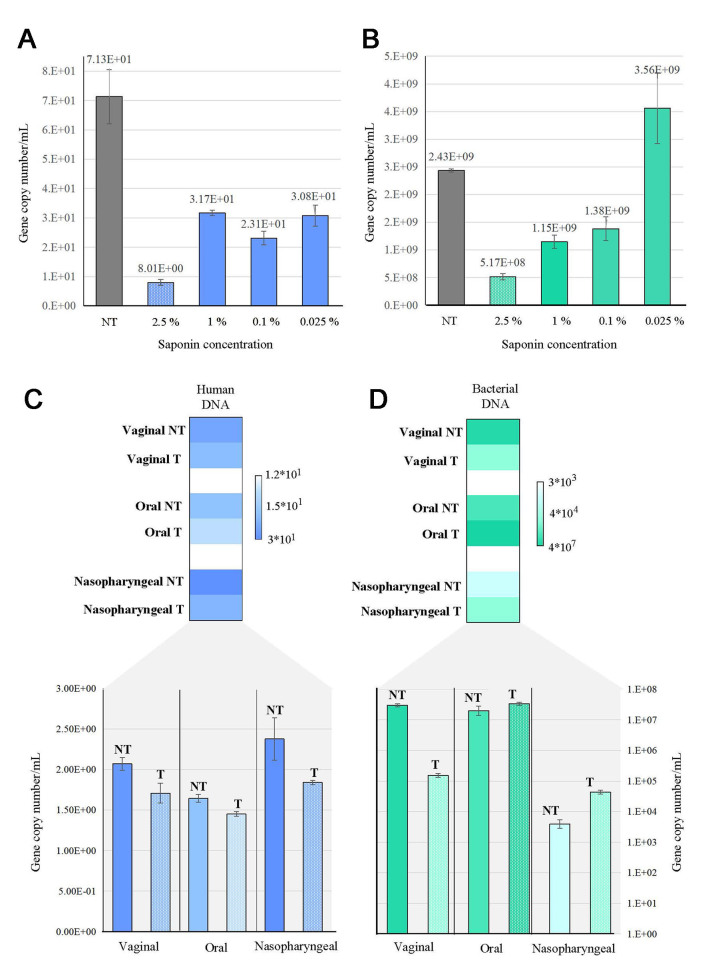
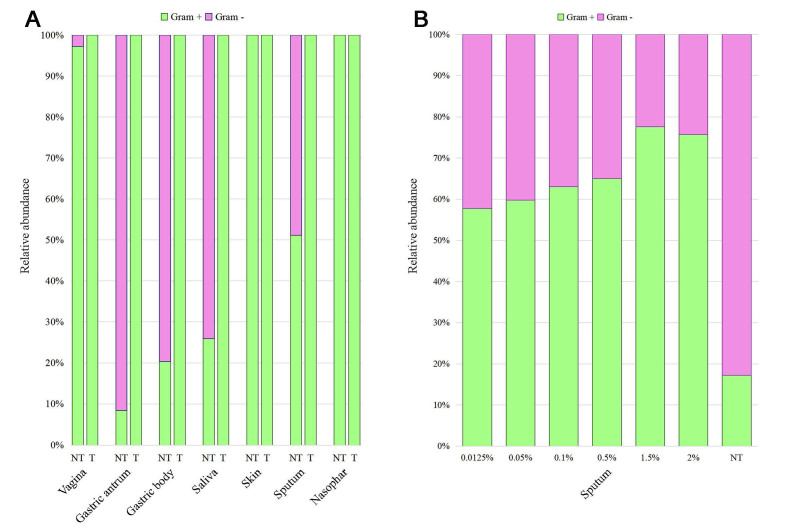
Recent advances in microbiome sequencing techniques have provided new insights into the role of the microbiome on human health with potential diagnostic implications. However, these developments are often hampered by the presence of a large amount of human DNA interfering with the analysis of the bacterial content. Nowadays, extensive scientific literature focuses on eukaryotic DNA depletion methods, which successfully remove host DNA in microbiome studies, even if a precise assessment of the impact on bacterial DNA is often missing. Here, we have investigated a saponin-based DNA isolation protocol commonly applied to different biological matrices to deplete the released host DNA. The bacterial DNA obtained was used to assess the relative abundance of bacterial and human DNA, revealing that the inclusion of 2.5% wt/vol saponin allowed the depletion of most of the host's DNA in favor of bacterial DNA enrichment. However, shotgun metagenomic sequencing showed inaccurate microbial profiles of the DNA samples, highlighting an erroneous increase in Gram-positive DNA. Even the application of 0.0125% wt/vol saponin altered the bacterial profile by depleting Gram-negative bacteria, resulting in an overall increase of Gram-positive bacterial DNA. The application of the saponin-based protocol drastically changes the detection of the microbial composition of human-related biological specimens. In this context, we revealed that saponin targets not only host cells but also specific bacterial cells, thus inducing a drastic reduction in the profiling of Gram-negative bacterial DNA.
微生物组测序技术的最新进展为微生物组在人类健康中的作用提供了新的见解,并具有潜在的诊断意义。然而,这些进展常常受到大量人类DNA干扰细菌含量分析的阻碍。如今,大量科学文献聚焦于真核DNA去除方法,这些方法在微生物组研究中成功去除了宿主DNA,尽管通常缺少对细菌DNA影响的精确评估。在此,我们研究了一种基于皂苷的DNA提取方案,该方案常用于不同生物基质以去除释放的宿主DNA。获得的细菌DNA用于评估细菌和人类DNA的相对丰度,结果表明加入2.5%(重量/体积)的皂苷可去除大部分宿主DNA,有利于细菌DNA富集。然而,鸟枪法宏基因组测序显示DNA样本的微生物图谱不准确,突出了革兰氏阳性DNA的错误增加。即使应用0.0125%(重量/体积)的皂苷也会通过消耗革兰氏阴性菌改变细菌图谱,导致革兰氏阳性细菌DNA总体增加。基于皂苷的方案的应用极大地改变了人类相关生物标本微生物组成的检测结果。在此背景下,我们发现皂苷不仅靶向宿主细胞,还靶向特定细菌细胞,从而导致革兰氏阴性细菌DNA图谱大幅减少。