Department of Pediatrics, University of Colorado Anschutz Medical Campus Heart Institute, Children's Hospital Colorado Aurora CO.
Modern Human Anatomy School University of Colorado Anschutz Medical Campus Aurora CO.
J Am Heart Assoc. 2024 Mar 19;13(6):e033239. doi: 10.1161/JAHA.123.033239. Epub 2024 Mar 8.
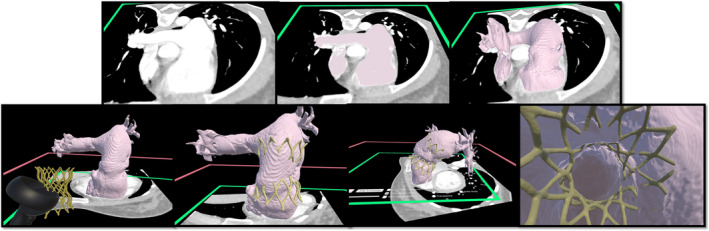
In recent years, self-expanding technology to treat pulmonary regurgitation in the native right ventricular outflow tract became Food and Drug Administration approved in the United States and is now routinely used. The current practice for selection of patients who are candidates for these devices includes screening for "anatomic fit," performed by each of the manufacturing companies. Our study aims to validate the use of virtual reality (VR) as a tool for local physician-led screening of patients.
This retrospective study from Children's Hospital Colorado included patients who underwent pulmonary valve replacement and had screening for a Harmony TPV or Alterra Prestent performed between September 2020 and January 2022. The data from the commercial companies' dedicated analysis for self-expanding transcatheter pulmonary valve frames evaluation with perimeter analysis were collected. VR simulation was performed blinded by 2 congenital interventional cardiologists using Elucis VR software and an Oculus Quest 2 headset. Among the 27 evaluated cases, the use of a self-expandable valve was recommended by companies' dedicated analysis in 23 cases (85.2%), by VR assessment in 26 cases (96.3), and finally implanted in 25 cases (92.6%). Regarding the level of agreement, both modalities (manufacturer and VR) were good at screening-in patients who received a self-expanding valve (100% versus 96.1%). When it came to screening-out the patients, VR presented good capacity to accurately classify nonsuitable patients (50% versus 100%).
Our institutional experience with VR transcatheter pulmonary valve implantation planning accurately predicted clinical outcomes. This paves the way for routine use of VR in patient selection for self-expanding valve technologies.
近年来,用于治疗原生右心室流出道肺动脉瓣反流的自膨式技术已获得美国食品和药物管理局批准,并已常规应用。目前,这些器械候选患者的选择标准包括各制造商进行的“解剖学适配”筛选。本研究旨在验证虚拟现实(VR)作为一种用于本地医生主导的患者筛选的工具的使用。
本项来自科罗拉多儿童医院的回顾性研究纳入了 2020 年 9 月至 2022 年 1 月期间接受肺动脉瓣置换术且接受 Harmony TPV 或 Alterra Prestent 筛选的患者。收集了商业公司专用分析用于周长分析的自膨式经导管肺动脉瓣框架评估的数据。由 2 名先天性介入心脏病专家使用 Elucis VR 软件和 Oculus Quest 2 耳机进行 VR 模拟。在评估的 27 例病例中,公司专用分析推荐使用自膨式瓣膜的有 23 例(85.2%),VR 评估推荐使用的有 26 例(96.3%),最终植入的有 25 例(92.6%)。在一致性方面,两种方法(制造商和 VR)在筛选出接受自膨式瓣膜的患者方面都很好(100%与 96.1%)。在筛选出不适合的患者方面,VR 具有良好的能力可以准确地对其进行分类(50%与 100%)。
我们机构使用 VR 经导管肺动脉瓣植入术规划的经验准确预测了临床结果。这为 VR 在自膨式瓣膜技术的患者选择中的常规使用铺平了道路。