Pediatric Neurosurgery, Neuroscience-Sense Organs-Chest Department, Fondazione Policlinico Universitario A. Gemelli IRCCS, Rome, Italy.
Department of Neuroscience, Catholic University Medical School, Rome, Italy.
Childs Nerv Syst. 2024 Apr;40(4):1221-1237. doi: 10.1007/s00381-024-06332-9. Epub 2024 Mar 8.
COVID-19 pandemic is thought to have changed the epidemiology of some pediatric neurosurgical disease: among them are the intracranial complications of sinusitis and otitis (ICSO). According to some studies on a limited number of cases, both streptococci-related sinusitis and ICSO would have increased immediately after the pandemic, although the reason is not clear yet (seasonal changes versus pandemic-related effects). The goal of the present survey of the European Society for Pediatric Neurosurgery (ESPN) was to collect a large number of cases from different European countries encompassing the pre-COVID (2017-2019), COVID (2020-2021), and post-COVID period (2022-June 2023) looking for possible epidemiological and/or clinical changes.
An English language questionnaire was sent to ESPN members about year of the event, patient's age and gender, presence of immune-deficit or other favoring risk factors, COVID infection, signs and symptoms at onset, site of primary infection, type of intracranial complication, identified germ, type and number of surgical operations, type and duration of medical treatment, clinical and radiological outcome, duration of the follow-up.
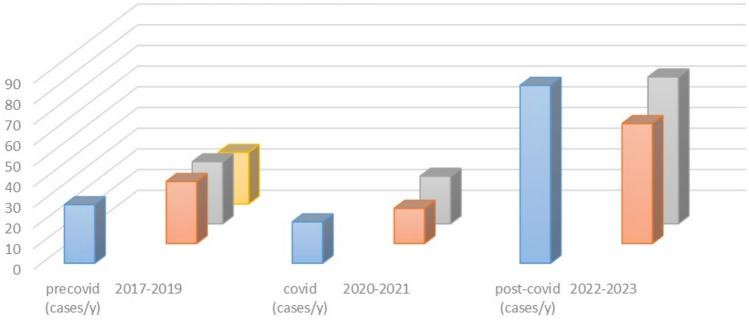
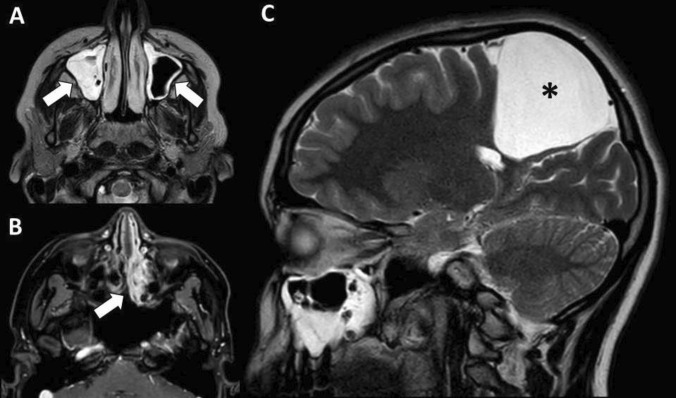
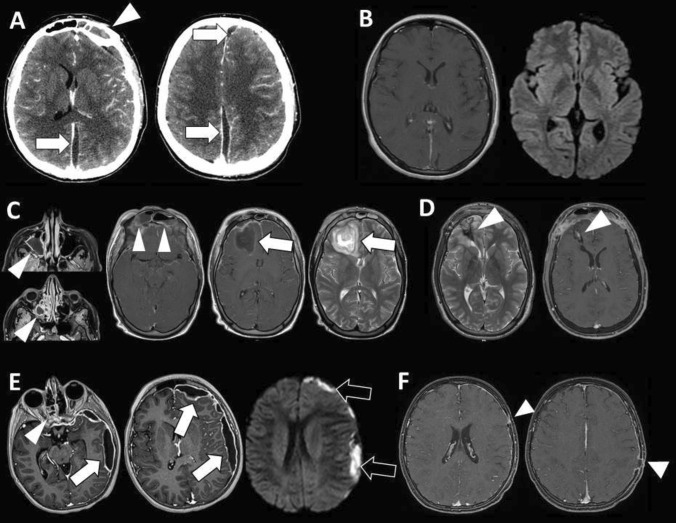
Two hundred fifty-four cases were collected by 30 centers coming from 14 different European countries. There was a statistically significant difference between the post-COVID period (129 children, 86 cases/year, 50.7% of the whole series) and the COVID (40 children, 20 cases/year, 15.7%) or the pre-COVID period (85 children, 28.3 cases/year, 33.5%). Other significant differences concerned the presence of predisposing factors/concurrent diseases (higher in the pre-COVID period) and previous COVID infection (higher in the post-COVID period). No relevant differences occurred as far as demographic, microbiological, clinical, radiological, outcome, morbidity, and mortality data were concerned. Paranasal sinuses and middle ear/mastoid were the most involved primary site of infection (71% and 27%, respectively), while extradural or subdural empyema and brain abscess were the most common ICSO (73% and 17%, respectively). Surgery was required in 95% of cases (neurosurgical and ENT procedure in 71% and 62% of cases, respectively) while antibiotics in 99% of cases. After a 12.4-month follow-up, a full clinical and radiological recovery was obtained in 85% and 84% of cases, respectively. The mortality rate was 2.7%.
These results suggest that the occurrence of ICSO was significantly increased after the pandemic. Such an increase seems to be related to the indirect effects of the pandemic (e.g., immunity debt) rather than to a direct effect of COVID infection or to seasonal fluctuations. ICSO remain challenging diseases but the pandemic did not affect the management strategies nor their prognosis. The epidemiological change of sinusitis/otitis and ICSO should alert about the appropriate follow-up of children with sinusitis/otitis.
COVID-19 大流行被认为改变了一些儿科神经外科疾病的流行病学:其中包括鼻窦炎和中耳炎的颅内并发症(ICSO)。根据一些对少数病例的研究,链球菌相关的鼻窦炎和 ICSO 在大流行后都会立即增加,尽管原因尚不清楚(季节性变化与大流行相关的影响)。本项来自欧洲小儿神经外科学会(ESPN)的调查旨在从涵盖大流行前(2017-2019 年)、大流行期间(2020-2021 年)和大流行后(2022 年 6 月 2023 年)的不同欧洲国家的大量病例中收集信息,以寻找可能的流行病学和/或临床变化。
向 ESPN 成员发送了一份英文问卷,内容涉及事件发生年份、患者年龄和性别、是否存在免疫缺陷或其他易感危险因素、COVID 感染、发病时的症状和体征、原发性感染部位、颅内并发症类型、鉴定出的病原体、手术类型和数量、药物治疗类型和持续时间、临床和影像学结果、随访时间。
来自 14 个不同欧洲国家的 30 个中心共收集了 254 例病例。大流行后时期(129 例患儿,86 例/年,占整个系列的 50.7%)与大流行期间(40 例患儿,20 例/年,占 15.7%)或大流行前时期(85 例患儿,28.3 例/年,占 33.5%)相比,差异具有统计学意义。其他显著差异涉及易感因素/并存疾病(大流行前时期更高)和既往 COVID 感染(大流行后时期更高)。就人口统计学、微生物学、临床、影像学、结局、发病率和死亡率数据而言,未观察到其他相关差异。鼻窦和中耳/乳突是最常见的原发性感染部位(分别为 71%和 27%),而硬膜外或硬膜下积脓和脑脓肿是最常见的 ICSO(分别为 73%和 17%)。95%的病例需要手术(神经外科和耳鼻喉科手术分别占 71%和 62%),99%的病例需要抗生素。在 12.4 个月的随访后,85%和 84%的病例分别获得了完全的临床和影像学恢复。死亡率为 2.7%。
这些结果表明,大流行后 ICSO 的发生率显著增加。这种增加似乎与大流行的间接影响(例如免疫负债)有关,而不是与 COVID 感染的直接影响或季节性波动有关。ICSO 仍然是具有挑战性的疾病,但大流行并未影响其管理策略或预后。鼻窦炎/中耳炎和 ICSO 的流行病学变化应提醒对鼻窦炎/中耳炎患儿进行适当的随访。