Department of Maternal, Child and Adolescent Health, School of Public Health, Anhui Medical University, No 81 Meishan Road, Hefei, 230032, China.
MOE Key Laboratory of Population Health Across Life Cycle, Hefei, 230032, China.
Reprod Health. 2024 Mar 8;21(1):33. doi: 10.1186/s12978-024-01761-w.
The caesarean section (CS) rate has increased worldwide and there is an increasing public and scientific interest in the potential long-term health consequences for the offspring. CS is related to persistent aberrant microbiota colonization in the offspring, which may negatively interfere with sex hormone homeostasis and thus potentially affect the reproductive health. It remains unknown whether adult sons' semen quality is affected by CS. We hypothesize that CS is associated with lower semen quality.
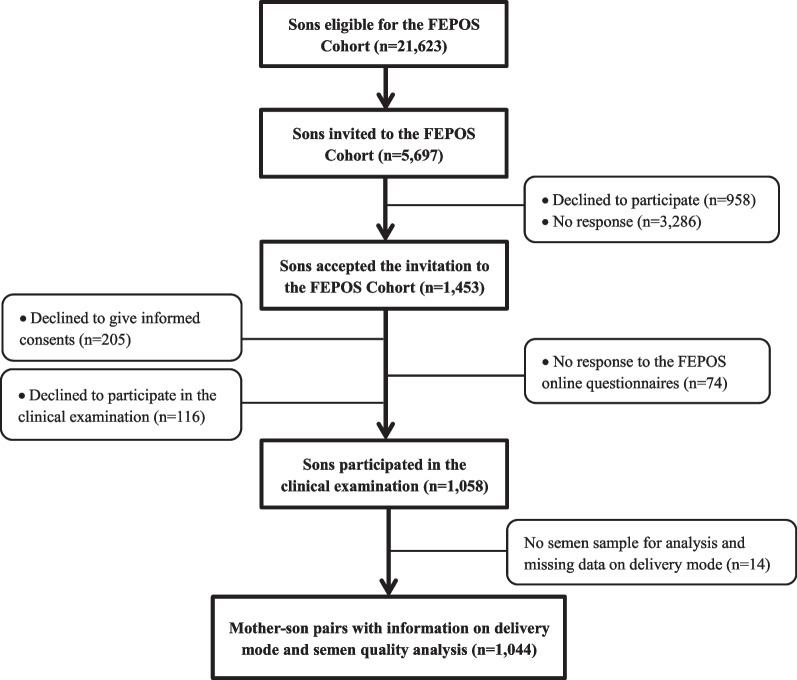
This study was based on the Fetal Programming of Semen Quality cohort (FEPOS, enrolled from 2017 to 2019) nested within the Danish National Birth Cohort (DNBC, enrolled from 1996 to 2002). A total of 5697 adult sons of mothers from the DNBC were invited to the FEPOS cohort, and 1044 young men participated in this study. Information on mode of delivery was extracted from the Danish Medical Birth Registry, and included vaginal delivery, elective CS before labor, emergency CS during labor and unspecified CS. The young men provided a semen sample for analysis of semen volume, sperm concentration, motility and morphology. Negative binomial regression models were applied to examine the association between CS and semen characteristics with estimation of relative differences in percentages with 95% confidence intervals (CIs).
Among included sons, 132 (13%) were born by CS. We found a slightly lower non-progressive sperm motility (reflecting higher progressive sperm motility) among sons born by CS compared to sons born by vaginal delivery [relative difference (95% CI): - 7.5% (- 14.1% to - 0.4%)]. No differences were observed for other sperm characteristics. When CS was further classified into elective CS, emergency CS and unspecified CS in a sensitivity analysis, no significant differences in non-progressive motility were observed among sons born by any of the three types of CS compared to sons born vaginally.
This large population-based cohort study found no significant evidence for an adverse effect on semen quality in adult sons born by CS.
剖宫产率在全球范围内呈上升趋势,公众和科学界对其可能对后代长期健康产生的影响越来越感兴趣。剖宫产与后代中持续存在的异常微生物定植有关,这可能会对性激素稳态产生负面影响,从而可能影响生殖健康。目前尚不清楚成年儿子的精液质量是否受到剖宫产的影响。我们假设剖宫产与较低的精液质量有关。
本研究基于胎儿编程精液质量队列(FEPOS,于 2017 年至 2019 年期间纳入),嵌套于丹麦全国出生队列(DNBC,于 1996 年至 2002 年期间纳入)。共有 5697 名来自 DNBC 的母亲的成年儿子被邀请参加 FEPOS 队列,其中 1044 名年轻男性参加了这项研究。分娩方式的信息从丹麦医疗出生登记处提取,包括阴道分娩、分娩前选择性剖宫产、分娩时紧急剖宫产和未明确剖宫产。年轻男性提供精液样本进行精液量、精子浓度、活力和形态分析。应用负二项回归模型来检查剖宫产与精液特征之间的关系,并估计百分比的相对差异,置信区间为 95%(CI)。
在所纳入的儿子中,有 132 名(13%)是通过剖宫产出生的。与阴道分娩出生的儿子相比,我们发现通过剖宫产出生的儿子的非进行性精子活力略低(反映进行性精子活力更高)[相对差异(95%CI):-7.5%(-14.1%至-0.4%)]。其他精子特征没有差异。在敏感性分析中,当进一步将剖宫产分为选择性剖宫产、紧急剖宫产和未明确剖宫产时,与阴道分娩出生的儿子相比,通过任何三种类型的剖宫产出生的儿子的非进行性运动能力均无显著差异。
这项基于人群的大型队列研究没有发现剖宫产对成年儿子精液质量产生不良影响的显著证据。