Division of Pharmacology and Therapy, Department of Biomedical Sciences, Faculty of Medicine, Universitas Padjadjaran, Bandung, Indonesia.
TB Working Group, Research Center for Care and Control of Infectious Diseases, Universitas Padjadjaran, Bandung, Indonesia.
J Antimicrob Chemother. 2024 May 2;79(5):977-986. doi: 10.1093/jac/dkae057.
Pharmacokinetic data on high-dose isoniazid for the treatment of rifampicin-/multidrug-resistant tuberculosis (RR/MDR-TB) are limited. We aimed to describe the pharmacokinetics of high-dose isoniazid, estimate exposure target attainment, identify predictors of exposures, and explore exposure-response relationships in RR/MDR-TB patients.
We performed an observational pharmacokinetic study, with exploratory pharmacokinetic/pharmacodynamic analyses, in Indonesian adults aged 18-65 years treated for pulmonary RR/MDR-TB with standardized regimens containing high-dose isoniazid (10-15 mg/kg/day) for 9-11 months. Intensive pharmacokinetic sampling was performed after ≥2 weeks of treatment. Total plasma drug exposure (AUC0-24) and peak concentration (Cmax) were assessed using non-compartmental analyses. AUC0-24/MIC ratio of 85 and Cmax/MIC ratio of 17.5 were used as exposure targets. Multivariable linear and logistic regression analyses were used to identify predictors of drug exposures and responses, respectively.
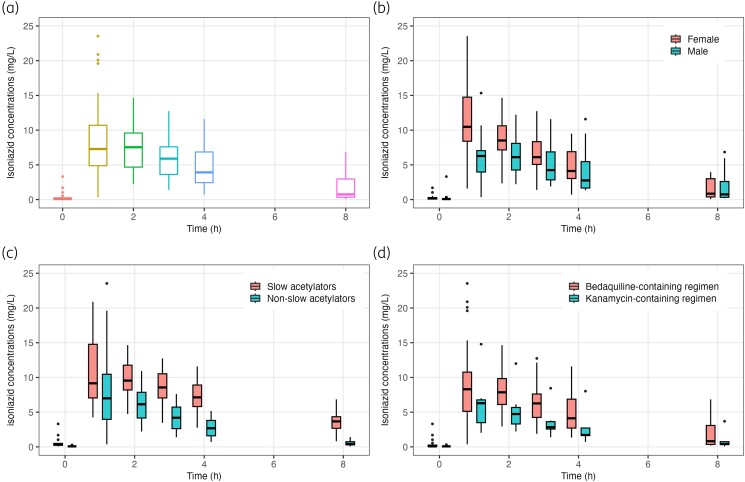
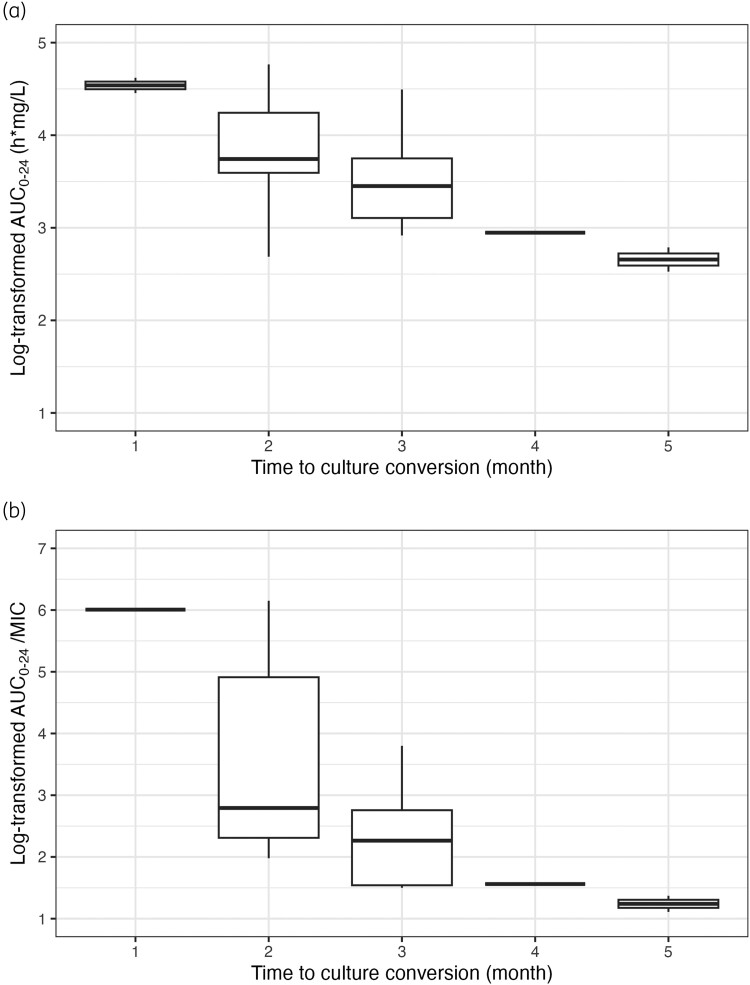
We consecutively enrolled 40 patients (median age 37.5 years). The geometric mean isoniazid AUC0-24 and Cmax were 35.4 h·mg/L and 8.5 mg/L, respectively. Lower AUC0-24 and Cmax values were associated (P < 0.05) with non-slow acetylator phenotype, and lower Cmax values were associated with male sex. Of the 26 patients with MIC data, less than 25% achieved the proposed targets for isoniazid AUC0-24/MIC (n = 6/26) and Cmax/MIC (n = 5/26). Lower isoniazid AUC0-24 values were associated with delayed sputum culture conversion (>2 months of treatment) [adjusted OR 0.18 (95% CI 0.04-0.89)].
Isoniazid exposures below targets were observed in most patients, and certain risk groups for low isoniazid exposures may require dose adjustment. The effect of low isoniazid exposures on delayed culture conversion deserves attention.
高剂量异烟肼治疗利福平/耐多药结核病(RR/MDR-TB)的药代动力学数据有限。本研究旨在描述 RR/MDR-TB 患者高剂量异烟肼的药代动力学特征,评估暴露达标情况,确定影响暴露的因素,并探索暴露-反应关系。
我们进行了一项观察性药代动力学研究,并进行了探索性药代动力学/药效学分析,纳入了在印度尼西亚接受标准化方案治疗的 18-65 岁成年 RR/MDR-TB 患者,方案中包含高剂量异烟肼(10-15mg/kg/天)治疗 9-11 个月。在治疗≥2 周后进行密集的药代动力学采样。采用非房室分析评估总血浆药物暴露(AUC0-24)和峰浓度(Cmax)。采用 AUC0-24/MIC 比值 85 和 Cmax/MIC 比值 17.5 作为暴露目标。采用多变量线性和逻辑回归分析分别确定药物暴露和反应的预测因素。
我们连续纳入了 40 例患者(中位年龄 37.5 岁)。异烟肼 AUC0-24 和 Cmax 的几何均数分别为 35.4h·mg/L 和 8.5mg/L。较低的 AUC0-24 和 Cmax 值与非慢乙酰化表型相关(P<0.05),而较低的 Cmax 值与男性相关。在 26 例有 MIC 数据的患者中,只有不到 25%的患者达到了异烟肼 AUC0-24/MIC(n=6/26)和 Cmax/MIC(n=5/26)的目标值。较低的异烟肼 AUC0-24 值与痰培养转阳延迟(>2 个月的治疗)相关(校正 OR 0.18,95%CI 0.04-0.89)。
大多数患者的异烟肼暴露值低于目标值,某些异烟肼低暴露的高危人群可能需要调整剂量。异烟肼低暴露对培养转阳延迟的影响值得关注。