Division of Molecular Oncological Pharmacy, Faculty of Pharmacy, Keio University, 1-5-30 Shibakoen, Minato-ku, Tokyo 105-8512, Japan.
Hospital Campus Laboratory, Radioisotope Center, Central Institute of Radioisotope Science and Safety Management, Kyushu University, 3-1-1 Maidashi, Higashi-ku, Fukuoka 812-8582, Japan.
J Radiat Res. 2024 May 23;65(3):263-271. doi: 10.1093/jrr/rrae005.
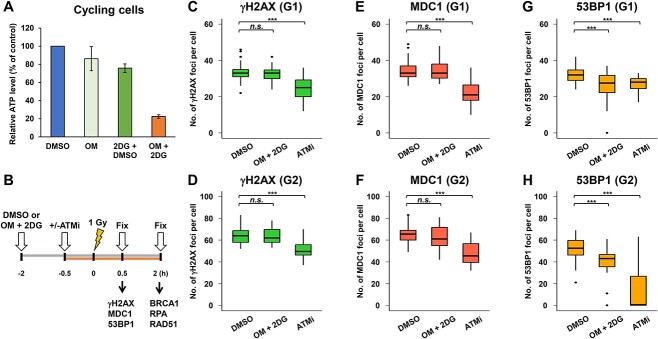
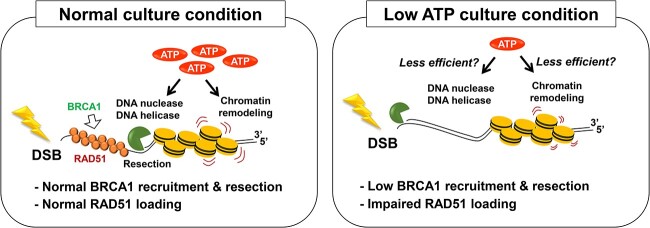
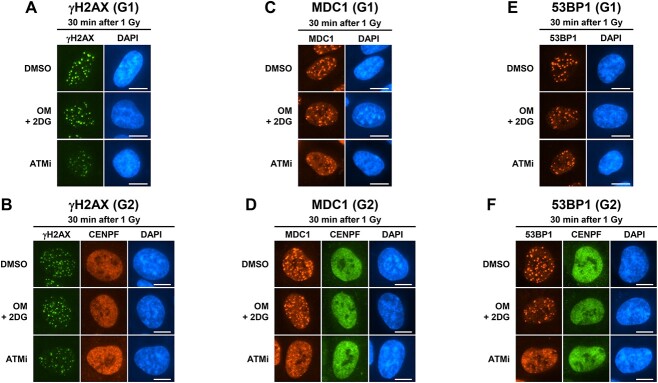
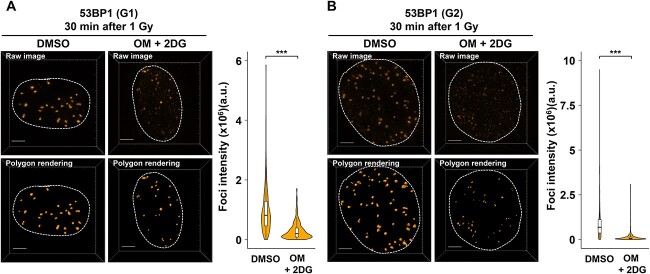
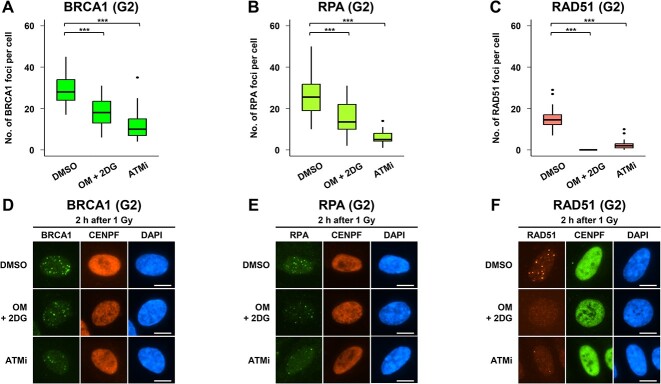
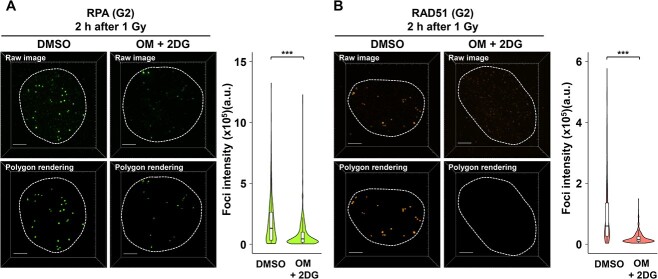
Ionizing radiation (IR)-induced double-strand breaks (DSBs) are primarily repaired by non-homologous end joining or homologous recombination (HR) in human cells. DSB repair requires adenosine-5'-triphosphate (ATP) for protein kinase activities in the multiple steps of DSB repair, such as DNA ligation, chromatin remodeling, and DNA damage signaling via protein kinase and ATPase activities. To investigate whether low ATP culture conditions affect the recruitment of repair proteins at DSB sites, IR-induced foci were examined in the presence of ATP synthesis inhibitors. We found that p53 binding protein 1 foci formation was modestly reduced under low ATP conditions after IR, although phosphorylated histone H2AX and mediator of DNA damage checkpoint 1 foci formation were not impaired. Next, we examined the foci formation of breast cancer susceptibility gene I (BRCA1), replication protein A (RPA) and radiation 51 (RAD51), which are HR factors, in G2 phase cells following IR. Interestingly, BRCA1 and RPA foci in the G2 phase were significantly reduced under low ATP conditions compared to that under normal culture conditions. Notably, RAD51 foci were drastically impaired under low ATP conditions. These results suggest that HR does not effectively progress under low ATP conditions; in particular, ATP shortages impair downstream steps in HR, such as RAD51 loading. Taken together, these results suggest that the maintenance of cellular ATP levels is critical for DNA damage response and HR progression after IR.
电离辐射(IR)诱导的双链断裂(DSB)主要通过非同源末端连接或同源重组(HR)在人类细胞中修复。DSB 修复需要三磷酸腺苷(ATP)来进行 DSB 修复的多个步骤中的蛋白激酶活性,例如 DNA 连接、染色质重塑以及通过蛋白激酶和 ATP 酶活性进行的 DNA 损伤信号转导。为了研究低 ATP 培养条件是否会影响修复蛋白在 DSB 位点的募集,在存在 ATP 合成抑制剂的情况下检查了 IR 诱导的焦点。我们发现,尽管磷酸化组蛋白 H2AX 和 DNA 损伤检查点 1 介导因子焦点形成不受损害,但在 IR 后低 ATP 条件下,p53 结合蛋白 1 焦点形成适度减少。接下来,我们检查了 HR 因子在 IR 后 G2 期细胞中乳腺癌易感性基因 I(BRCA1)、复制蛋白 A(RPA)和辐射 51(RAD51)焦点的形成。有趣的是,与正常培养条件下相比,低 ATP 条件下 G2 期的 BRCA1 和 RPA 焦点明显减少。值得注意的是,RAD51 焦点在低 ATP 条件下受到严重损害。这些结果表明,HR 在低 ATP 条件下不能有效进行;特别是,ATP 短缺会损害 HR 的下游步骤,例如 RAD51 加载。总之,这些结果表明,维持细胞内 ATP 水平对于 IR 后 DNA 损伤反应和 HR 进展至关重要。