Department of Surgery, Vanderbilt University Medical Center, Nashville, Tennessee.
Metamor Institute, Pennington Biomedical Research Center at Louisiana State University, Baton Rouge, Louisiana.
Surg Obes Relat Dis. 2024 Jul;20(7):687-694. doi: 10.1016/j.soard.2024.01.013. Epub 2024 Jan 30.
Weight loss response after bariatric surgery is highly variable, and several demographic factors are associated with differential responses to surgery. Preclinical studies demonstrate numerous sex-specific responses to bariatric surgery, but whether these responses are also operation dependent is unknown.
To examine sex-specific weight loss outcomes up to 5 years after laparoscopic Roux-en-Y gastric bypass (RYGB) and sleeve gastrectomy (SG).
Single center, university, United States.
Retrospective, observational cohort study including RYGB (n = 5057) and vertical SG (n = 2041) patients from a single, academic health center. Percentage total weight loss (TWL) over time was examined with generalized linear mixed models to determine the main and interaction effects of surgery type on weight loss by sex.
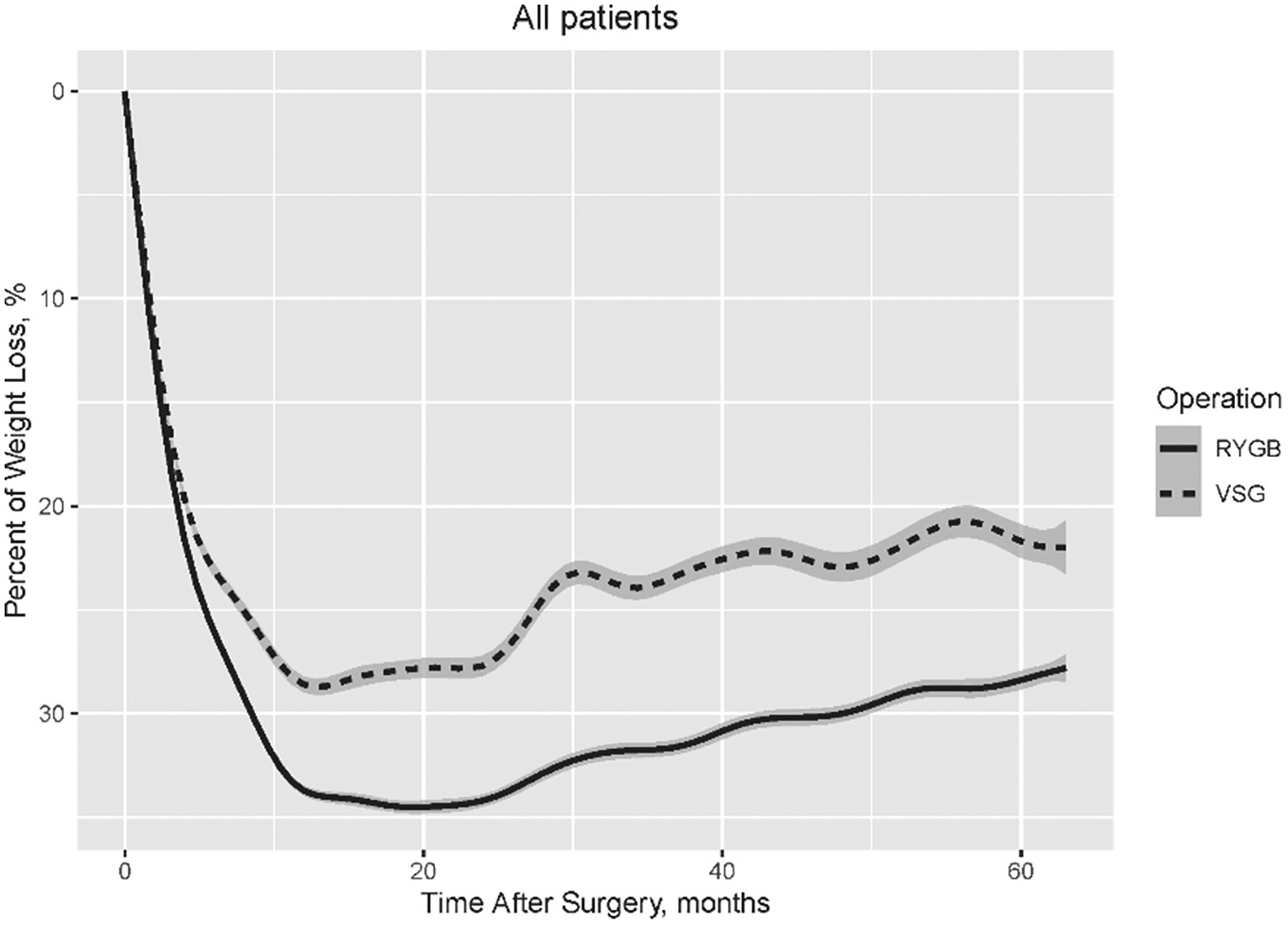
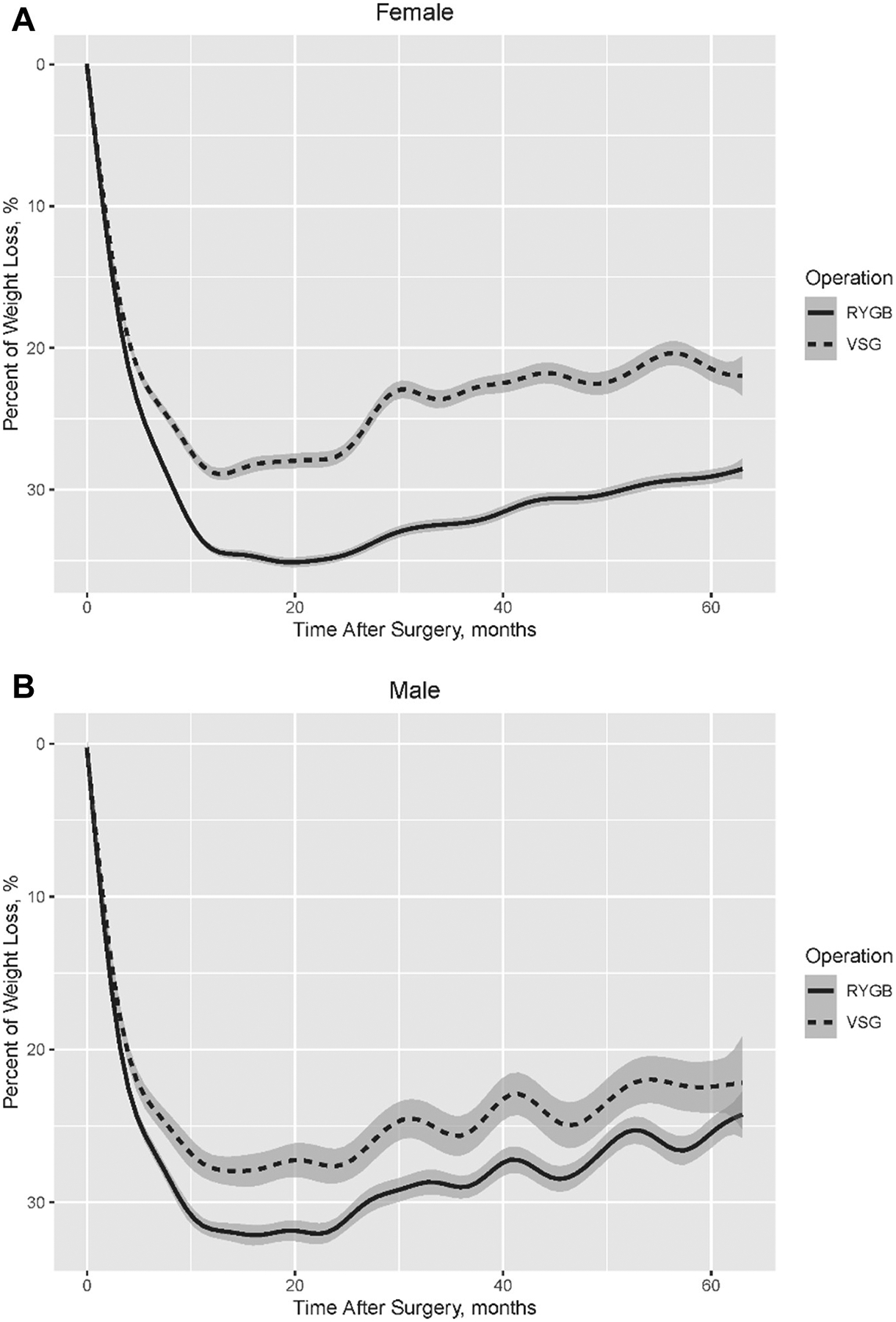
TWL demonstrated a strong sex-by-procedure interaction, with women having a significant advantage with RYGB compared with SG (adjusted difference at 5 yr: 8.0% [95% CI: 7.5-8.5]; P < .001). Men also experienced greater TWL over time with RYGB or SG, but the difference was less and clinically insignificant (adjusted difference at 5 yr: 2.9% [2.0-3.8]; P < .001; P interaction between sex and procedure type = .0001). Overall, women had greater TWL than men, and RYGB patients had greater TWL than SG patients (adjusted difference at 5 yr: 3.1% [2.4-3.2] and 6.9% [6.5-7.3], respectively; both P < .0001). Patients with diabetes lost less weight compared with those without (adjusted difference at 5 yr: 3.0% [2.7-3.2]; P < .0001).
Weight loss after bariatric surgery is sex- and procedure-dependent. There is an association suggesting a clinically insignificant difference in weight loss between RYGB and SG among male patients at both the 2- and 5-year postsurgery time points.
减重手术后的减重反应差异很大,一些人口统计学因素与手术的不同反应有关。临床前研究表明,减重手术后存在多种性别特异性反应,但这些反应是否也与手术有关尚不清楚。
检查腹腔镜 Roux-en-Y 胃旁路术(RYGB)和袖状胃切除术(SG)后 5 年内的性别特异性减重结果。
单中心、大学、美国。
对来自单一学术医疗中心的 RYGB(n=5057)和垂直 SG(n=2041)患者进行回顾性、观察性队列研究。使用广义线性混合模型检查随时间推移的总体重减轻百分比(TWL),以确定手术类型对性别体重减轻的主要和交互作用。
TWL 显示出强烈的性别与手术方式相互作用,女性与 SG 相比,RYGB 具有显著优势(调整后 5 年差异:8.0%[95%CI:7.5-8.5];P<0.001)。男性在 RYGB 或 SG 中随时间推移也经历了更大的 TWL,但差异较小且临床意义不大(调整后 5 年差异:2.9%[2.0-3.8];P<0.001;性别与手术方式之间的 P 交互作用=0.0001)。总体而言,女性的 TWL 大于男性,RYGB 患者的 TWL 大于 SG 患者(调整后 5 年差异:3.1%[2.4-3.2]和 6.9%[6.5-7.3],均 P<0.0001)。患有糖尿病的患者比没有糖尿病的患者体重减轻少(调整后 5 年差异:3.0%[2.7-3.2];P<0.0001)。
减重手术后的减重反应受性别和手术方式的影响。有研究表明,在手术后 2 年和 5 年的时间点,RYGB 和 SG 男性患者的减重反应之间存在差异,但临床意义不大。