Nardone Olga Maria, Calabrese Giulio, La Mantia Alessia, Testa Anna, Rispo Antonio, Alfonsi Lucia, Pasanisi Fabrizio, Castiglione Fabiana
Gastroenterology, Department of Public Health, University of Naples Federico II, Naples, Italy.
Gastroenterology, Department of Clinical Medicine and Surgery, University of Naples Federico II, Naples, Italy.
Crohns Colitis 360. 2024 Feb 22;6(1):otae011. doi: 10.1093/crocol/otae011. eCollection 2024 Jan.
Partial enteral nutrition (PEN) is a well-established treatment for children with Crohn's disease (CD). However, its efficacy in adults with CD remains uncertain. We aimed to assess the effectiveness of PEN as an add-on to escalated biological therapy in adults with CD who have lost response to biologics.
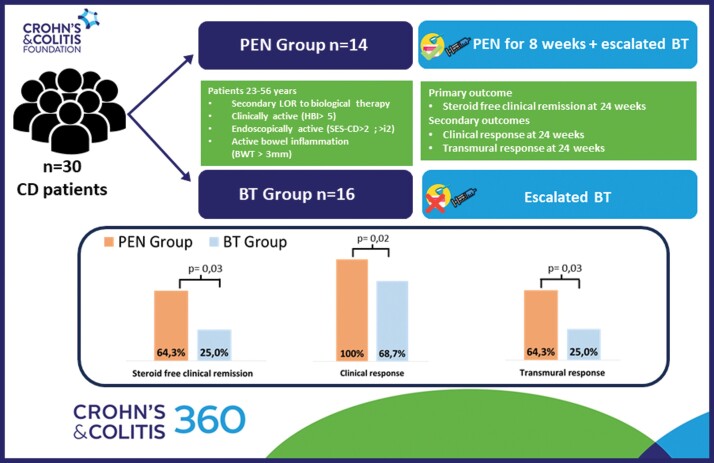
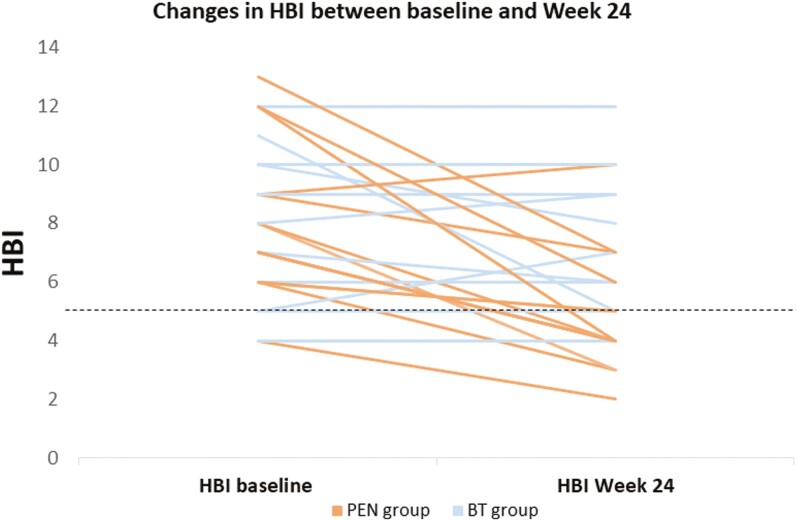
We conducted a retrospective observational study including patients who had lost response to biologics and received PEN in combination with escalated treatment, compared to those treated only with escalated therapy. The primary endpoint was steroid-free clinical remission (CR) at 24 weeks. Secondary endpoints included transmural healing (TH) and response (TR) rates along with selected clinical outcomes.
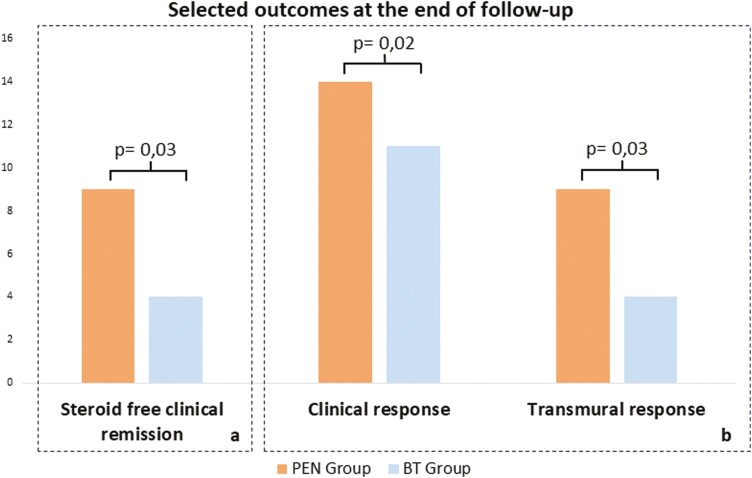
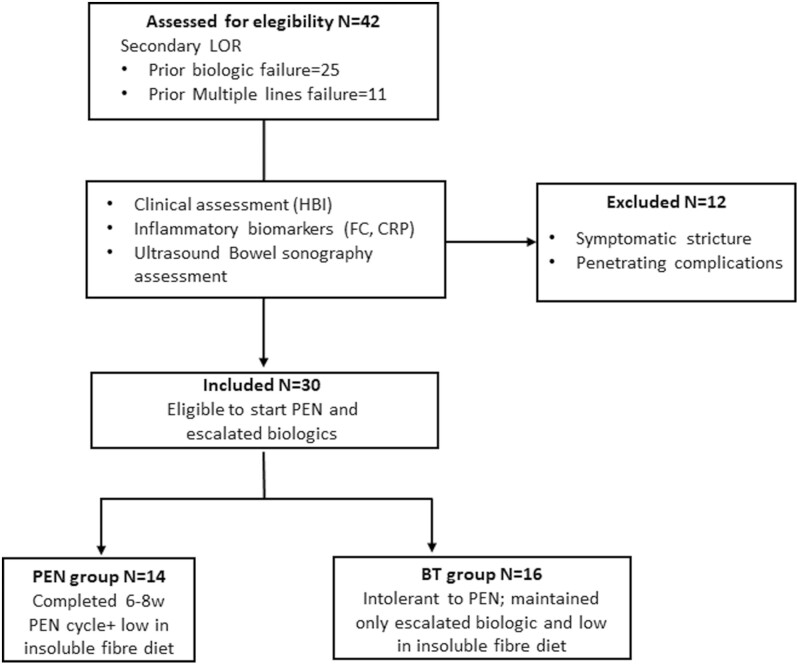
Forty-two patients were screened; 12 (28.6%) were excluded for complicated disease and 30 (71.4%) were included in the final analysis. Fourteen (46.7%) patients completed PEN treatment at 8 weeks, while 16 patients (53.3%) discontinued treatment due to intolerance and continued with escalation of biologic (BT group). At 24 weeks, 9 patients (64.3%) in the PEN group achieved CR, compared to 4 patients (25%) in the BT group ( = .03). The TR rate was 64.9% in the PEN group and 25% in the BT group ( = .03). Patients receiving PEN exhibited an increase in albumin levels compared to those in the BT group ( = 0.5; = .02). A higher rate of therapy changes (68.7%) was observed in the BT group compared to 14.2% in the PEN group ( = .004). Prior failure to 2 lines of biological therapy was associated with adherence to PEN (OR = 1.583; CI = 1.06-2.36; = .01).
In patients who had lost response to biologics, PEN in combination with escalated biologics was associated with CR and TR and improved nutritional status. Hence, the addition of PEN should be considered for patients with difficult-to-treat CD.
部分肠内营养(PEN)是治疗克罗恩病(CD)患儿的一种成熟疗法。然而,其对成年CD患者的疗效仍不确定。我们旨在评估PEN作为对生物制剂治疗反应不佳的成年CD患者强化生物治疗补充疗法的有效性。
我们进行了一项回顾性观察研究,纳入了对生物制剂治疗反应不佳且接受PEN联合强化治疗的患者,并与仅接受强化治疗的患者进行比较。主要终点是24周时无类固醇临床缓解(CR)。次要终点包括透壁愈合(TH)和缓解(TR)率以及选定的临床结局。
共筛查了42例患者;12例(28.6%)因病情复杂被排除,30例(71.4%)纳入最终分析。14例(46.7%)患者在8周时完成了PEN治疗,16例(53.3%)患者因不耐受停止治疗并继续接受生物制剂强化治疗(BT组)。24周时,PEN组9例(64.3%)患者达到CR,而BT组为4例(25%)(P = 0.03)。PEN组的TR率为64.9%,BT组为25%(P = 0.03)。与BT组患者相比,接受PEN治疗的患者白蛋白水平有所升高(P = 0.5;P = 0.02)。BT组的治疗方案更改率(68.7%)高于PEN组的14.2%(P = 0.004)。既往两线生物治疗失败与坚持PEN治疗相关(OR = 1.583;CI = 1.06 - 2.36;P = 0.01)。
在对生物制剂治疗反应不佳的患者中,PEN联合强化生物制剂治疗与CR和TR相关,并改善了营养状况。因此,对于难治性CD患者,应考虑加用PEN治疗。