Coubris Constance, Duchatelet Laurent, Dupont Sam, Mallefet Jérôme
Marine Biology Laboratory, Earth and Life Institute, Université catholique de Louvain, Louvain-La-Neuve, Belgium.
Department of Biological & Environmental Sciences, University of Gothenburg, Fiskebäckskil, Sweden.
PLoS One. 2024 Mar 11;19(3):e0298185. doi: 10.1371/journal.pone.0298185. eCollection 2024.
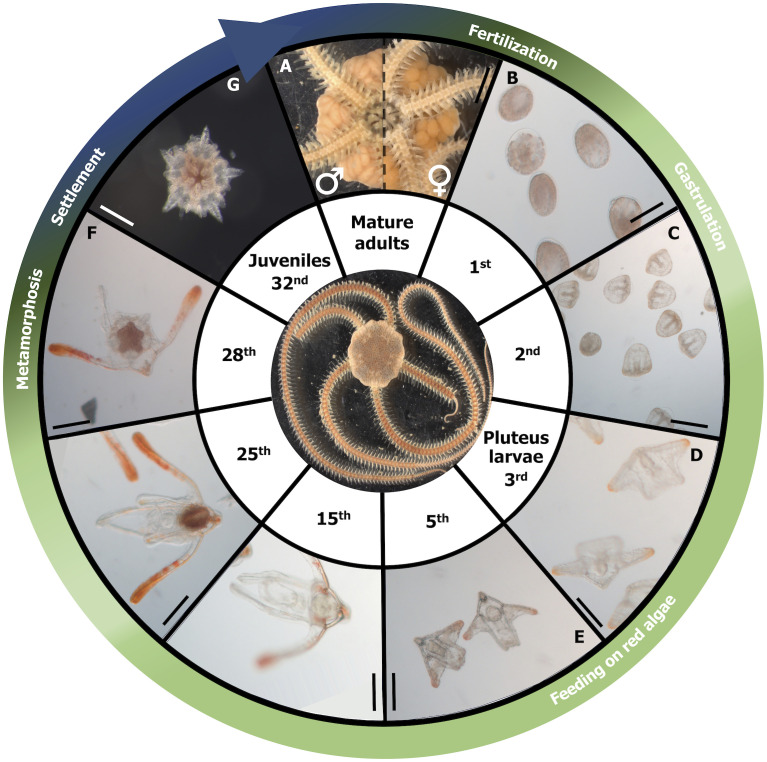
Bioluminescence is the production of visible light by living organisms thanks to a chemical reaction, implying the oxidation of a substrate called luciferin catalyzed by an enzyme, the luciferase. The luminous brittle star Amphiura filiformis depends on coelenterazine (i.e., the most widespread luciferin in marine ecosystems) and a luciferase homologous to the cnidarian Renilla luciferase to produce blue flashes in the arm's spine. Only a few studies have focused on the ontogenic apparitions of bioluminescence in marine organisms. Like most ophiuroids, A. filiformis displays planktonic ophiopluteus larvae for which the ability to produce light was not investigated. This study aims to document the apparition of the luminous capabilities of this species during its ontogenic development, from the egg to settlement. Through biochemical assays, pharmacological stimulation, and Renilla-like luciferase immunohistological detection across different developing stages, we pointed out the emergence of the luminous capabilities after the ophiopluteus larval metamorphosis into a juvenile. In conclusion, we demonstrated that the larval pelagic stage of A. filiformis is not bioluminescent compared to juveniles and adults.
生物发光是生物体通过化学反应产生可见光的现象,这意味着一种名为荧光素的底物在一种酶——荧光素酶的催化下发生氧化反应。发光的脆星(Amphiura filiformis)依赖腔肠素(即海洋生态系统中分布最广泛的荧光素)和一种与刺胞动物海肾荧光素酶同源的荧光素酶,在其腕棘中产生蓝色闪光。只有少数研究关注海洋生物中生物发光的个体发育显现。与大多数蛇尾类动物一样,丝状脆星具有浮游的蛇尾幼虫,但尚未对其发光能力进行研究。本研究旨在记录该物种从卵到定居的个体发育过程中发光能力的显现。通过生化分析、药理刺激以及在不同发育阶段进行类似海肾荧光素酶的免疫组织学检测,我们指出在蛇尾幼虫变态为幼体后发光能力才出现。总之,我们证明了与幼体和成体相比,丝状脆星的幼虫浮游阶段不具有生物发光能力。