Yongjiang Wu, Zhengzheng Cao, Zhenhua Li, Feng Du, Wenqiang Wang, Minglei Zhai, Zijie Hong, Yi Xue
International Joint Research Laboratory of Henan Province for Underground Space Development and Disaster Prevention, School of Civil Engineering, Henan Polytechnic University, Jiaozuo, 454000, Henan, China.
Henan Mine Water Disaster Prevention and Control and Water Resources Utilization Engineering Technology Research Center, Henan Polytechnic University, Jiaozuo, 454000, Henan, China.
Sci Rep. 2024 Mar 11;14(1):5862. doi: 10.1038/s41598-024-54180-z.
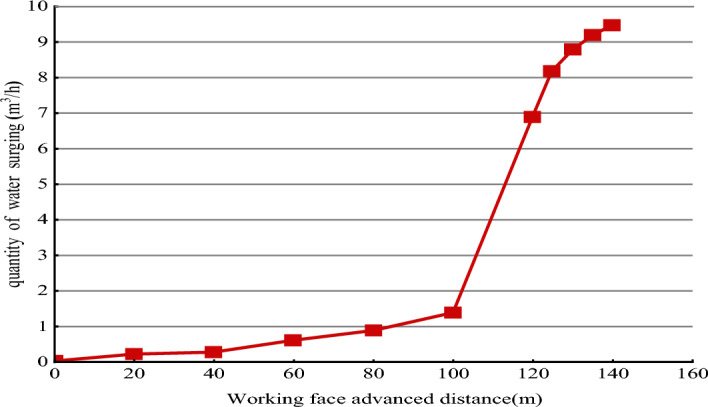
To obtain the seepage evolution rule and water inrush mechanism of the collapse column, a multi-field coupled mechanical model for water inrush disasters caused by the collapse column is established in this paper, on the basis of the specific engineering conditions of the 1908 working face in the Qianjin coal mine. The mechanical model is composed of internal column elements within the collapse column and surrounding rock masses. The research focuses on the seepage evolution rule in the roof collapse column under different mining conditions and investigates the permeation instability mechanism of collapse column based on the transition of flow state. The research results indicate that the seepage pathway evolves continuously, ultimately forming a channel for water inrush, as the working face advances towards the collapse column. Besides, the water inflow increases rapidly when the working face advances 100 m, then gradually stabilizes, indicating that the seepage channel entry of the collapse column is in a stable stage. Meanwhile, mass loss in the collapse column gradually moves upward. the collapse column remains stable as a whole in the initial stage of water flow, with a small permeability, exhibiting linear flow. As time steps increases, particle loss in collapse column gradually extends to the upper part, forming a stable seepage channel. The flow velocity shows fluctuations with a slow declining trend over time.
为了获得陷落柱的渗流演化规律及突水机理,本文基于前进煤矿1908工作面的具体工程条件,建立了陷落柱突水灾害的多场耦合力学模型。该力学模型由陷落柱内部的柱体单元和周围岩体组成。研究重点在于不同开采条件下顶板陷落柱的渗流演化规律,并基于流态转变研究陷落柱的渗透失稳机理。研究结果表明,随着工作面朝着陷落柱推进,渗流通道不断演化,最终形成突水通道。此外,当工作面推进100 m时,涌水量迅速增加,随后逐渐稳定,表明陷落柱的渗流通道进入稳定阶段。同时,陷落柱内的质量损失逐渐向上移动。在水流初始阶段,陷落柱整体保持稳定,渗透率较小,呈现线性流动。随着时间步长增加,陷落柱内的颗粒损失逐渐向上延伸,形成稳定的渗流通道。流速随时间呈现波动且有缓慢下降趋势。