Institute for Molecular Medicine Finland (FIMM), University of Helsinki, Helsinki, Finland.
The Stanley Center for Psychiatric Research, Broad Institute of MIT and Harvard, Cambridge, MA, USA.
Eur J Hum Genet. 2024 May;32(5):576-583. doi: 10.1038/s41431-024-01581-3. Epub 2024 Mar 11.
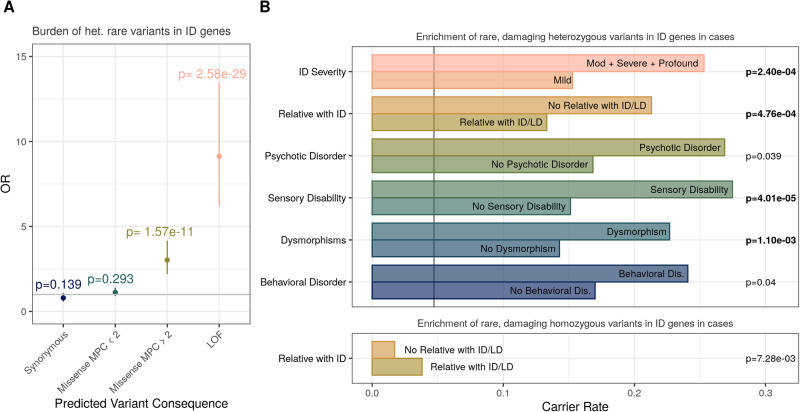
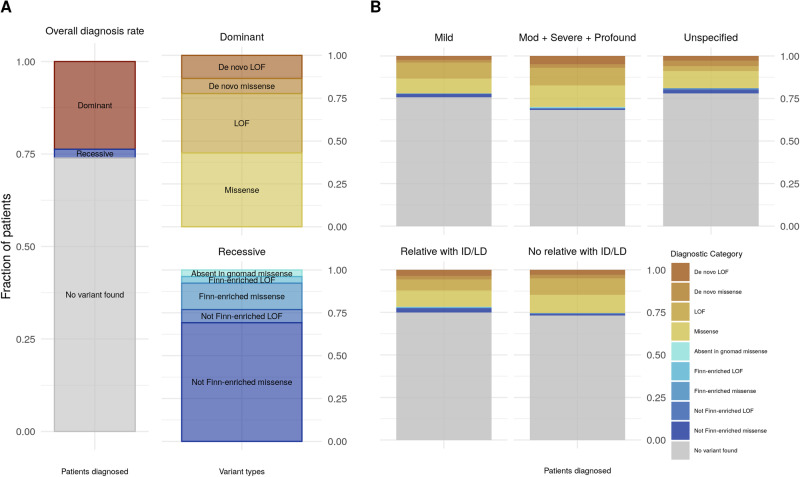
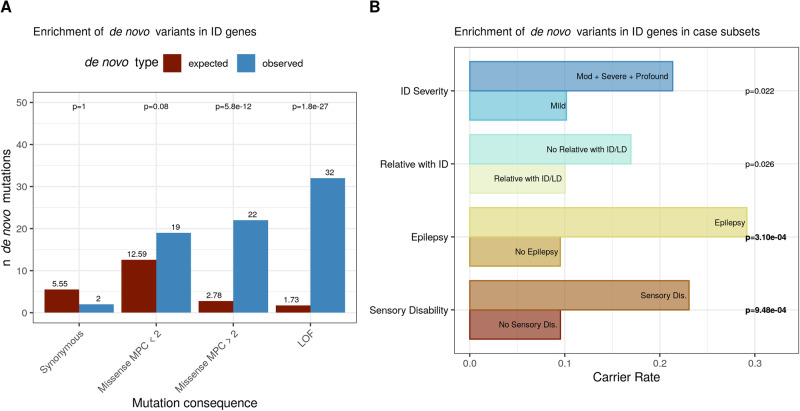
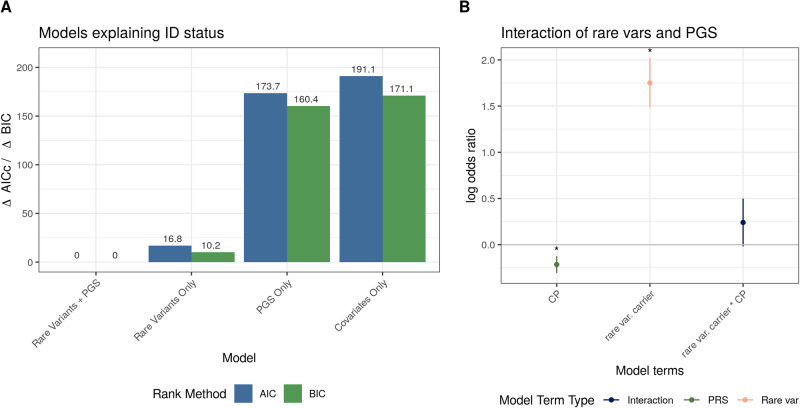
Intellectual disability (ID) is a common disorder, yet there is a wide spectrum of impairment from mild to profoundly affected individuals. Mild ID is seen as the low extreme of the general distribution of intelligence, while severe ID is often seen as a monogenic disorder caused by rare, pathogenic, highly penetrant variants. To investigate the genetic factors influencing mild and severe ID, we evaluated rare and common variation in the Northern Finland Intellectual Disability cohort (n = 1096 ID patients), a cohort with a high percentage of mild ID (n = 550) and from a population bottleneck enriched in rare, damaging variation. Despite this enrichment, we found only a small percentage of ID was due to recessive Finnish-enriched variants (0.5%). A larger proportion was linked to dominant variation, with a significant burden of rare, damaging variation in both mild and severe ID. This rare variant burden was enriched in more severe ID (p = 2.4e-4), patients without a relative with ID (p = 4.76e-4), and in those with features associated with monogenic disorders. We also found a significant burden of common variants associated with decreased cognitive function, with no difference between mild and more severe ID. When we included common and rare variants in a joint model, the rare and common variants had additive effects in both mild and severe ID. A multimodel inference approach also found that common and rare variants together best explained ID status (ΔAIC = 16.8, ΔBIC = 10.2). Overall, we report evidence for the additivity of rare and common variant burden throughout the spectrum of intellectual disability.
智力障碍(ID)是一种常见疾病,但损害程度从轻度到重度患者差异较大。轻度 ID 被视为智力正态分布的低端,而重度 ID 通常被认为是由罕见的、致病性的、高外显率变异引起的单基因疾病。为了研究影响轻度和重度 ID 的遗传因素,我们评估了芬兰北部智力障碍队列(n = 1096 名 ID 患者)中的罕见和常见变异,该队列中轻度 ID 患者比例较高(n = 550),且人群经历过瓶颈效应,其中富集了罕见、有害的变异。尽管存在这种富集,但我们发现只有一小部分 ID 是由隐性芬兰富集变异引起的(0.5%)。更大的比例与显性变异有关,在轻度和重度 ID 中都存在大量罕见的、有害的变异负担。这种罕见变异负担在更严重的 ID 中更为丰富(p = 2.4e-4),在没有 ID 亲属的患者中更为丰富(p = 4.76e-4),并且与单基因疾病相关的特征更为丰富。我们还发现了与认知功能下降相关的常见变异的显著负担,但在轻度和更严重的 ID 之间没有差异。当我们将常见和罕见变异纳入联合模型时,罕见和常见变异在轻度和重度 ID 中均具有相加效应。多模型推理方法也发现,常见和罕见变异共同最好地解释了 ID 状态(ΔAIC = 16.8,ΔBIC = 10.2)。总体而言,我们报告了在整个智力障碍谱中罕见和常见变异负担相加的证据。