
钝性撞击中头部频率响应特征:一项生物力学建模研究。
Characteristics of head frequency response in blunt impacts: a biomechanical modeling study.
作者信息
Li Guibing, Xu Shengkang, Xiong Tao, Li Kui, Qiu Jinlong
机构信息
School of Mechanical Engineering, Hunan University of Science and Technology, Xiangtan, China.
School of Pharmacy and Bioengineering, Chongqing University of Technology, Chongqing, China.
出版信息
Front Bioeng Biotechnol. 2024 Feb 26;12:1364741. doi: 10.3389/fbioe.2024.1364741. eCollection 2024.
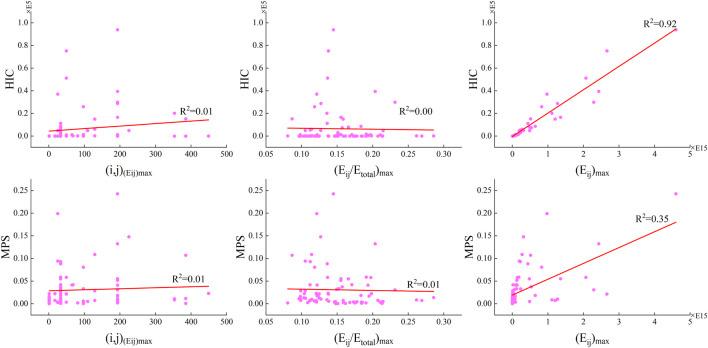
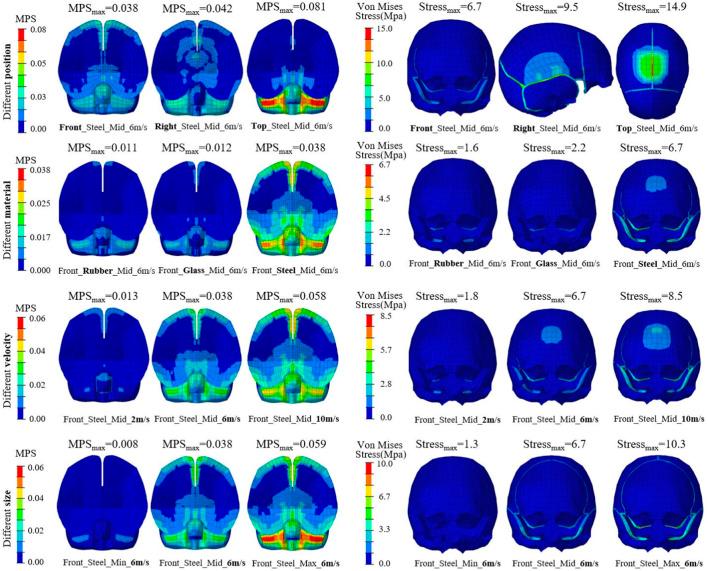
Existing evaluation criteria for head impact injuries are typically based on time-domain features, and less attention has been paid to head frequency responses for head impact injury assessment. The purpose of the current study is, therefore, to understand the characteristics of human body head frequency response in blunt impacts via finite element (FE) modeling and the wavelet packet analysis method. FE simulation results show that head frequency response in blunt impacts could be affected by the impact boundary condition. The head energy peak and its frequency increase with the increase in impact; a stiffer impact block is associated with a higher head energy peak, and a bigger impact block could result in a high proportion of the energy peak. Regression analysis indicates that only the head energy peak has a high correlation with exiting head injury criteria, which implies that the amplitude-frequency aggregation characteristic but not the frequency itself of the head acceleration response has predictability for head impact injury in blunt impacts. The findings of the current study may provide additional criteria for head impact injury evaluation and new ideas for head impact injury protection.
现有的头部撞击损伤评估标准通常基于时域特征,而对于头部撞击损伤评估的头部频率响应关注较少。因此,本研究的目的是通过有限元(FE)建模和小波包分析方法来了解钝性撞击中人体头部频率响应的特征。有限元模拟结果表明,钝性撞击中的头部频率响应可能会受到撞击边界条件的影响。头部能量峰值及其频率随撞击的增加而增加;更硬的撞击块与更高的头部能量峰值相关,更大的撞击块可能导致能量峰值的比例更高。回归分析表明,只有头部能量峰值与现有的头部损伤标准具有高度相关性,这意味着头部加速度响应的幅频聚集特征而非频率本身对钝性撞击中的头部撞击损伤具有预测性。本研究的结果可能为头部撞击损伤评估提供额外的标准,并为头部撞击损伤防护提供新的思路。



 Zotero 插件