
自行车骑行者碰撞事故的数值重建:头盔能否保护骑行者的头颈部位?
Numerical Reconstruction of Cyclist Impact Accidents: Can Helmets Protect the Head-Neck of Cyclists?
作者信息
Wang Fang, Peng Ke, Zou Tiefang, Li Qiqi, Li Fan, Wang Xinghua, Wang Jiapeng, Zhou Zhou
机构信息
School of Automotive and Mechanical Engineering, Changsha University of Science and Technology, Changsha 410114, China.
Hunan Province Key Laboratory of Safety Design and Reliability Technology for Engineering Vehicle, Changsha University of Science and Technology, Changsha 410114, China.
出版信息
Biomimetics (Basel). 2023 Sep 27;8(6):456. doi: 10.3390/biomimetics8060456.
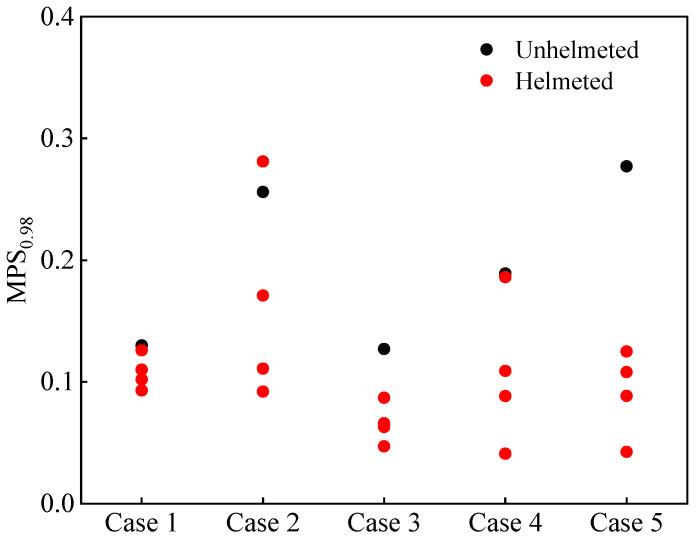
Cyclists are vulnerable road users and often suffer head-neck injuries in car-cyclist accidents. Wearing a helmet is currently the most prevalent protection method against such injuries. Today, there is an ongoing debate about the ability of helmets to protect the cyclists' head-neck from injury. In the current study, we numerically reconstructed five real-world car-cyclist impact accidents, incorporating previously developed finite element models of four cyclist helmets to evaluate their protective performances. We made comparative head-neck injury predictions for unhelmeted and helmeted cyclists. The results show that helmets could clearly lower the risk of severe (AIS 4+) brain injury and skull fracture, as assessed by the predicted head injury criterion (HIC), while a relatively limited decrease in AIS 4+ brain injury risk can be achieved in terms of the analysis of CSDM. Assessment using the maximum principal strain (MPS) and head impact power (HIP) criteria suggests that helmets could lower the risk of diffuse axonal injury and subdural hematoma of the cyclist. The helmet efficacy in neck protection depends on the impact scenario. Therefore, wearing a helmet does not seem to cause a significant neck injury risk level increase to the cyclist. Our work presents important insights into the helmet's efficacy in protecting the head-neck of cyclists and motivates further optimization of protective equipment.
骑自行车的人是易受伤害的道路使用者,在汽车与自行车的事故中经常遭受头颈部损伤。佩戴头盔是目前预防此类损伤最普遍的保护方法。如今,关于头盔保护骑自行车者头颈部免受伤害的能力存在持续的争论。在当前的研究中,我们对五起真实世界中的汽车与自行车碰撞事故进行了数值重建,纳入了之前开发的四种自行车头盔的有限元模型,以评估它们的防护性能。我们对未戴头盔和戴头盔的骑自行车者的头颈部损伤进行了对比预测。结果表明,根据预测的头部损伤标准(HIC)评估,头盔可以明显降低严重(AIS 4+)脑损伤和颅骨骨折的风险,而根据CSDM分析,在AIS 4+脑损伤风险方面只能实现相对有限的降低。使用最大主应变(MPS)和头部撞击能量(HIP)标准进行评估表明,头盔可以降低骑自行车者弥漫性轴索损伤和硬膜下血肿的风险。头盔在颈部保护方面的效果取决于碰撞场景。因此,佩戴头盔似乎不会显著增加骑自行车者颈部受伤的风险水平。我们的工作为头盔保护骑自行车者头颈部的效果提供了重要见解,并推动了防护装备的进一步优化。




 Zotero 插件