Wagner Isabella V, Boopathiraj Nithya, Lentz Connor, Dorairaj Emily Aashna, Draper Christian, Kumar Devesh, Checo Leticia, Miller Darby D, Krambeer Chelsey, Dorairaj Syril
Department of Ophthalmology, Mayo Clinic, Jacksonville, FL, USA.
Department of Medicine, Charles E. Schmidt College of Medicine, Florida Atlantic University, Boca Raton, FL, USA.
Clin Ophthalmol. 2024 Mar 7;18:713-721. doi: 10.2147/OPTH.S451002. eCollection 2024.
To report clinical outcomes of successful excisional goniotomy with the Kahook Dual Blade (KDB), through 60 months.
This was a noncomparative, single-surgeon, retrospective review of eyes receiving successful KDB goniotomy with or without concomitant phacoemulsification between October 2015 and January 2016 with five years of uninterrupted follow-up. Intraocular pressure (IOP), number of glaucoma medications, best corrected visual acuity (BCVA), and complications were recorded. Primary outcomes included changes from baseline in IOP, medication use, and BCVA, through five years.
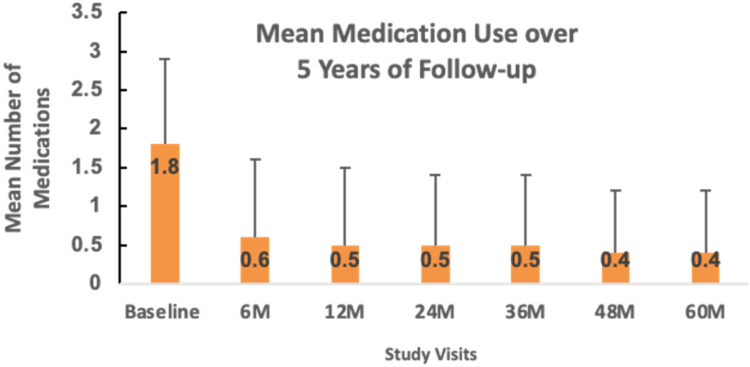
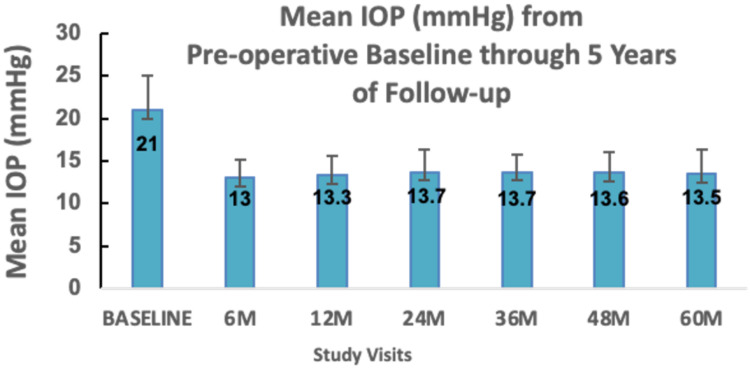
Fifty-two eyes of 28 patients were analyzed. Most eyes had mild primary open angle glaucoma (73%). Of the eyes analyzed, 41 underwent combined surgery and 11 underwent standalone surgery. With all eyes combined, mean (standard deviation) baseline IOP was 21.0 (4.1) mmHg and mean baseline medication use was 1.8 (1.1) medications per eye. Across time points at months 6, 12, 24, 36, 48, and 60, mean postoperative IOP ranged from 13.0 to 13.7 mmHg, representing mean reductions of 7.3-8.0 mmHg (34.7-38.3%; p <0.0001 at every time point). Similarly, mean medication use ranged from 0.4 to 0.6 medications per eye, representing mean reductions of 1.2-1.4 medications (66-75.5%; p <0.0001 at every time point). Mean logMAR BCVA improved from 0.321 (0.177) preoperatively to 0.015 (0.035) at month 60 (p < 0.0001).
In eyes not requiring secondary surgical procedures (eg, long-term surgical successes), excisional goniotomy provided clinically and statistically significant reductions in both IOP and the need for medications that were highly consistent through five years of follow-up. KDB goniotomy appears to be highly successful in Caucasian patients with open angle glaucoma on ≥1 IOP-lowering medications at baseline and with no history of prior ocular surgery. Successful excisional goniotomy with the KDB can be expected to improve long-term glaucoma-related visual outcomes through IOP reduction and to improve quality of life through medication reduction.
报告使用卡胡克双刃刀(KDB)成功进行切开式前房角切开术60个月的临床结果。
这是一项非对照、单术者的回顾性研究,纳入2015年10月至2016年1月期间接受成功的KDB前房角切开术(无论是否同时行白内障超声乳化术)且有五年不间断随访的患者。记录眼内压(IOP)、青光眼药物使用数量、最佳矫正视力(BCVA)及并发症。主要结局指标包括五年内IOP、药物使用及BCVA相对于基线的变化。
分析了28例患者的52只眼。大多数眼为轻度原发性开角型青光眼(73%)。在分析的眼中,41只眼接受了联合手术,11只眼接受了单独手术。所有眼合并计算,平均(标准差)基线IOP为21.0(4.1)mmHg,平均基线药物使用量为每只眼1.8(1.1)种药物。在第6、12、24、36、48和60个月的各时间点,术后平均IOP在13.0至13.7 mmHg之间,平均降低7.3 - 8.0 mmHg(34.7 - 38.3%;各时间点p<0.0001)。同样,平均药物使用量为每只眼0.4至0.6种药物,平均减少1.2 - 1.4种药物(66 - 75.5%;各时间点p<0.0001)。平均logMAR BCVA从术前的0.321(0.177)提高到第60个月时的0.015(0.035)(p<0.0001)。
在无需二次手术的眼中(如长期手术成功),切开式前房角切开术在五年随访期间使IOP及药物需求在临床和统计学上均有显著降低,且高度一致。KDB前房角切开术在基线时使用≥1种降眼压药物且无既往眼部手术史的白种开角型青光眼患者中似乎非常成功。使用KDB成功进行切开式前房角切开术有望通过降低IOP改善长期青光眼相关视力结局,并通过减少药物使用提高生活质量。